The Hobby area and the short-trip traveler
William P. Hobby Airport sits in southeast Houston, surrounded by established neighborhoods, hotels, small businesses and major roads. Many people who fly from Hobby are making short trips: a day of meetings in another city, a long weekend with family, a quick flight for work. They park for a day or two, return on a schedule and expect to drive home without trouble.
That shorter pace changes how key problems feel. A traveler who is gone for four days has time to think about where a key might be. A traveler who flew out and back in the same day arrives at the lot with a tight evening ahead, maybe a pickup to make or a late dinner, and a missing key hits harder. The same is true of people who returned from a work trip and need the car for an early morning.
This page walks through what to do if you lose your car key near Hobby Airport, how mobile service works in hotel lots and neighborhood streets, what documents to have ready and how to avoid repeating the mistake. It does not teach how to get into a vehicle without a key. That is professional work, and only after the technician confirms the vehicle belongs to you.
The key left in a bag that is somewhere else
One story comes up again and again with travelers: the key is in a bag that did not come back with them. A traveler packs the key in a suitcase before a security checkpoint, or a spouse carries it on a flight, or the key stays in a pocket of a jacket that was handed to a friend. The traveler arrives at the car and the key is somewhere else entirely.
If your key is in a checked bag, the first step is to find the bag. Ask the airline about delivery, and find out how long it will take. If the bag arrives the same day and you can wait, that may solve the problem. If the bag is delayed or lost, you need a different plan. A new key made on site can get you on the road without waiting for baggage services.
If your key traveled with a companion who flew somewhere else, ask whether a spare exists and whether someone can bring it. A family member who lives nearby with a spare is sometimes the fastest fix, but only if the distance and traffic are reasonable. A dispatcher can explain the quote by phone and help you decide between waiting and making a new key.
Whatever the cause, keep your identification handy. You will need it, and you may not have a registration in your bag. A photo of your registration on your phone, taken ahead of the trip, saves time at this point. Our page on all keys lost car key service describes what happens when no working key is available.
- Ask the airline when a delayed or checked bag can reach you
- Check whether a spare exists and whether someone can bring it
- Keep photo identification and a photo of your registration on your phone
- Decide whether waiting or making a new key suits your schedule
Hotel lots and neighborhood parking near the airport
Many people who fly from Hobby stay at nearby hotels the night before or park there under a package that includes shuttle service. Hotel lots are private property, and the hotel has a say in who works there. If you are a guest, tell the front desk about the situation before a technician arrives. Some hotels have no issue with a locksmith servicing a guest's car, and others want to know who is coming and when.
Some travelers park on streets in nearby neighborhoods, in lots belonging to businesses or in spaces arranged through private parking services. Each of these is a different environment. If you are parked at a business, find out whether the owner minds a service vehicle. If you are parked on a residential street, check for posted rules about parking duration or overnight restrictions.
Be clear with the dispatcher about where you are. A street address, a hotel name, the name of the lot and the nearest cross street all help. A vehicle in a tight lot may require the technician to work around other cars, so mention if the space is cramped. If the lot has a gate, tell the dispatcher how the technician can enter.
If you are leaving the vehicle for a few days, take a photo of the lot, the row and the space before you walk to the shuttle. It helps in more ways than finding the car. If the key is lost, the photo gives the dispatcher a precise location.
What to have ready before the technician arrives
A little preparation shortens the visit. Have your photo identification out. Have a registration, title or insurance card showing the vehicle belongs to you. If the paperwork is in the locked car, use your phone to find a digital copy. Know the vehicle's make, model and year, the color, and the license plate number. If you can read the vehicle identification number through the windshield at the base of the dashboard, write it down.
Know what keys you have. Do you have a working spare at home? Is the lost key a fob, a plain metal key or a key with a rubber head? Does the car use a push-button start? These answers help the dispatcher estimate the work and tell the technician what to bring.
If the vehicle is registered to someone else, such as a spouse, a parent or an employer, let the dispatcher know before the visit. The technician may need to speak with the registered owner by phone, and the owner should be reachable. For company cars, a manager's authorization may be needed.
Finally, tell the dispatcher about your schedule. If you have to be somewhere, say so. The dispatcher cannot promise an arrival window, but can tell you what is realistic for your location and discuss alternatives. For more about preparing, read our guide on preparing for your key visit.
How a key gets made in the lot
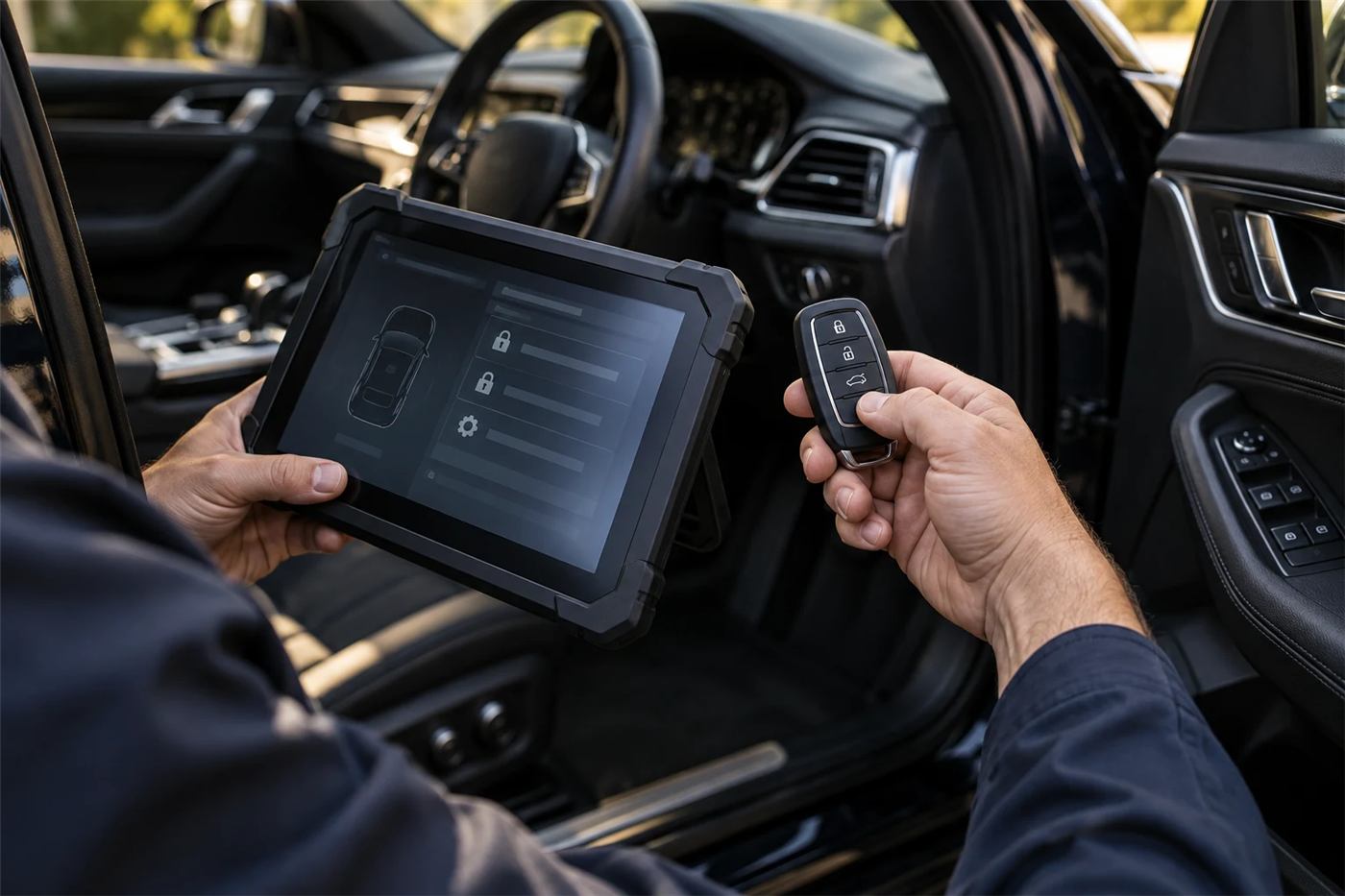
A technician who arrives at a Hobby-area lot carries cutting equipment, programming tools and a range of blanks and fobs. The first task is verifying who you are and that the vehicle is yours. The next is identifying the key type. A transponder key must be programmed so that the car recognizes it. A remote head key adds remote functions. A smart key is registered with the car's computer. If no key is left, the technician uses the vehicle identification number and specialist equipment to make a new one.
Many jobs can be completed in the lot, in the vehicle's own parking space, as long as there is room to work. The time needed depends on the vehicle. A common older car with a simple transponder key is quicker than a late-model car with a smart key and a complex security system. A dispatcher will not promise a duration, but a technician can tell you at the car what the process is and roughly how it will go.
When the new key is ready, test it thoroughly. Lock and unlock the doors by key and remote, start the engine, turn it off, start it again and check the dashboard for warning lights. If you have asked to remove lost keys from the vehicle's memory, confirm that was done. Do not leave until you are satisfied. For a plain-English overview of what is involved, see car key replacement.
Quotes are given by phone, never at the curb. A service call charge is explained before anyone is dispatched. If the job is complicated, an on-site visit may be needed before a final price is set.
- Call with the vehicle, the location and what happened to the key.
- Hear the quote and the service call charge on the phone.
- Tell the hotel or lot staff that a technician will be arriving.
- Show identification and proof of ownership at the vehicle.
- Test the key and remote fully before paying.
Older cars and well-worn keys in southeast Houston neighborhoods
Neighborhoods around Hobby Airport include long-settled residential areas where many households keep older vehicles for years. Those cars may be on their second or third set of keys, and the keys may have been copied from copies. A worn key can be hard to turn, can fail to unlock a door or can snap in a lock.
If a key is bent, cracked or worn smooth, do not wait for it to break. A new key cut properly is better for the lock and the ignition than a worn copy. A key that works only when held at an angle is a sign that something is off. Our page on worn out keys and the page on bent or cracked keys describe what to look for.
If a key does break, do not try to remove the remaining piece with improvised tools. Dropping a pin or a knife into the lock can push the piece deeper and damage the cylinder. A technician has extraction tools made for the purpose. Keep any broken piece, because it can help identify the key.
Rideshares, drop-offs and keys that stay behind
Not everyone parks at the airport. Many people in the Hobby area get a ride to the terminal from a friend, a relative or a rideshare, and have a car waiting at home when they return. In that case, a key lost on the trip is a problem that you discover at the front door of your own house, and the stakes are a little lower, since the car is parked in your own driveway.
Still, keys do get left in odd places during a drop-off. A key slides out of a pocket in the back seat of a rideshare. A set of keys is handed to a friend for safekeeping and goes into a glove box. A jacket with the key in its pocket is left in a car that is now across town. If you think the key is in someone else's vehicle, call them first. If it is in a rideshare, use the app to contact the driver through the proper channel and describe the item.
If you are returning home and the key is not in your bag, think about the order of your day. Where did you last hold it? Who else has touched your car or your house keys? If you share a driveway with housemates, check whether anyone moved the car. Sometimes the simplest explanation is that someone else has the key.
If the key is gone for good and you have a vehicle at home, a technician can come to your driveway, confirm ownership and make a new key. At home, you have the registration, the title and other documents within reach, which makes the process easier than in a lot at night.
When a missing key might be in the wrong hands
Most lost keys are simply lost. Some are not. If your key went missing during a trip and you have reason to think someone took it, such as a stolen bag or a break-in at your hotel room or vehicle, treat the vehicle's security seriously. A person with your key and a way to find your car can drive away with it.
In that case, do not wait for the key to turn up. Report the theft, and consider having your vehicle reprogrammed so the missing key no longer starts it. On many vehicles, a technician can erase lost keys from the vehicle's memory as part of programming new ones. Ask the dispatcher whether this applies to your make and model. If you also lost house keys with the same ring, think about the security of your home too.
If you drive a vehicle with a keyless system, remember that a thief does not always need your fob. Relay attacks and other tricks exist, though they are less common than simple theft of the key. Keeping a spare key in a signal-blocking pouch at home helps. Our guide on relay attack protection explains the idea.
Business travelers and the company vehicle
Hobby draws plenty of business travelers, and some of them drive company vehicles to and from the airport. A key lost on a work trip raises questions that a personal vehicle does not. Who owns the vehicle? Who can authorize a new key? Does the company have a policy? Is there a manager who can confirm by phone?
Before calling, find out what your employer requires. Some companies have a contract with a particular provider or insist on being informed before any work. If the vehicle is a leased car, the leasing company may have rules. If the vehicle is a fleet vehicle, a fleet manager may need to approve. Have a contact number ready for the person who can authorize the work.
A technician will still need identification and some proof that the vehicle is a company vehicle and that you are authorized to use it. Letters, emails or a vehicle assignment document can help. For a larger overview, read about fleet vehicle key service.
Habits for people who fly out of Hobby
A few simple habits protect travelers. Keep your car key in a pocket that you zip, not in a bag that goes through scanners and gets reorganized. Take a photo of your registration and keep it on your phone. Make a spare key and keep it at home, not in the car. If you travel often, consider a small tracking tag for your keys so that you can find them if they go missing.
Before a trip, check that your key fob works and that the battery is not near the end of its life. A weak fob that quits in a lot at night is the worst way to end a trip. A fresh battery is a small job, and our page on key fob battery replacement explains it.
Finally, tell someone at home where the spare is. If a key is lost and a relative can reach it, the problem gets smaller. A short text before you leave, saying where the spare lives, is one of the easiest ways to prevent a long evening at an airport lot.
Calling from the Hobby area
If you are at a lot, a hotel or a neighborhood street near Hobby Airport and your key has gone missing, gather the vehicle details and call. The dispatcher will ask where you are, what the vehicle is and what happened to the key. They will explain the service call charge, give you a quote by phone and tell you what can be done for your location. Call and tell them what is going on.
Questions people ask
I flew out and back the same day and my key is gone. What is the quickest path?
First, check your pockets and bags again and call the airline or the last place you used the key. If it is not found, call a mobile locksmith with your location and vehicle details. The dispatcher will give a quote by phone and explain what is possible. Have identification and proof of ownership ready for the technician.
My key is in a checked bag that went to another city. Should I wait?
It depends on how soon the bag will reach you. Ask the airline for a delivery estimate. If it will be too long, a new key made on site may be the better choice. If a relative has a spare and lives nearby, that may also work. The dispatcher can explain the quote to help you choose.
Do hotel lots allow locksmith work?
Many do, but each hotel decides. If you are a guest, tell the front desk about the situation before the technician arrives. Some hotels have rules about service vehicles. Give the dispatcher the hotel name, lot and space, and mention any gate or entrance the technician should use.
What if my car is a company vehicle?
Find out what your employer requires before calling. The technician needs your identification and proof that the vehicle is a company vehicle and that you are authorized to use it. A manager may need to confirm by phone. Tell the dispatcher in advance so the process runs smoothly.
Are quotes given at the car or on the phone?
Quotes are given by phone only. A service call charge is explained before anyone is sent. The price depends on the vehicle, the type of key and whether any working keys remain. A complicated job may need an on-site visit before a final price. Ask questions on the call, so there are no surprises when the technician arrives.
Can I prevent this from happening on my next trip?
Mostly, yes. Keep the key in a zipped pocket, take a photo of your registration, store a spare at home with someone who knows where it is and check your fob battery before you fly. A small tracking tag can help you find keys that go astray. These steps take little effort and prevent most airport lot problems.
Describe the situation by phone and we will tell you what the job involves. Quotes are given by phone. Jobs that cannot be quoted without seeing them need a technician on site, and the service call charge is explained on the phone before anyone is dispatched.
(713) 574-7660Related pages
Written by Claude (AI) (AI) for Houston Car Key Locksmith.