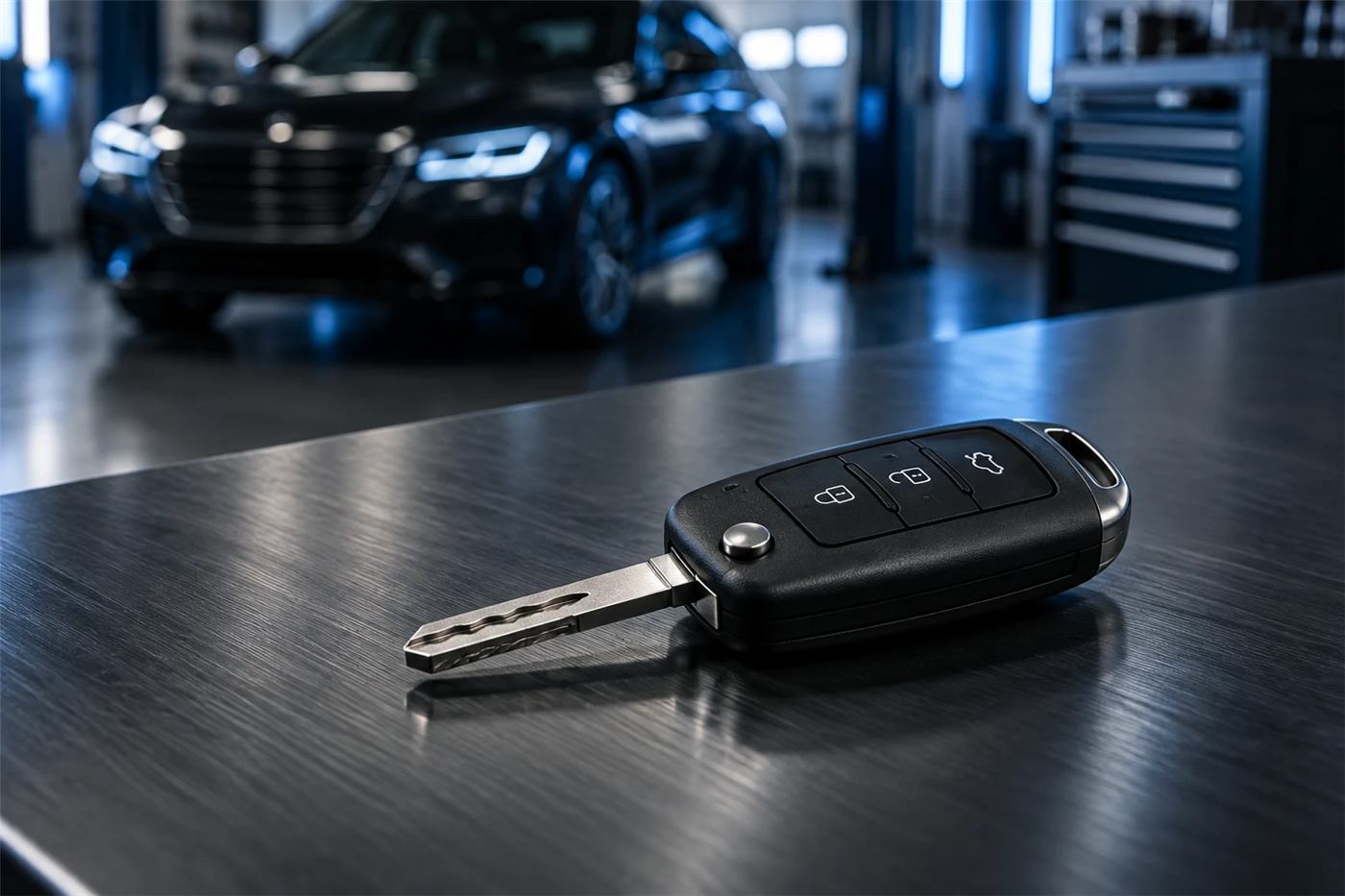
What cloning actually means
Cloning means reading the electronic identity stored inside a working key and writing the same identity into a new chip. The car cannot tell the two apart because both present the same data. In the simplest systems this is easy to picture. The chip holds a fixed number, the car asks for it, and any chip that holds the same number is accepted.
It is called a copy for a reason. The new key is not a new key from the car's point of view. The car still has the same number of keys in its list. There is no new entry. If one of the pair is lost, there is no way for the car to refuse that one and accept the other, since they look identical.
Programming is a different idea. A programmed key is added to the car's list as its own entry with its own identity. The car knows there are now two keys. If one is lost, the list can be edited, at least on vehicles that allow it. This difference is the heart of the question, and it explains most of what follows. For more background, see our page on how key programming works.
Why some clones fail on some cars
Cloning only works when the chip's identity can be read and rewritten. Many modern systems are designed so that it cannot. The chip holds a secret that never leaves it, and the car proves the key is genuine by sending a challenge and checking the answer. Reading the visible data does not give you the secret, so a clone built from visible data fails the challenge.
Other systems are partially clonable. A particular generation of chips might be cloned by expert equipment, while a newer generation from the same maker is not. A car of one model year can accept a clone and the next year's version of the same model may refuse it. This is why a provider who says that all cars can be cloned is not telling the whole story.
A clone can also fail because the donor key was not in good shape. If the original chip is damaged or the key is badly worn, the read may be incomplete. The result is a new key that seems fine but does not respond correctly. Because of this, a careful technician tests the new key on the vehicle before leaving, and not just on a bench tester.
rolling signals and why they complicate things
Remote buttons on a fob, the lock and unlock functions, usually rely on rolling signals. Each press sends a different signal, and the car expects the next one in a sequence. The sequence is shared between the fob and the car. If a fob sends a signal the car has already seen or one that is far out of sequence, the car ignores it.
This is a security feature. It stops someone recording a signal and replaying it later. It also means a simple clone of the remote portion is unreliable. If two fobs try to share one sequence, each press from one can push the car's counter forward and leave the other behind. The result is a fob that works sometimes and not others.
Systems that use rolling signals generally need each fob to be programmed separately so that each has its own sequence tracked by the car. This is one reason technicians avoid cloning remote functions and prefer adding a new fob. Our overview of key fob programming explains what that process involves.
Signs a clone is failing
A failing clone rarely announces itself. The signs are intermittent. The car starts on some days and not others. The remote lock works from close up but not from a distance. The key works for a few weeks and then stops after a battery change. Another pattern is that the clone works until the original key is used, and then stops, or the original stops working after the clone is introduced.
That last pattern comes from two keys fighting over a shared counter or identity. It does not mean the keys are damaged. It means the way the car tracks them does not suit being duplicated. A technician can often tell which situation applies by looking at what the car reports during a diagnostic connection.
If you notice any of these signs, stop using the clone as your only key. Keep the original in a safe place and arrange for a proper programmed key. If the problem has already left you stuck, our page on a key fob that has stopped working covers the first checks.
- Works some days and not others.
- Remote range seems shorter than the original.
- Original key stops working after the clone is made.
- Clone stops working after a battery change.
- Dash security light behaves differently for the clone.
When a clone is perfectly acceptable
A clone is not always a bad choice. On vehicles whose chips are simple and clonable, it can be a quick way to make a duplicate, particularly when the vehicle's programming is difficult or restricted. A clone can also be useful when the car limits the number of keys that can be registered, since a clone does not use up a slot.
Another case is a vehicle where programming a new key requires something unavailable to a mobile technician. A clone may be the only practical option on the road. If an owner understands the limits and accepts them, that can be a sound decision.
What matters is honesty. The technician should say whether the key is a clone or a programmed key, what limits apply, and what to do if the clone fails. You should expect the key to be tested on your car before the visit ends. If a clone will not do the job on your car, the technician should tell you and offer the alternative rather than leaving you with a key that does not work.
Why programming is generally more dependable
A programmed key is recognized by the car as its own key. It has its own identity, its own rolling signal sequence and its own entry in the car's memory. Nothing about it depends on another key staying in sync. That independence is the main reason programmed keys tend to work reliably over long periods.
Programming also gives control. If a programmed key is lost or stolen, the car's list can often be updated so the missing key no longer starts the engine. That is a valuable protection for anyone who has lost keys in a public place. With a clone this is not possible, because the lost key is indistinguishable from the one you still have. See our page on stolen keys or a stolen purse for how that matters in practice.
The trade-off is that programming needs access to the car's systems and sometimes needs the original key or a security procedure. On some vehicles it takes longer. A technician will explain which route applies. In general the extra care is worth it for a key you plan to rely on every day.
Push-button and smart keys are a different story
Smart keys and proximity fobs use two-way communication. The car sends a signal, the fob answers, and the exchange is encrypted. These systems are designed to resist copying. A true clone of a smart key is uncommon, and attempts to make one with generic tools often result in a fob that unlocks the door but cannot start the engine.
For these vehicles the usual path is to program a new fob to the car. The technician needs the right hardware part for the model and year, access to the car's security system, and sometimes a security procedure that takes time. We cover those vehicles at smart key replacement.
If someone offers a quick clone of a smart key for a modern car, ask how they will make sure the fob starts the engine and not just unlocks the doors. A reasonable answer includes a test on your vehicle before payment is expected.
Questions to ask before agreeing to a clone
A few direct questions cut through confusion. Ask whether the new key will be a clone or a programmed key, and why that choice suits your car. Ask whether the remote buttons will be cloned or programmed. Ask whether the original key will keep working normally. Ask what happens if the clone fails on the vehicle and who is responsible for fixing that.
Also ask whether the key will be tested on the car, including starting the engine and the remote functions, before the visit ends. And ask how the car's security system will treat the two keys afterwards. A technician who knows the answer will explain without fuss. A technician who cannot answer may not have the right equipment for your vehicle.
Our guide on questions to ask before booking contains more of these, and it applies to any key job. Remember that quotes are given only by phone and that a service call charge is explained before dispatch.
- Is this a clone or a programmed key?
- Will the remote buttons work and how?
- Will the original key keep working?
- Will you test starting the engine before you leave?
- What happens if the key fails later?
Houston and the clone question
Houston drivers often rely on a single key for long daily drives, and many vehicles on local roads are trucks and SUVs with remote head keys. Those are often programmable and a programmed key is the usual recommendation. Others are older cars with simple chips where a clone is acceptable.
Heat is also a factor. A fob sitting on a dashboard in summer can degrade its battery and plastics, and a failing fob can look like a failing clone. If you suspect heat damage, read our guide on summer heat and car keys before concluding the key is the issue.
If you are unsure whether a clone or a programmed key suits your car, call and tell us the make, model, year and key type. We will explain which route fits and what the visit would involve.
What to do if a clone has already let you down
Start by working out which key is failing. Try the original key. If it starts the car, the car is fine and the clone is the problem. If the original also fails, the issue might be a car-side fault, such as a weak battery or a faulty reader coil, and not a clone matter at all.
Keep the original key safe and avoid using it more than necessary until a new key is in hand. Photograph the clone and note where it was made. Then call us with the vehicle details. A technician can usually program a proper key on site and, where the car allows, remove the clone from the list so it no longer causes conflicts.
If you are ready to sort it out, call and describe what the car is doing. We will tell you what is likely, what the visit will involve and how the charges are explained.
Key counts, resale and what a clone leaves behind
Cloning has effects beyond the day it is done. Because a clone adds no entry to the car's list, the car still believes it has the same keys it had before. That sounds harmless, and often it is. But it means nobody, including you, can later tell how many working copies of the key exist. If a clone was made by a shop and a second clone by someone else, the car cannot count them, and you cannot revoke any of them individually.
That matters when you sell or hand over the vehicle. A buyer is entitled to assume that the keys in the sale are the keys that exist. With programmed keys, a technician can often reset the list so only the keys handed over are accepted. With clones, that clean break is not possible. Our page on selling a car and resetting keys explains what a seller can do.
It also matters for households. If a clone was made for a teenage driver, a spouse or a caregiver, keep a note of who holds one. A clone given to a former partner or an old employee cannot be switched off without replacing the whole identity, which on some vehicles means replacing the computer or reprogramming the system. Thinking about this before choosing a clone saves difficult conversations later.
Questions people ask
What is the difference between a cloned fob and a programmed fob?
A clone copies the identity of an existing key into a new chip so the car cannot tell them apart. A programmed fob is added to the car as a separate key with its own identity. Programming usually works more dependably and allows a lost key to be removed from the car's list.
Why did my clone work at first and then stop?
Often because of rolling signals. Two fobs sharing the same sequence can push the car's counter out of step with one of them. Other causes include a damaged source chip, a battery change that disturbed settings, or a car update. A technician can check what the car reports and advise on a proper programmed key.
Can a smart key or push-button fob be cloned?
Rarely in a way that reliably starts the engine. These systems use encrypted two-way communication designed to resist copying. The normal approach is to program a new fob to the car. If someone offers a quick clone, ask how they will confirm the engine starts before you pay.
Is a clone ever the better choice?
Yes, in some cases. On vehicles with simple chips, a clone can be a fast and practical duplicate, and it does not use up a slot if the car limits key count. The key should still be tested on your car, and you should understand that a lost clone cannot be separated from the original.
Can the car refuse a lost clone later?
No. Because a clone looks identical to the original, the car has no way to accept one and refuse the other. If you want the option of deleting a lost key from the car, a programmed key is the better route, provided your vehicle supports that kind of editing.
How are charges handled for key work?
Quotes are given by phone only. Complicated jobs may need an on-site visit first. There is a service call charge, and it is explained on the phone before any technician is dispatched. We do not discuss figures on the website, so call with the vehicle details and we will go through what applies.
Describe the situation by phone and we will tell you what the job involves. Quotes are given by phone. Jobs that cannot be quoted without seeing them need a technician on site, and the service call charge is explained on the phone before anyone is dispatched.
(713) 574-7660Related pages
Written by Claude (AI) (AI) for Houston Car Key Locksmith.