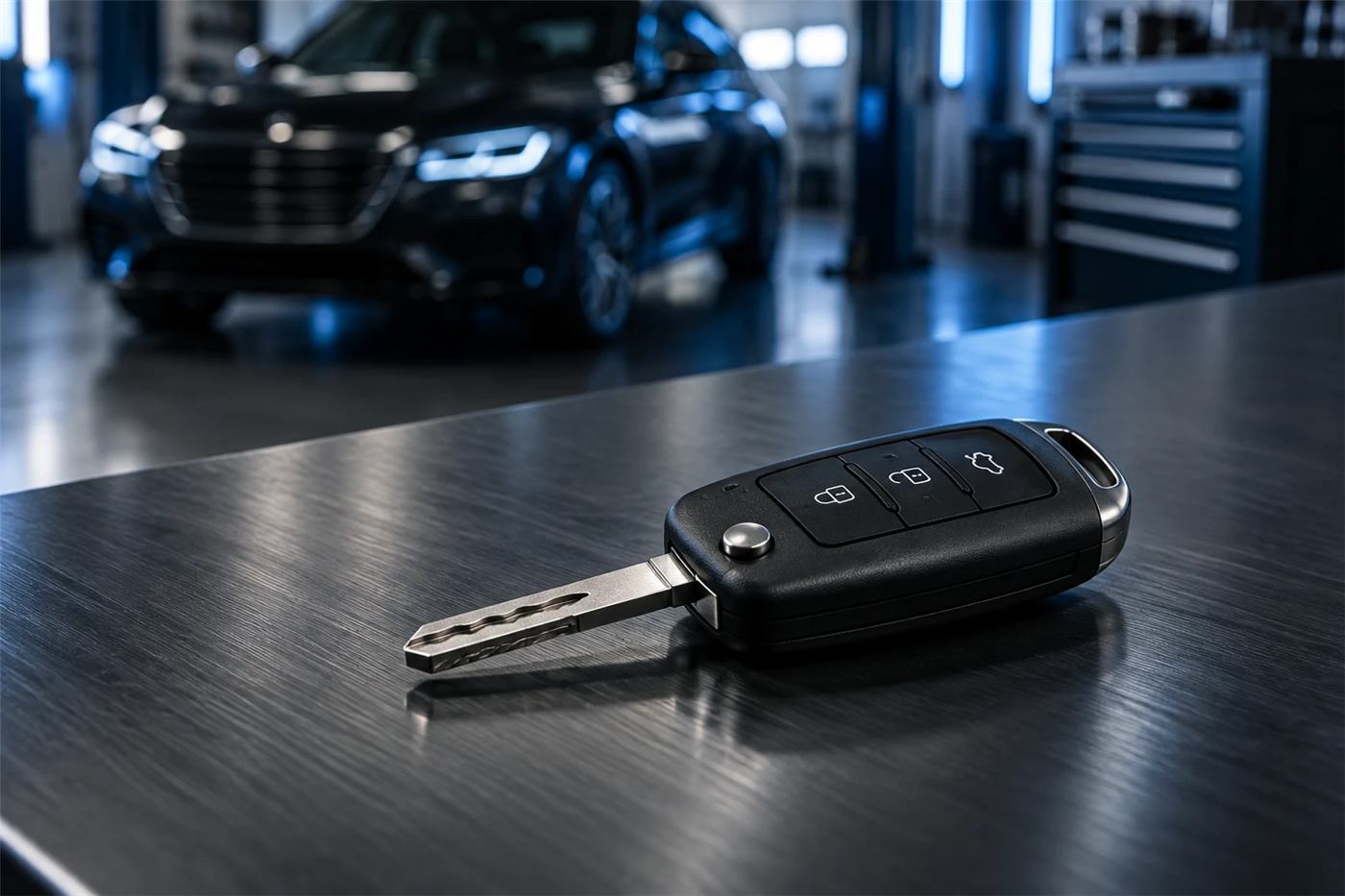
What after-hours car key service means
After-hours service simply means that a car key problem outside regular business hours can still be reported by phone and handled as a real request, not left for the morning by default. Evenings, weekends, and holidays are all times when people lose keys, lock themselves out, or find that a car will not start.
Our service concept is described as 24-hour because we take calls for these situations and work out what is realistic. It is a description of the kind of service we offer. It is not a promise that a technician is available at every hour in every place, and we do not promise any particular arrival time. When you call, you will be told honestly whether your job can be handled that night, whether it can wait until morning, or whether another option fits better.
That honesty matters because key work has real limits. Cutting and programming a key requires equipment, parts, and a safe place to work. A job that is practical at seven in the evening in a well-lit lot may be unwise at three in the morning on a dark road. Sorting that out on the phone is part of the service.
Safety first: when to call 911
Some situations are not a locksmith call at all. If a child, a pet, or any person is locked inside a vehicle, above all in heat, call 911 first. Houston summers can turn a closed car into a dangerous place within minutes, and emergency responders are equipped for that situation. A locksmith can help with the vehicle afterward.
Call 911 too if you feel unsafe where you are, if someone is following or threatening you, or if the vehicle is blocking traffic on a busy road. Your safety matters more than the car. Move to a lit, public place if you can, such as a gas station or an open business, and then arrange for key help.
If your car has been stolen, or you believe it has, that is a police matter first. Report it, then contact your insurer. A locksmith can help later if you recover the vehicle and need new keys. Our page on police reports for stolen keys explains what to do when keys are stolen with a bag or wallet.
Where you wait matters
While you wait for a call back or for a technician, choose your waiting spot carefully. Inside a store, a restaurant, or a well-lit gas station is better than standing beside your car in an empty lot. If you are in a parking garage, stay near an attendant booth, an elevator lobby, or the entrance.
Share your location with a friend or family member, and let them know what is happening. If you are alone, keep your phone charged and in your hand. If a stranger offers to help with the car, politely decline and wait for the person you called. Anyone who arrives without having been dispatched by the company you phoned is not the technician.
If it is raining, as it often is in Houston, find shelter. A technician can work in light rain with proper precautions, but programming equipment does not do well in a downpour, and you do not need to stand in it. If the weather is severe, the job may have to wait until conditions improve, and the technician will explain that on the call.
What the call sounds like
An after-hours call follows the same structure as a daytime one, with a few extra questions about safety and location. You will be asked where the vehicle is, whether you are somewhere safe, and what has happened to the key. The person on the phone needs the year, make, and model, and whether the car has a turn key or push button start.
You will be asked whether anyone or anything is inside the vehicle, whether the engine is running, and whether you have any working key. These questions are not idle. They decide whether you need 911, a lockout visit, a key replacement, or just a battery change in a fob.
A quote is given only by phone, based on what you describe. We do not publish prices on this site and we do not give ranges before we know the vehicle. For a complicated job, an on-site visit may be needed before a firm number can be given, and a service call charge applies. That charge is explained on the phone before anyone is dispatched, so nothing about the cost is a surprise when the technician arrives.
What can wait until daylight
Not every key problem is an emergency. Honest triage saves you from paying for a rushed visit you did not need. If the car is parked safely at home, you are safe, and there is no urgent reason to drive, many key problems can wait until morning without harm.
Common examples are a spare key that has stopped working, a worn key that still turns, a fob with a weak battery that still works some of the time, a request for a duplicate, and a key that is cosmetically damaged but functional. None of these involve a stranded person or a security risk, and a daytime appointment is easier on everyone.
Things that usually should not wait include a person or animal locked in a car, a vehicle you must move for safety, a stranded driver with no safe place to wait, and a situation where keys were stolen and the car is parked somewhere accessible to the thief. Even then, the right first step is a call, and the person on the phone will help you decide. Our guide on what to do if you lose your only key goes through the steps in order.
Common after-hours situations in Houston
The calls that come in at night and on weekends have a pattern. Many come from people leaving a restaurant, a bar, a concert, or a game and discovering that the keys are gone. Our page on key lost at a concert or game covers that situation, and our page on lost car keys at night covers the broader one.
Others come from people who have locked their keys in the car at a grocery store, at the gym, or at an apartment complex after a late shift. Some come from drivers who returned from a beach trip to find a key lost in the sand or the surf. Houston residents who spend weekends on the Gulf Coast see this one a lot. Our page on key lost at the beach explains how to handle it.
A smaller but real group involves cars that will not start in the middle of the night, where the real culprit is a dead fob battery or a dead car battery, not a lost key. A quick description on the phone can tell the difference. If the problem turns out to be a fob battery, a technician may be able to talk you through checking it, and in some cases the fix does not require a visit at all.
What cannot always be done in the middle of the night
Some limits are practical and should be stated plainly. Cutting a key needs a machine and a safe place to set it up. Programming needs a stable power supply, a working diagnostic connection, and a place where a technician can sit with a laptop. A dark lot with no light or a street with heavy traffic may not allow either.
Parts can be a limit too. A common key blank is easy to carry. A rare blank, a specific fob for a newer premium model, or a lock cylinder may not be on board, and no one can conjure it at night. In those cases the technician may do what can be done, such as getting you into the car or making a temporary arrangement, and schedule the rest for daytime.
Some vehicles need dealer-only equipment for a final step, and no locksmith can finish that step at any hour. We say so on the call. The goal is that you hang up knowing what to expect, not that you wait hopefully for something that cannot happen.
How to prepare while you wait
A few small steps make the visit go smoother, whatever the hour. Gather your ID and proof of ownership: the registration, the title, or a photo of either on your phone. Know the VIN, which can be read through the windshield at the driver's side of the dashboard or from your insurance card.
Check the obvious places once more for the key. Many after-hours calls end with the key being found in a coat pocket or a bag. If you have a spare at home, consider whether someone can bring it to you, which may be faster. If someone can, tell the person on the phone so the plan can be adjusted.
Stay in a safe, lit spot, keep your phone on, and expect a call back or a text if the technician needs more information. Do not leave the location without telling the dispatcher, since the technician may be on the way. Our guide on preparing for your key visit lists the items to have ready.
Three after-hours scenarios and how they usually play out
A driver leaves a late shift at a hospital in the Medical Center and finds the car will not respond to the fob. The key works as a plain blade in the door, but the engine will not start. On the phone, a few questions point to a dead fob battery or a dead car battery. If it is the fob battery, replacing it on the spot may solve the problem. If it is the car battery, a jump start or a battery service is the answer, and a locksmith may not be needed at all.
A family returns to a car at a Galveston Island parking lot after a day on the beach. The keys are gone, lost in the sand or the water. They are tired, the children are restless, and the nearest hotel is blocks away. The first step is to confirm everyone is safe and has somewhere comfortable to wait. After that, a mobile technician can discuss whether a replacement key can be cut and programmed on site, and whether the area is within reach.
A third case is a driver in a downtown garage who finds the key fob has cracked in a pocket, with the buttons dead and the case in two pieces. The car can be opened with the hidden blade, but the engine will not start without the fob's chip close to the start button. Often the chip is intact and can be moved to a new shell or the fob replaced. A technician can explain which applies once the garage and the vehicle are known.
These cases are only examples. Each vehicle and location is different, and the right answer always starts with a clear description on the phone.
Phone etiquette that speeds things along
A few habits make the call faster for everyone. Speak plainly and give the location first, since the location decides whether the job is practical. Then describe the vehicle and the key. If you cannot remember the trim level, the year, make, and model are enough to start.
If you have a battery that is nearly dead, say so at the start of the call, so the technician can reach you by text if the call drops. Keep your phone's ringer on and answer unknown numbers for a short time after you call, since a dispatcher may call back from a different line.
Be honest about what you know. If you are not sure whether the key is lost or just misplaced, say that. If you were drinking and are not certain where you went, say that too. The person on the phone is trying to work out what is safe and practical, not to judge you. A technician will not dispatch to a situation where it is unsafe for either of you, and a plain description lets the call end in the right place.
If you can, have a pen or a note on your phone ready to write down any instruction or reference number you are given. Late at night, details slip away fast.
Calling with confidence
If you are stuck, call and describe what is happening. You do not need to know the technical terms. Say what the car is, where you are, whether you are safe, and what happened to the key. The person on the phone will work through the rest and tell you what is realistic.
We do not promise arrival windows or any specific hour. What we do is tell you honestly what can be done, give you the quote by phone before anyone is dispatched, and explain the service call charge if one applies. Our service areas page lists where we work around Houston.
When you are ready, call. Tell us the vehicle, where it is, and what has happened, and we will take it from there.
Questions people ask
Do you take car key calls at night and on weekends?
Yes, calls are taken outside regular hours and each is assessed honestly. The 24-hour description is the service concept, not a promise of a technician at every hour and place. You will be told whether the job can be handled that night, can wait until morning, or needs another option.
Can you tell me how soon someone will arrive?
No. We do not give arrival windows because conditions across the Houston area change from hour to hour. On the call we tell you honestly whether the job is realistic that day and what the technician will need. If you are stranded, say so at the start.
What if a child or pet is locked in the car?
Call 911 first. A closed car in Houston heat becomes dangerous quickly, and emergency responders are equipped for that situation. Do not wait for a locksmith. Once the person or animal is safe, a locksmith can help with the vehicle and keys afterward.
Is it safe to wait next to my car at night?
Where possible, wait inside a lit, open business such as a store or gas station. Share your location with someone you trust, keep your phone charged, and do not accept help from anyone you did not call. If you feel unsafe, call 911 and move to a public place.
What key problems can wait until morning?
Spare keys that stopped working, worn but functional keys, weak fob batteries, duplicate requests, and cosmetic damage usually can. Anything involving a person at risk, a safety issue, or stolen keys with the car in a vulnerable place should not wait. The person on the phone will help you decide.
How are after-hours jobs quoted?
By phone only, based on your vehicle and what you describe. We do not publish prices or give ranges beforehand. For a complicated job an on-site visit may be needed first, and a service call charge applies, explained before anyone is dispatched, so nothing is a surprise at the door.
Describe the situation by phone and we will tell you what the job involves. Quotes are given by phone. Jobs that cannot be quoted without seeing them need a technician on site, and the service call charge is explained on the phone before anyone is dispatched.
(713) 574-7660Related pages
Written by Claude (AI) (AI) for Houston Car Key Locksmith.