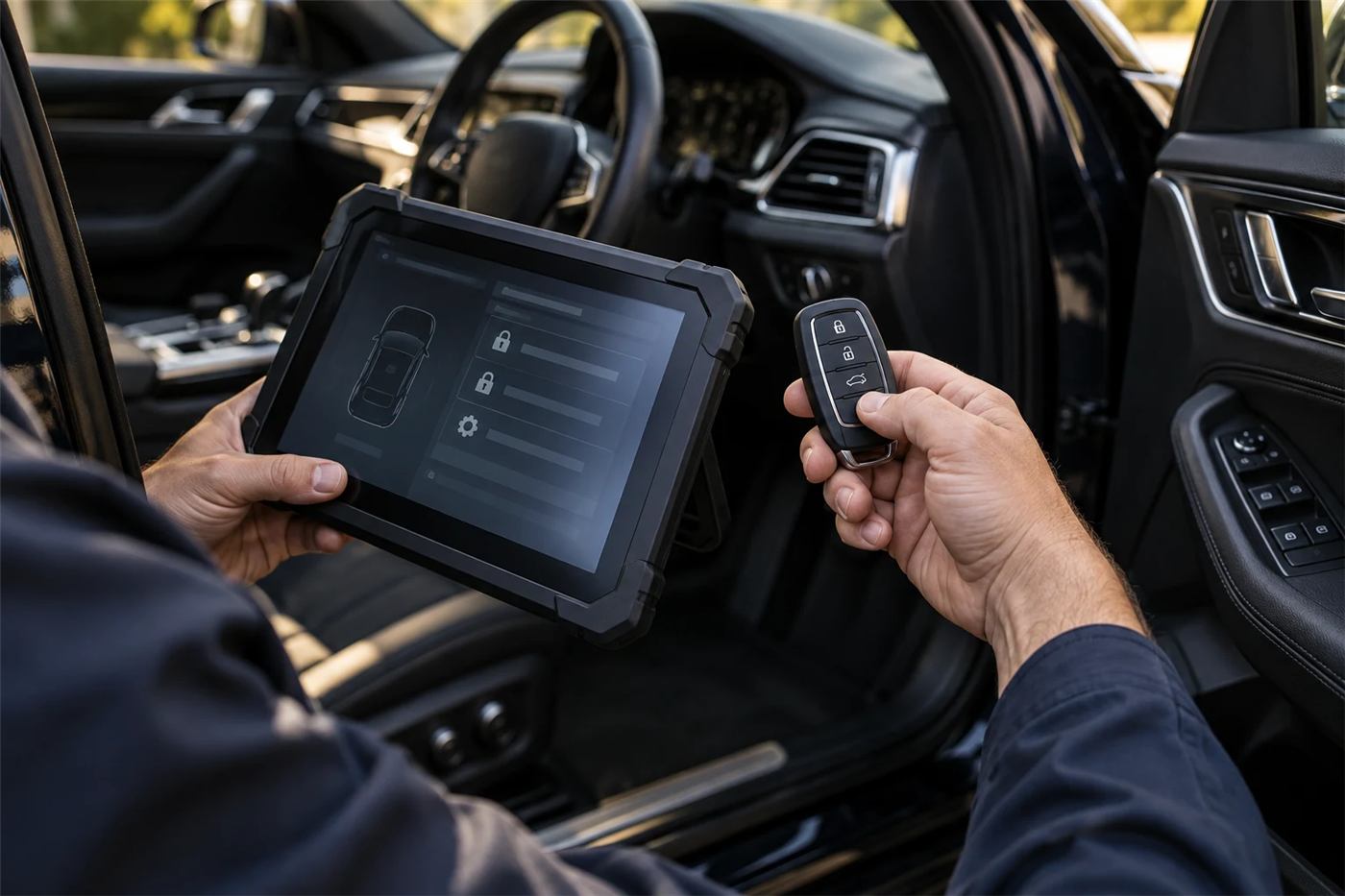
Why your fob has a metal key inside it
If you drive a car with push button start, you may never have used a metal key in your life. The fob does everything: it unlocks the doors, lets you start the engine and tells the car you are nearby. So it surprises many owners to learn that a real key is built into the fob, and that the car has a real mechanical lock for it somewhere on the outside.
The reason is simple. Electronics fail. A fob battery runs down, a car battery goes flat, a fob gets wet, or the car's receiver stops working. A mechanical backup means you can still get inside the vehicle. Manufacturers include it so a dead battery does not turn into a lockout.
The blade is a real key, cut to match the door lock on your vehicle, but it is usually not the key that starts the car. On a push button start vehicle, the blade opens the driver door in an emergency, and a separate process, covered later in this guide, lets you start the car if the fob battery is dead. The blade itself typically does not contain a transponder.
Because owners rarely use it, the blade is often forgotten, and the hidden lock is often unnoticed. Taking a few minutes now, in daylight and with no pressure, to find both is worth the effort. This guide explains how, and where the limits are. For background on how these systems work, see our guides on how car keys work and on transponder keys versus smart keys.
Where the blade hides and how to release it
On most fobs, the blade slides out from the end of the case. Look closely at the fob for a small button, a slider or a latch, often on the back or along an edge. On many fobs, you push or slide that control and pull the blade out with your other hand. On others, the blade is held by a spring-loaded catch and pops partly out when you press the release.
The release is usually a small mechanical piece, not electronic, so it works with a dead battery. If you cannot find one, check the owner's manual for the illustration, which usually shows the exact motion for your model. Some fobs hide the blade behind a short cap or a section of the case that comes apart with a quick twist.
Take care with the motion. Pull the blade straight, in line with the fob, and do not force it sideways. The release catch is small plastic and can break. Once the blade is out, look at it: a typical emergency blade is slim, flat and has a pattern of cuts along one or both edges, or a milled groove down the face.
It is also worth noticing how the blade re-seats. Slide it back in until it clicks, and make sure it is held firmly. A loose blade can rattle or drop out in a pocket, and a lost blade is a nuisance. If the fob looks worn near the release, and the blade does not stay in, it may be time to look at key fob shell repair.
- Hold the fob with the buttons facing you.
- Look for a small slider, button or notch near an edge or the back.
- Press or slide the release while pulling the blade out in a straight line.
- Look at the blade and note its shape.
- Slide it back until it clicks and test that it is secure.
Finding the hidden door lock
Here is the part that surprises people: on many modern vehicles, the driver door has no visible keyhole. The manufacturer hides it behind a small plastic cap on the door handle, often a rectangular piece at the end of the handle that looks like trim. Behind the cap sits the lock cylinder.
To find it, look at the driver's door handle in daylight. You are looking for a small seam, a slot or a notch on the underside or end of the handle. The cap is usually the same color as the door and sits flush. It may be held on by a small catch at one end.
On some vehicles, you place the tip of the emergency blade into a slot on the underside of the cap and gently pry it off. On others, you pull the door handle outward while you tug the cap. The owner's manual shows this step for your vehicle and is the best guide. Do not use a screwdriver or a sharp tool on the cap, since it is easily scratched or broken and the paint around it is easy to mark.
If you have a vehicle with a conventional exposed keyhole on the driver door, the blade will work in it exactly as an ordinary key does. Some vehicles have the visible keyhole only on the driver door, and others have none at all, relying on the cap. If you are not sure which applies to your car, check the manual or ask when you call. Different makes handle this differently, and our door lock cylinder repair page covers what can go wrong with the cylinder itself.
Using the blade the right way
With the cap removed and the blade ready, insert the blade fully into the lock. A good fit is smooth, with no force. Turn it in the unlock direction, and the door should unlock. On some vehicles, the first turn unlocks only the driver door, and a second turn unlocks the others.
A word about alarms. On many vehicles, opening a door with the mechanical key while the alarm is armed can trigger the alarm. The car may not know a valid key was used. If the alarm sounds, placing the fob against the start button, or in a specific marked spot, and pressing the start button usually quiets it. This is covered in the owner's manual, and it is a good thing to know in advance.
Never force the blade. If it does not turn easily, remove it and check that it is the correct blade, that it is fully inserted and that the lock is not blocked by dirt or corrosion. A forced blade can bend or snap in the lock, and a broken piece in the cylinder becomes a bigger problem. Our page on broken key extraction explains what is involved in that case.
This guide is only for using your own key on your own vehicle. It does not describe any way to get into a vehicle without the key, and we do not provide such instructions.
- Insert the blade fully and straight.
- Turn gently, with no force.
- Expect the alarm to sound on some vehicles, and know how to silence it.
- Stop if the blade binds, and do not twist harder.
- Return the cap to the handle when finished.
Starting the car with a dead fob battery
Opening the door is only half the problem. On a push button start vehicle, the car expects to detect the fob before it will start. If the fob battery is dead, the car may not sense it at all, and you may see a message such as key not detected.
Most manufacturers build in a workaround. The fob contains a passive part, a small transponder or coil, that does not need battery power but can be read when the fob is placed very close to a specific spot in the vehicle. That spot varies. It may be a marked pocket in the center console, a spot on the steering column, a mark beside the start button, or a slot in the cup holder or glovebox.
The usual routine is to place the fob against that spot, press the brake pedal and press the start button. The car reads the passive chip and allows the engine to start. Your owner's manual gives the exact spot, and it is worth reading before you ever need it. Our page on a key not detected message explains the other causes of that warning.
If you have a weak car battery as well as a weak fob, the workaround may not work. In that case, the more pressing problem may be the car battery. A dead car battery often shows up in other ways, such as dim lights or clicking, and our page about a dead car battery and the fob covers that case.
Differences between makes and models
Every manufacturer approaches the emergency blade a little differently, so it helps to treat the details here as general. Some makes hide the lock cap on the driver door only. Some provide a visible keyhole on the driver door and a hidden one on the trunk or liftgate. Some use blades with cuts on one edge, some on both, and some with a milled track down the middle, known as a laser-cut or high-security style.
A laser-cut blade has a more complex shape than a traditional notched key and needs advanced equipment to cut. Our page on laser cut key service explains what is different. If you ever lose just the blade and not the fob, a replacement blade is a job where a technician needs to cut to the vehicle's lock, using the VIN and proof of ownership.
Some vehicles have no emergency blade at all. A small number of newer designs rely on a phone app, a keypad or a backup procedure with the fob in a spot, and have no mechanical lock. If your car came with a fob that has no slot for a blade and no visible keyhole, check the manual rather than assuming something is broken.
Because of all this variety, it pays to check yours. A few minutes learning what your specific vehicle uses will tell you far more than any general guide.
Why the blade is for emergencies only
The blade is a backup, and it is wise to treat it that way. Using it every day wears the lock, exposes the cylinder to dirt and weather, and can trigger the alarm. The lock behind the cap is rarely used, which means it can become stiff over time, particularly in a humid area where moisture and corrosion build up. Our page on corroded locks and humidity describes how this can show up.
A lock that has not been turned in years may stick when you need it most. If you have never tried your emergency blade, do a gentle test while the car is parked at home. Insert the blade, turn it, and confirm that it moves. If it feels rough, do not push harder. Call and describe what happens, and a technician can advise whether the cylinder needs service.
Another reason to keep it as a backup: the blade is not a security upgrade. Some owners remove the blade and leave it at home to keep the fob compact, or to avoid carrying a metal piece in their pocket. That is a personal decision, but if you do it, keep the blade somewhere safe and known, since if the fob dies when you are away from home, you will need it.
Also, never hand the blade to someone you do not know, and do not leave it in the car. It is a working key to the door.
What can go wrong with the blade and the lock
A few predictable problems turn up. The blade can bend if it is used as a pry tool or a screwdriver, which is a common misuse. It can break in the lock if forced, particularly after long disuse. The release can fail, leaving the blade stuck inside the case. The cap on the door handle can crack or be lost, leaving the lock open to rain and dirt.
The lock itself can corrode or jam. In Houston, with heavy humidity and frequent storms, a lock that is open to the weather can pick up grime and rust inside. If a blade will not turn, resist the urge to spray random lubricants into it, since the wrong product can attract dust and gum up the mechanism. Gentle handling and professional advice are better.
Another common problem is that owners find the blade is missing. It may have been removed and lost, or it may have fallen out. If you discover your blade is gone, do not wait for the day you need it. A replacement can be arranged, and a technician will want the vehicle details and proof of ownership, as with any new key.
A stuck or broken blade is a job for a professional. Please do not use pliers or tools to force it, because damage to the lock or the fob adds to the repair.
- Blade will not slide out: the release may be jammed or the case warped.
- Blade will not turn in the lock: dirt, corrosion or the wrong blade.
- Blade snapped in the lock: stop and call for extraction.
- Door handle cap missing: the lock is exposed and should be protected.
- Alarm sounds after use: follow the manual to silence it.
A practice run you can do at home
The best time to learn your emergency procedure is when you do not need it. Pick a calm afternoon, park the car in a safe place and work through the steps with the manual open. It takes only a few minutes and removes a great deal of uncertainty.
Do the practice in daylight, with the vehicle in a safe, private spot, and keep another key or the fob in your hand while you test, so that you cannot lock yourself out. Do not test with the only key in the car or with the doors closed and locked behind you.
- Locate the blade release on your fob and slide the blade out.
- Find the hidden lock on the driver door handle, and read the manual to learn how the cap comes off.
- Remove the cap gently, if the manual says to, and insert the blade.
- Turn the blade slowly to confirm the lock moves, then return it to the locked position.
- Replace the cap and check that it is firmly seated.
- Locate the spot in the cabin where a dead fob is held to start the car.
- Put a reminder in your phone to repeat the check each year.
If you cannot get in or the blade does not work
If you are locked out and the blade does not work, or you have no blade, do not try to force the door, the window or the lock. Forced entry can damage door panels, wiring and seals, and the repair is often costlier than the lockout. Never try to bypass the lock.
If a child, a pet or a vulnerable person is locked inside, or the vehicle is in a dangerous condition such as extreme heat, call 911 first. Emergency services can get inside quickly and are the right call in that situation. Our page on a child locked in a car explains why it is better to call 911 first.
If it is a standard lockout and nobody is in danger, call a locksmith, explain where you are, describe the vehicle and say whether you have the fob. Ask for a quote by phone, and ask about the service call charge before you agree to a dispatch. A professional will check ownership when they arrive. Please verify the credentials of anyone who comes to help, and be wary of anyone who is reluctant to explain the work or asks for payment before you have seen the job.
For help with a lockout, see our page on keys locked in a car.
Having a spare and a plan
The emergency blade is a good backup, but a spare key is a better plan. If your only fob is lost, the blade goes with it. Having a second working key at home, with a good battery, means you can recover from a dead fob, a lost fob or a stolen bag far more easily. Our guide on why you need a spare key now sets this out.
Add a short routine. Test the blade once a year, check the fob battery and keep the manual page about the emergency start in a place you can find. If you ever feel unsure, call and talk it over. The technician can often tell you what to expect for your make and model, what a replacement blade or fob would involve and what to have ready.
When you call, please have the vehicle details and your photo ID and registration ready, and we will go through the options by phone.
Questions people ask
Does every key fob have a hidden metal key?
Most smart key fobs do, but not all. A few newer designs rely on a keypad, a phone app or a backup procedure instead, and some have no mechanical lock at all. Check your owner's manual for the release slider and for any hidden lock. If neither is mentioned, your vehicle may not use a mechanical backup.
Where is the keyhole on my car if I cannot see one?
Many modern vehicles hide the driver door lock behind a small plastic cap at the end or underside of the door handle. The manual shows how the cap comes off, often with the tip of the blade. Avoid using a screwdriver, which can scratch the paint or break the cap.
Will the emergency blade start my car?
Usually it only opens the door. On a push button start vehicle, you typically start the car by holding the fob against a marked spot in the cabin, pressing the brake and pressing the start button. The exact place depends on the vehicle, and the owner's manual gives the details for your model.
Why did the alarm go off when I used the blade?
Some vehicles treat a door opened with the mechanical key as an intrusion because the car did not detect the fob. Placing the fob against the start spot and pressing start usually silences it. Knowing this ahead of time keeps you calm if it happens, and the manual lists the exact silencing steps.
The blade will not turn in the door lock. What should I do?
Stop and do not force it. Check that the blade is fully inserted and that it is the right one. A lock that has not been used in a long time can be stiff or corroded. Call and describe what is happening, and a technician can tell you whether the cylinder needs service.
I lost the metal blade. Can it be replaced?
Yes, a replacement blade can usually be cut, but a technician needs the vehicle details and proof of ownership first. Some blades are laser cut and need advanced equipment. Call, describe the fob, and you will get a quote by phone. A more complicated case may need an on-site visit.
Describe the situation by phone and we will tell you what the job involves. Quotes are given by phone. Jobs that cannot be quoted without seeing them need a technician on site, and the service call charge is explained on the phone before anyone is dispatched.
(713) 574-7660Related pages
Written by Claude (AI) (AI) for Houston Car Key Locksmith.