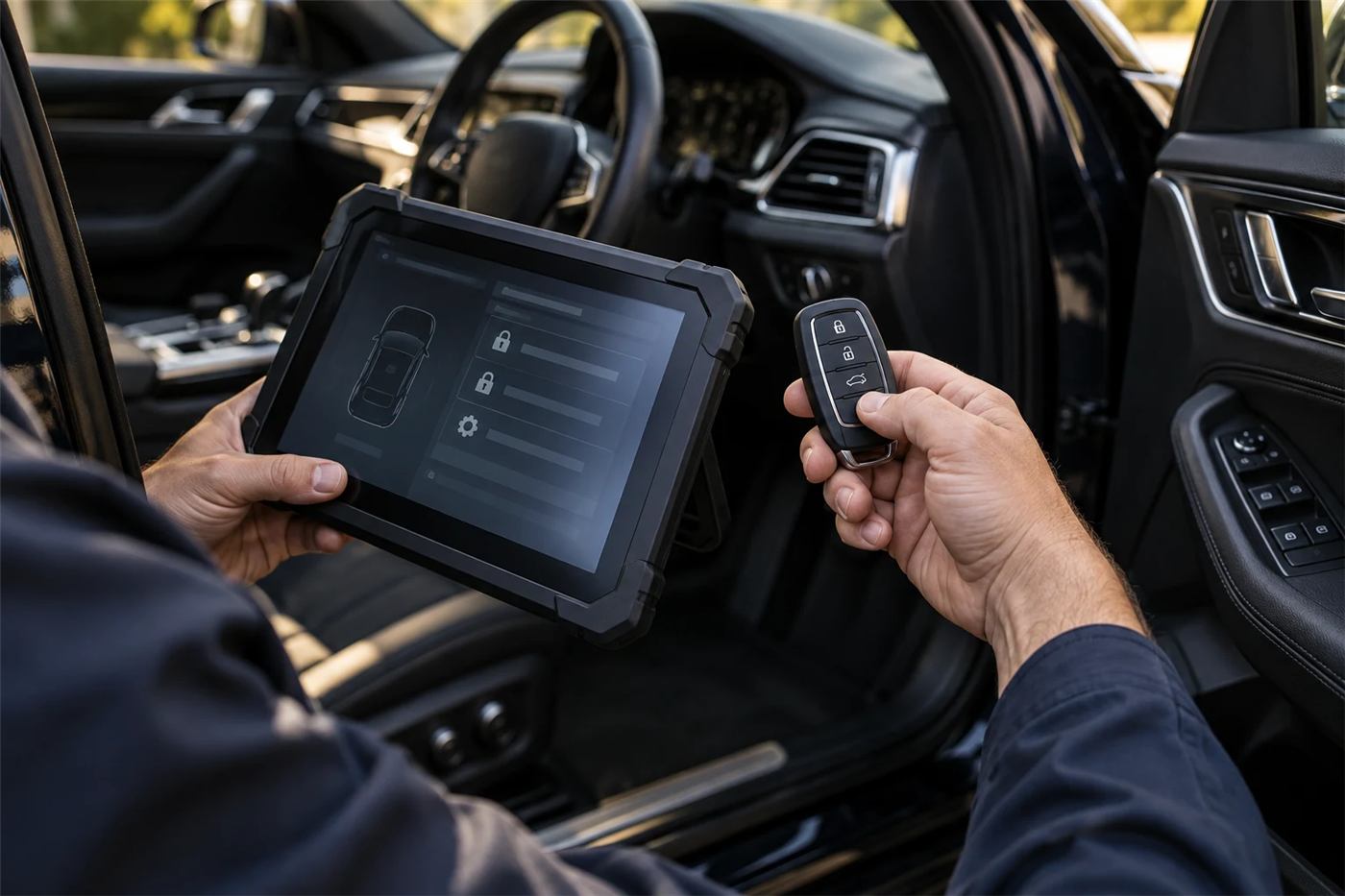
Why flooding is different from an ordinary lost key
A normal lost key is a single problem. A flood creates several at once. The key may be gone, soaked, or sitting in a car that is itself sitting in standing water. People in Houston have seen neighborhood streets, underpasses and apartment parking lots fill within hours, and the keys are often the last thing on anyone's mind until the water has gone down and the real work of recovering begins.
Flood water is rarely clean. It carries mud, fuel, road salts and runoff, and it dries into a film that stays on metal contacts and circuit boards. A modern key fob is a small sealed computer with a battery, a radio chip and a printed circuit board. Water that gets inside does not just sit there. It carries minerals that corrode the traces long after the fob looks dry.
The car adds its own complications. The computer that reads your key, the immobilizer module, the door control units and the wiring that connects them often sit low in the vehicle or under the dash. Water that reached the seats may have reached some of those parts too. That is why a locksmith visit after a flood often turns into a conversation about what is wrong with the car as well as what is wrong with the key.
First priorities before you think about keys
Safety comes first. If water is still rising, if there is standing water around the car, or if you are in any danger, leave the vehicle where it is and get yourself and your family to safety. A car can be replaced or repaired. Do not wade through moving water to reach a vehicle, and do not go near a car that is partly submerged near downed power lines. If anyone is hurt or trapped, call 911 first.
Once it is safe, the next priority is to leave the car alone. The urge to check whether it still starts is strong, and it is the single most expensive mistake people make after a flood. A vehicle that has been in water above the door sills may have water in places you cannot see. Turning the key and cranking the engine can push water into the engine cylinders or energize wet electronics that would otherwise have recovered.
If the vehicle was only splashed, or the water stayed below the floor, you may be fine. If the water reached the seats, the dash or the engine bay, treat the car as one that needs a proper inspection before it is ever started again. Your insurance company or a repair shop can tell you more about the vehicle itself. Our role is the keys and the key-related electronics, and we can work alongside whatever else the car needs.
- Do not crank the engine if water reached the seats or the dash.
- Do not keep pressing the start button or turning the key to see what happens.
- Do not charge or connect anything to a soaked fob.
- Take photographs of the water line, the interior and the keys before anything is moved.
- Write down where and when the car was parked and roughly how high the water got.
What flood water does to different kinds of keys
A basic metal key with no chip is the most forgiving. It may rust or tarnish, but it will usually still cut and turn a lock once it is cleaned. The problem is that very few cars on Houston roads today use a plain metal key. Most keys made in the last couple of decades contain a transponder chip inside the plastic head, and that chip is small, passive and fairly tough. A chip key that went through water is often fine electronically, though the plastic casing may hold moisture and the blade may be dirty.
A remote head key, which combines a metal blade with a lock and unlock remote, is more fragile. It has a battery, a circuit board and rubber button pads. Water gets under the pads and into the board, and the battery contacts corrode. A key like that may work for a few days after drying and then stop, or it may work only some of the time.
A smart key or proximity fob is the most vulnerable. It contains a radio transmitter that talks to the car continuously, a battery, a circuit board and often a hidden emergency blade. Corrosion on the board can cause intermittent faults that are hard to trace. A smart fob that seems fine on the day may begin dropping its connection with the car a week later, usually at the worst moment.
Metal parts also matter. Flood debris can scratch a blade, and silt can pack into the grooves. Once a blade is worn or fouled, it may still enter the lock but not turn smoothly, which can damage the lock cylinder if forced.
Why the rice, hair dryer and oven ideas do not work
Advice about drying out a wet phone gets applied to car keys, and most of it does more harm than good. Burying a fob in uncooked rice does very little. Rice does not pull moisture out of sealed electronics, and the dust and starch can add to the mess inside the case. It also gives a false sense that the problem has been solved.
Heat is worse. A hair dryer, a heater vent or a low oven can warp the plastic shell, loosen the glue that holds the case together and push moisture deeper into the board. Battery cells inside a fob are also sensitive to heat. A battery that has been heated and then used can swell, leak or fail early.
Another popular idea is to put the battery back in right away and press buttons to test. When the board is still wet, power can create tiny short circuits across the moisture and burn traces that would have survived if left unpowered. If a fob has been in water, the safest sequence is to remove the battery if it can be done without prying, stop pressing buttons, and let a technician open the case and look at the board properly.
Cleaning the contacts and the board with the right solvent, drying them in a controlled way and then replacing the battery is a legitimate repair. It is also not certain to hold. Corrosion that has started under components can come back. That is why, for a key you depend on, replacement is often the more honest recommendation.
When the key is lost rather than soaked
Sometimes the water takes the key away entirely. A key can come out of a pocket during an evacuation, wash out of a bag in a flooded stairwell, or end up somewhere under mud in a car that has been moved. If the key is simply gone and the car cannot be found easily, you are in lost key territory, and the approach is the same as for any lost key with a few extra steps.
A mobile locksmith can cut and program a replacement for most vehicles on site, provided the car can be reached and ownership can be shown. For a modern vehicle with an immobilizer, the new key has to be introduced to the car's computer, which usually means connecting a programming tool to the car's diagnostic port. That needs a car whose electrical system is in a condition to talk. If the car is in a lot where water has reached the cabin, that conversation is sometimes difficult and a technician may need to assess the car before promising anything.
If you have a spare, use it as the model for the replacement. If the lost key was your only one, the job is called an all keys lost job, and the process is covered on our all keys lost page. The first call should cover the make, model, year, where the car is and whether it was in water. Your answers decide whether the work can be done on the spot or needs a visit to see the car first.
What a technician will check on a flood-exposed car
A good technician will start by asking questions, not by plugging in a tool. How high did the water get? How long was the car in it? Has anyone tried to start it? Has the battery been disconnected? These answers tell the technician whether it is sensible to connect anything at all.
On site, the technician will look at the car's interior, the lower door panels and the area around the driver's footwell. Signs such as a waterline on the door cards, damp carpet, mud on the pedals or a musty smell tell part of the story. They may check whether the doors respond to the remote, whether the dash lights come on normally and whether the car shows a security or immobilizer warning.
If the vehicle's electronics respond, the technician can usually read the key system through the diagnostic port, confirm which keys the car knows and add a new one. If the electronics are unresponsive or give errors that point to water damage elsewhere in the car, the honest answer may be that the key work should wait until the car has been dried, tested or repaired. Programming a new key into a car whose control units are failing wastes your money and can leave you with a key that stops working again later.
Where a key blade has to be cut, the technician will clean the blank, cut it and test it in the door and the ignition before any programming is done. For vehicles with a push button start, the test happens in the cabin with the car's reader.
The honest limits of key work after a flood
There are cases where a locksmith cannot make a car start, and it is better to say so plainly. A new key can be cut and programmed perfectly and the car may still not run, because the problem is not the key. Water damage can affect the engine control unit, the body control module, the wiring harness and the fuel system. None of those are repaired by a key.
Insurance may also have a say. If the car has been declared a total loss, replacing the key may not be worth doing, or may be something the insurer handles through their own channels. If you are unsure, it is worth asking your insurer before paying for work on a car that may be written off.
We will tell you on the phone whether the work you are describing is the kind of work we can do and what we would need to see before attempting it. Pricing is given only by phone, based on the vehicle and the situation. Some flood jobs are straightforward and others need an on-site visit, and a service call charge applies, which is explained before anyone is dispatched. If a visit shows the car needs something else first, you will hear that before any work begins.
Insurance, photographs and paperwork
Flood losses usually involve a claim, and keys are part of what the claim may cover. The details depend on your policy, and only your insurer can say what is included. What you can do is keep a clear record from the start.
Take photographs of the car, the water line, the interior, the keys and any damage you can see. Keep any receipts for tow trucks, storage, locksmith work and repairs. Ask the locksmith for an invoice that lists the make, model and year of the vehicle, what was done and the date. Keep that invoice with your claim paperwork.
Your insurer may want the vehicle inspected before any key work is done. If so, tell the locksmith. A technician can often work around that, or they can wait until the adjuster has taken photographs. It is better to ask first than to have a claim complicated by work done before the inspection.
If the car is a lease or has a loan, the lender or leasing company may also have rules about repairs and key replacement. Reading your agreement or calling the company before any work is done avoids surprises.
- Photograph the car and the keys before anything is moved.
- Call your insurance company and ask what they need before key or repair work.
- Keep every receipt and the technician's invoice.
- Write down the date, the place and the water level.
- Tell the locksmith about the claim so the paperwork matches.
Keeping a spare that is not in the same place
One lesson that comes up after every Houston flood is the value of a spare key kept somewhere other than the car or the same bag. If a flood takes the main key, a dry spare at a friend's house, in a lockbox or at the office turns a long ordeal into a short one. For more on spare keys, see our guide on why you need a spare key now.
Many owners keep the only spare in the glovebox, which fails in exactly this situation. A spare in the same car shares the same fate as the car. A spare key stored with a trusted person who lives on higher ground, or in a waterproof container inside a home, gives you a way to get into the car and a way to prove ownership while you sort out the rest.
Hurricane season is the other time to think about this. If a storm is in the forecast, it makes sense to gather keys, fobs and paperwork, put them in a sealed bag and take them with you rather than leave them in a ground-floor drawer. Our hurricane season key prep guide goes through what to pack. There is also a longer look at the car side of flooding in our guide to flood damaged vehicle keys.
How the call goes and what to have ready
When you call, expect a few plain questions. What is the make, model and year of the car? Is it a push button start or a key you turn? Did you have any keys left, and were they in the water? Where is the car right now, and can it be reached? Was the car in water, and did anyone try to start it? You do not need to know the technical terms. Describing what you see is enough.
You will be asked to show that the car is yours before a key is made. That usually means a photo identification and either the registration, the title or an insurance document in your name. If the paperwork was in the car and was ruined, other documents such as a loan statement, a bill of sale or a letter from your insurer can help. Mention that on the call so the technician knows what to expect.
If the work can be done at the car, the technician will tell you what happens next, the price will be given by phone before anyone is dispatched and the service call charge is explained at that time. Where the situation is complicated, such as a car that cannot be reached or a vehicle with clear water damage, the technician may recommend a visit to assess it before quoting.
If you are dealing with a flood now and the car is fine but the key is gone or ruined, call and describe what happened. If the car is the problem, say so, and we will tell you what we can and cannot do. Either way, call and talk it through before you try anything on the keys yourself.
Questions people ask
Can I dry out a flooded key fob myself?
It is not a good idea to rely on home drying. Rice does little for sealed electronics, and heat from a hair dryer or oven can warp the case and damage the battery. If a fob has been in water, remove the battery if you can do so without prying, stop pressing buttons and have a technician open the case and inspect the board. Corrosion can return later, so replacement is often the safer choice.
Should I try to start my car after it was in flood water?
If water reached the seats, the dash or the engine bay, do not crank the engine. Water can enter the cylinders and energize wet electronics, turning a recoverable problem into an expensive one. Leave the car alone, photograph everything and ask your insurer or a repair shop how to proceed. Key work can wait until the car has been assessed, and a technician can advise on the order.
Can a locksmith make a new key if my car was flooded?
Often yes, if the car can be reached and its electronics respond. A key can be cut and programmed on site for most vehicles once ownership is shown. If the car's control units are damaged by water, the key work may need to wait until the car is repaired. A technician will tell you on the call what is realistic and may recommend a visit to look at the car first.
Will insurance pay for a replacement key after a flood?
That depends on your policy and the type of coverage you have, and only your insurer can say. Keep photographs, receipts and the technician's invoice, and call your insurer before key or repair work if you can. If the car is declared a total loss, the insurer may handle things differently, so it is wise to ask before paying for work on the vehicle.
What if my ownership papers were ruined in the water?
Tell the technician on the call. Other documents can often show ownership, such as a loan or lease statement, a bill of sale, an insurance document or a letter from your insurer, together with a photo identification. Your local county tax office can also issue copies of a title or registration record. Having something in your name that matches the vehicle is what matters.
Is it worth repairing a fob that has been in flood water?
Sometimes, if the fob is cleaned and dried by a technician and the board shows no corrosion. But corrosion can continue under components after the fob appears fine, so a repaired fob may fail again later. If you depend on the key every day, replacement is usually the sounder choice, and the old fob can be kept only as a backup for door access.
Describe the situation by phone and we will tell you what the job involves. Quotes are given by phone. Jobs that cannot be quoted without seeing them need a technician on site, and the service call charge is explained on the phone before anyone is dispatched.
(713) 574-7660Related pages
Written by Claude (AI) (AI) for Houston Car Key Locksmith.