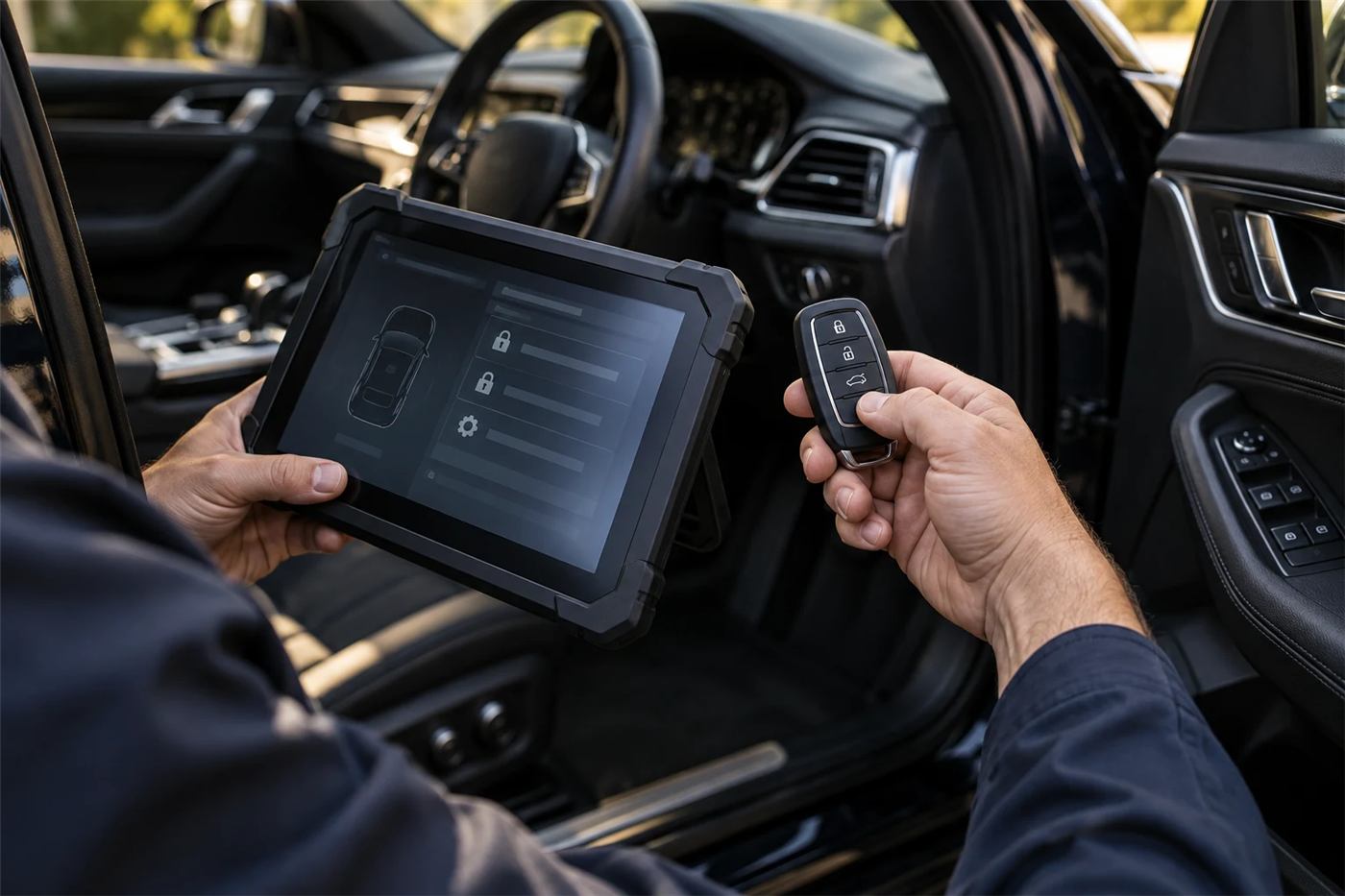
A key is really three tools in one case
Most people think of a car key as a piece of metal that fits a lock. That was true a few decades ago. Today the metal part is often only one of three tools packed into the same plastic head. The first tool is the blade, which physically turns a lock or an ignition. The second is the remote, a small radio transmitter that locks and unlocks the doors and opens the trunk from a distance. The third is the transponder chip, a tiny identification device that talks to the vehicle computer and decides whether the engine is allowed to run.
Each of these three tools can fail on its own. A worn blade can leave the key sticking in the ignition even though the remote works perfectly. A dead remote battery can stop the buttons while the blade and chip are fine. A damaged chip can stop the engine from starting even though the key turns easily and the buttons all respond. When something goes wrong, working out which tool has failed is the first step to fixing it.
Newer vehicles with push button start combine and reshape these tools. There may be no visible blade, and the chip and the remote may share a single circuit board. The functions are the same, but the way they work together changes. The rest of this guide takes each part in turn, then shows how they cooperate when you get into the car.
The blade: the part you can see
The blade is the oldest part of the key and the easiest to understand. It has a pattern of cuts along its edge that match the arrangement of small pins or wafers inside a lock. When the right blade goes in, the pins line up and the lock can turn. When the wrong blade goes in, they do not.
Blades come in two common styles. Edge-cut blades have notches along the top and bottom edges, like a traditional house key. Laser-cut blades, sometimes called sidewinder keys, have a groove milled into the face of the blade, which gives a thicker, smoother look and makes the key harder to copy with basic equipment. Our page on laser cut key service explains how those are made.
Blades wear. A key used daily for many years can lose some of its cut depth, which is why an old key may feel sticky or may need a wiggle to turn. Copying a very worn key can reproduce the wear, which is why a technician may prefer to cut a fresh blade from a code rather than from the old one. Many modern smart keys hide a small blade inside the fob for emergencies, to be used only when the battery has died.
The transponder chip: the part that talks to the car
Inside the plastic head of most keys made in recent decades sits a tiny chip, often smaller than a grain of rice. This is the transponder. It does not need a battery in the usual way. When the key is brought near the ignition, a ring-shaped antenna around the lock sends out a small burst of energy. That energy wakes the chip, and the chip answers with a coded message.
The vehicle computer checks the message. If it matches one of the codes the car has been taught to accept, the computer allows the fuel and ignition systems to operate. If it does not match, the engine may turn over for a moment and then shut off, or it may not turn over at all, and a security light on the dash may flash. This design is why a copied key that has the right cuts but no chip can open the door and still fail to start the car.
The code on the chip is not a simple number that can be read and repeated. Better systems use a changing code, so that the answer is different each time. That makes it much harder to record and replay. The chip is a major reason that auto theft by simply hot-wiring a car became far harder on modern vehicles.
The remote: the part with the buttons
The remote circuit is a small radio transmitter powered by a coin-style battery. When you press a button, the circuit sends a coded radio message to a receiver in the vehicle. The message says which button was pressed and carries an identification code. The receiver checks the code and, if it is accepted, performs the action: unlock, lock, open the trunk, sound the alarm or start the engine remotely on cars that have that feature.
Remote codes change with each press in most modern systems. This is called a rolling code, and it prevents someone from recording your signal and playing it back later. The key and the car keep track of where they are in the sequence, and if they drift too far apart, such as after many presses while out of range, the remote may need to be resynchronized.
Because the remote is battery powered, it is the part that most often fails for ordinary reasons. A weak battery can reduce range before the buttons stop altogether. If your remote suddenly needs you to stand closer to the car, that is a classic sign. Our page on key fob battery replacement explains what can be done and what to watch for.
The vehicle computer: the decision maker
The key is only half of the system. The other half is the vehicle computer, which stores the list of key codes it has been taught to accept. This list is held in memory in one or more control modules. When a key is presented, the computer compares what it receives with what it has stored and makes a decision.
This is why replacing a key is a two-sided job. The new key has to carry the right kind of chip and remote, and the car has to be taught to accept it. The teaching step happens through the diagnostic port under the dash, where a technician connects equipment that can speak to the car security system. Our guide on how key programming works walks through that process step by step.
The computer can also forget keys. If a key is lost or stolen, a technician can often erase it from the list so that it no longer starts the car. That is a valuable protection that older purely mechanical keys could never offer, because a lost mechanical key worked until the lock itself was changed.
What happens when you get in and start the car
Take a conventional transponder key as an example. You insert the blade and turn it. As the key enters the ignition, the antenna ring wakes the chip and the chip answers. The computer verifies the answer within a fraction of a second. If it is accepted, the starter engages and the engine runs. If it is rejected, the security light flashes and the engine is disabled.
With a smart key, the exchange begins earlier. When you touch a door handle, antennas around the car send a short-range signal. Your fob, in your pocket, wakes up and replies. The car unlocks. Inside, when you press the start button, antennas in the cabin check that the fob is present, and the computer then allows the engine to start. If the fob battery is weak, many cars have a backup spot where holding the fob lets the car read it by a closer, lower power method.
All of this happens so quickly that you never notice. The reason it matters is that each step can fail, and the failure points to a cause. A car that unlocks but will not start suggests the chip or the vehicle side. A car that starts but will not unlock suggests the remote. A car that does neither suggests a dead fob battery or a car with a weak battery.
Why a key cannot simply be copied at a counter
Hardware counters can cut a blade, and for a very old car that may be all that is needed. For most cars built in recent decades, cutting the blade is only the first step. The chip has to be of the right type, and it has to be written with the right data or taught to the car. Without that, the key may turn the lock and still fail to start the engine.
Some people try to avoid the cost by buying a key online and having a blade cut. That can work when the key type is exactly right and a technician is available to program it, but many online keys turn out to be the wrong frequency, the wrong chip type or a low-quality copy. The result is a key that looks fine and does not work. Our guide on car key scams to avoid covers related traps.
A mobile technician brings the right blanks, the right fobs and the programming equipment in one visit, tests the result and ties the work to your vehicle. That is why the job is more than a copy.
Common failures and what they usually point to
Understanding the parts makes troubleshooting easier. A key that turns hard or sticks is usually a blade or ignition wear issue. A key that turns easily but will not start the car is usually a chip, pairing or battery issue on the vehicle side. A key whose buttons do nothing is usually a dead remote battery, worn button pads or a damaged circuit board.
Water damage can affect all three parts. Moisture corrodes the remote circuit, shorts the chip and can swell the plastic. If a key has been through a wash cycle or a flood, stop trying it in the car. Our page on key fob water damage explains what to do next.
Physical damage matters too. Dropping a key can crack the board or dislodge the chip. A key that rattles when shaken, has a cracked case or has lost a button cap should be looked at before it fails completely. A cracked key head also exposes the chip to moisture and dirt, which can shorten its life.
- Sticks or turns hard: suspect blade or ignition wear.
- Turns but car will not start: suspect chip, pairing or vehicle battery.
- Buttons do nothing: suspect remote battery or worn pads.
- Works only sometimes: suspect a weak battery, a cracked board or interference.
- Wet or dropped: stop using it in the car and have it inspected.
Keeping your key healthy and knowing when to call
A few habits help a key last. Keep the ring light, so the weight does not wear the ignition. Keep the key out of direct sun, away from magnets and away from liquids. Replace the remote battery when range drops rather than waiting for the buttons to fail. Keep a spare in a safe place at home and have it tested now and then, so you know it still works.
If something goes wrong, note what the car does and what the dash shows, and describe it when you call. The person on the phone can often tell from your description whether the problem is the blade, the chip, the remote or the car. Quotes are given only by phone, and a service call charge is explained before a technician is dispatched.
When you are ready, call the number on this page. Tell us the make, model and approximate age of your car, what kind of key you have, and what happened. We will explain the next step in plain terms.
Questions people ask
Does every car key have a chip in it?
Most cars built in recent decades do, and the chip is what lets the vehicle computer accept the key. Very old cars may have only a metal key with no electronics at all. Smart keys also contain a chip and an antenna. If you are unsure whether your key has one, describe the car to a technician and they can usually tell.
Why does my key turn the lock but the car will not start?
The blade only opens the mechanical part. The engine start depends on the chip being recognized by the vehicle computer. If the chip is missing, damaged or unpaired, the car may crank briefly and stop, and a security light may flash on the dash. A technician can test the chip and pair a new key.
Why does the remote work only when I stand close to the car?
Reduced range is a classic sign of a weak remote battery. Replacing the coin-style battery often restores normal range. If a new battery does not help, the circuit board, the button pads or the pairing may be at fault. It is worth having the key checked before it stops working altogether.
Can a lost key be stopped from starting my car?
On many vehicles, yes. During programming, a technician can erase missing keys from the vehicle memory so they no longer start the engine. This does not apply the same way to every model, so ask what your vehicle supports, and consider reporting a key that may have been stolen.
What is a rolling code?
It is a system where the code sent by the remote changes each time you press a button. The car and the key keep track of the sequence, so a recorded signal cannot be replayed later. If the two drift out of step, the remote may need to be resynchronized by a technician.
Is a smart key different inside from a regular key?
It does the same three jobs but arranges them differently. A smart key uses short-range radio exchanges with antennas around the car rather than a blade in a lock. It still contains a chip and a transmitter, and it still has to be programmed to the vehicle. Most carry a hidden emergency blade as well.
Describe the situation by phone and we will tell you what the job involves. Quotes are given by phone. Jobs that cannot be quoted without seeing them need a technician on site, and the service call charge is explained on the phone before anyone is dispatched.
(713) 574-7660Related pages
Written by Claude (AI) (AI) for Houston Car Key Locksmith.