Why keys deserve attention on delivery day
Buying a new car involves paperwork, financing, options and a long walk around the vehicle. By the time the salesperson hands over the keys, most buyers are focused on getting out the door. Yet the keys are the one component you will touch every single day, and they hold more technology than most owners realize. A modern key or fob is a radio transmitter, an immobilizer credential and, increasingly, a small computer that can start the engine, open the trunk and even park the car.
Taking a few minutes at delivery to understand what you have been given is worthwhile. How many keys came with the car? What type are they? What do their buttons do? Is there a hidden emergency blade? Can the car be configured for more keys later? What happens if one is lost? None of these questions take long, and the answers shape how easily you can handle problems in the future.
This guide is written for Houston area buyers, but the checklist applies anywhere. It does not replace the owner manual or the advice of the dealership, whose staff know the specific vehicle. Think of it as a list of questions that help you use the manual and the staff well. If something is unclear, ask, and ask for the answer in writing where that is practical.
Count the keys and know what they are
Most new vehicles come with two keys or fobs. Some come with one and a valet key. Some come with a card style key that fits in a wallet. Check the paperwork and the vehicle to confirm what was supposed to be included. Do not assume. If the vehicle was advertised with two fobs and you are handed one, say so at the desk before you leave, not three weeks later when the memory has faded.
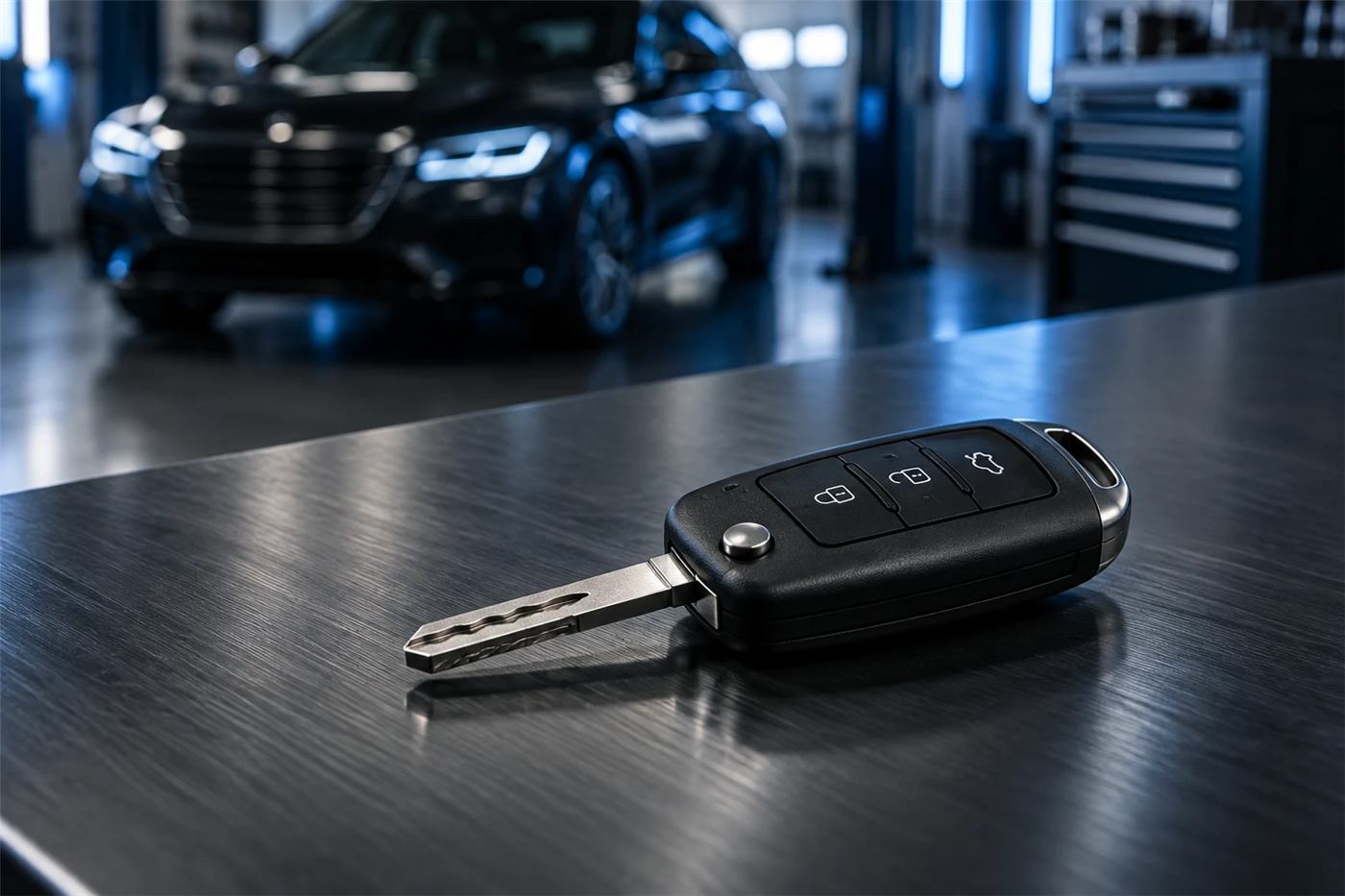
Take a moment to identify each item. A smart key lets you keep the fob in a pocket and press a button on the door handle or dash. A flip key has a folding blade attached to the remote. A remote head key is a traditional blade with built in buttons. A keycard is a thin card that works like a smart key. A phone based digital key lets your phone act as the key on supported vehicles. Each type has its own features and its own replacement path. Our guide on transponder versus smart key explains the differences.
Look for the emergency blade. Many smart fobs have a small metal key hidden inside the casing, released by a small catch. This is the way to open the driver door if the fob battery dies. Ask the salesperson to show you where it is and how to release it, and try it once yourself. Our page on the emergency key blade covers how most of them work.
Finally, check the condition. New fobs should be clean, unscratched and working. Press each button and confirm the car responds. Test the trunk release, the panic button and any remote start. If something does not work, ask the dealer to fix or replace it before you leave. A fob that is faulty on day one is easier to resolve at the desk than in a parking lot.
Ask about the spare key situation
A spare key is one of the most important items to discuss at delivery. Ask directly: is there a second key included, and where is it? Some dealerships keep a spare in the file until the sale is complete. Some hand it over in a separate envelope. Some do not have one at all, and you may need to order it. Whichever applies, know the answer before you sign.
If the vehicle comes with only one key, ask what a second would involve and when it can be arranged. A new vehicle usually has a clear process for ordering and programming additional keys, since the dealership has direct access to the manufacturer systems. It is easier to have a second key made while you still have the original, and while the vehicle is new and the dealership relationship is fresh. We discuss why in why you need a spare key now.
Think about the household. If two people will drive the vehicle, each should have a key. If a teenager will use it, consider whether a separate key or a restricted option such as a valet or limited mode makes sense. Our guide on spare keys for teen drivers covers that conversation. A single key shared among several people is a recipe for a lost key and a stranded vehicle.
Ask where the spare is allowed to live. Storing it in the vehicle defeats the purpose, since a thief who gets into the car gets the spare as well. Keep it at home in a safe, dry place, or leave it with a trusted person. We cover placement in where to keep a spare key.
Understand how keys are registered to the vehicle
Every key that starts the engine has to be known to the vehicle. In technical terms, the key is registered or learned by the immobilizer system, and the vehicle holds a record of which keys are authorized. When a dealership programs a new key, it adds that key to the list. When a key is lost, the vehicle can sometimes be told to forget the lost one, so that anyone who finds it cannot use it.
Ask the dealer how many keys the vehicle is currently set up to recognize, and whether any previous keys, such as ones used for testing or delivery, have been removed. In most cases a new vehicle has only the keys that came with it, but it is a fair question. Ask also whether there is a limit to the number of keys that can be added, since some systems cap the count.
Find out whether the key information is tied to the vehicle identification number and what documentation you will receive. Some manufacturers provide a card or a record with key information, and keeping it in a safe place can help later. If a key is lost, a technician can use the vehicle identification number and proof of ownership to start the process. Our guide to what a VIN is and why it matters explains why this number is central to key work.
If you buy through a dealership, ask what service the dealership would provide if a key is lost, and what that process looks like. If you later choose a mobile locksmith instead, the same vehicle information applies. Our comparison in dealer versus locksmith keys lays out the tradeoffs.
Smart key features worth asking about
Smart keys have grown more capable, and not every owner knows what theirs can do. Ask the salesperson to demonstrate the full feature list. Does the fob support remote start? Can you roll down windows or open the sunroof from outside? Does it open the trunk with a kick sensor or a button? Does it have a panic button? Does the vehicle remember driver settings for each key? Can you set the doors to lock automatically when you walk away?
Ask also about the safety and security features. Some vehicles let you disable the proximity feature to reduce the risk of relay theft, where a thief amplifies the fob signal to open and start a car. Some fobs go to sleep after a period of stillness. Our guides on relay attack protection and the Faraday pouch cover what these threats look like and the habits that reduce the risk. Ask whether your vehicle has a setting to turn off keyless entry when parked at home.
If the vehicle offers a phone based digital key, find out how it works, what happens if the phone battery dies or is lost, and whether a physical key is still needed as a backup. Digital keys are convenient, but a dead phone should not strand you. Also ask whether the digital key can be shared with family members and how to revoke it.
Finally, ask about the fob battery. What type does it use? How long does it typically last? How do you know it is weak? Does the vehicle display a warning? Our page on key fob features explained goes through the common functions, and a short note about the battery type now saves a trip later.
Paperwork, documents and what to keep
Along with the keys, you will receive a stack of documents. Keep the ones relevant to the keys together. That includes the bill of sale, the title or registration, any key information card or sheet that came with the vehicle, the owner manual and the warranty booklet. If the dealership gives you a card that lists key information, store it somewhere safe and separate from the vehicle. Do not leave it in the glove box, where a thief could find it.
Take photographs of the documents, the vehicle identification number on the dash and door jamb, and the keys themselves. If a key is lost, these pictures help with ownership proof, insurance and the work of a technician. Store the images in a place you can reach from another device.
Ask whether the vehicle includes any roadside assistance or key related coverage as part of the purchase, and read the terms. Some programs cover lockouts or key replacement, with conditions. We do not know what your plan includes, so read the details and ask the provider. For a general discussion of how coverage works, see insurance and lost or stolen car keys.
If you are financing the vehicle, keep the lender contact information. If a vehicle is stolen or a key is compromised, the lender may need to be notified, and it helps to have the contact on hand.
Plan for the day a key goes missing
Most owners never think about this until it happens. A little planning makes a difference. Decide now where the spare lives, who knows about it and what you would do if the primary key vanished. Write down the phone numbers of the dealership service department, your insurer and a mobile locksmith. Keep a copy of the vehicle details in your phone and on paper.
Understand the difference between adding a key and replacing the last one. If you still have a working key, a new one can be added with a relatively simple visit. If every key is lost, the job is more complex and takes longer. That situation is described in all keys lost car key service. Adding a spare now, while you still have two keys, keeps you in the easier category.
A mobile technician can come to your vehicle, which saves moving a car that will not start. A dealership may be preferable for a vehicle still under warranty or one so new that the key data is not yet available outside the manufacturer network. We explain which situations favor each option in the comparison guide, and we will tell you honestly if a vehicle is one that should go back to the dealer.
Quotes are given by phone after the make, model, year and key situation are known. A service call charge applies and is explained before dispatch. Complicated jobs may need an on site look first. There is no honest way to quote without the details.
A one page delivery day checklist
Here is the short version to carry in your head. Count the keys and fobs. Test every button. Locate the emergency blade. Ask about the spare and where it is. Ask how many keys the vehicle recognizes. Ask about smart features and security settings. Collect and photograph the paperwork. Note the vehicle identification number. Ask what happens if a key is lost. Store the spare at home, not in the car.
If you remember only two things, make them these: leave with two working keys, and make sure you know where the spare lives. Everything else can be sorted out later, but those two shape how easy the next several years of ownership will be.
If you have already bought the vehicle and realize you have only one key, do not wait. Call and describe the vehicle, and we can explain what adding a second key involves and what to have ready. It is much easier to make a spare while the first key still works.
Questions people ask
How many keys should come with a new car?
Most new vehicles include two keys or fobs, though some come with one plus a valet key or a keycard. Check the sales paperwork to see what was supposed to be included, and confirm you have everything before leaving. If a key is missing, raise it at the dealership right away.
Should I order a spare key at the dealership?
If your vehicle came with only one key, ordering a second early is wise, since adding a key while one still works is simpler than replacing the last one. Ask the dealer what is involved, and compare it with what a mobile locksmith can offer once the vehicle is no longer brand new.
What is a valet key?
A valet key is a limited key that opens the door and starts the engine but may not open the trunk or glove box. It is meant for parking attendants. Some vehicles supply one in the package, and it can serve as a backup, though you should not treat it as a substitute for a full spare.
Is a phone based digital key enough on its own?
Not safely. A dead phone, a lost phone or a software problem can leave you unable to start the vehicle. Keep a physical key or fob as a backup, and ask the dealer how to open and start the car if the phone fails. Also ask how to revoke access if the phone is lost.
Where should I store the spare key for a new car?
Keep it at home in a dry, cool, secure place, away from the vehicle. Do not hide it in or on the car, since a thief who finds it gets the whole vehicle. Some owners leave it with a trusted family member. Test it occasionally to confirm it still starts the engine.
Can I get a new key from a locksmith instead of the dealer?
Often yes, for vehicles where the key information is accessible to independent technicians. Very new models or certain brands may require the dealership. Call with the make, model and year, and you will be told plainly whether mobile service is possible or whether the dealership is the better route.
Describe the situation by phone and we will tell you what the job involves. Quotes are given by phone. Jobs that cannot be quoted without seeing them need a technician on site, and the service call charge is explained on the phone before anyone is dispatched.
(713) 574-7660Related pages
Written by Claude (AI) (AI) for Houston Car Key Locksmith.