Why one key is a real problem and not just an inconvenience
When you drive home in a used car with one key, you have no margin for error. Every modern car key is more than a piece of cut metal. It carries a transponder chip, and many carry a remote board, a battery and sometimes a proximity radio. If any one of those parts fails, the car may refuse to start even though the key looks perfect. With a spare in your pocket, a failed key is a nuisance. With no spare, it is a stranded car and a service call at a time you did not choose.
The difference in the work involved is also large. Making a copy from a key that still works is usually the simplest key job there is, because the technician can read what the car already knows and add a second key to the same list. Starting from nothing, with no working key at all, requires the technician to work from the vehicle identification number, the lock itself and the car's computer. That job exists and we do it, but it takes longer and involves more steps. You can read how that situation works on our all keys lost car key page.
The practical advice is short. Treat the first key as an asset you should not risk. Get a spare made while the original still works, and keep the two in different places. Everything else on this page is detail about how to do that sensibly.
Why used cars so often come with a single key
Cars are sold with one key for ordinary reasons. The previous owner may have lost the spare years ago and never replaced it. A fob may have broken and been thrown away. A dealer lot or auction may have separated the keys during transport. A family member may have kept the second key after a sale between relatives. Rental fleets and company vehicles are sometimes sold with only the key that was in the car at the time.
Sometimes the missing key is not an accident at all. Some sellers keep the spare out of habit, and a few keep it deliberately. A spare key held by a stranger is a security concern, because that person could open and start your car. This is one reason a locksmith will often recommend more than simply cutting a new key. The goal is to make sure that every key that works in your car is a key you know about.
You do not need to assume bad intent. In most cases the story is boring. But the practical effect is the same whichever story is true. You now own a car whose key history you cannot verify, so it makes sense to take control of the key list as early as you reasonably can.
- Ask the seller in writing how many keys the car had when they bought it and where the others went.
- Check the dash and owner paperwork for any note about key count.
- Ask whether the key you were handed is original or a previous copy.
- Keep the sale paperwork, since you may need proof of ownership for a replacement.
Copy it now while the first key still works
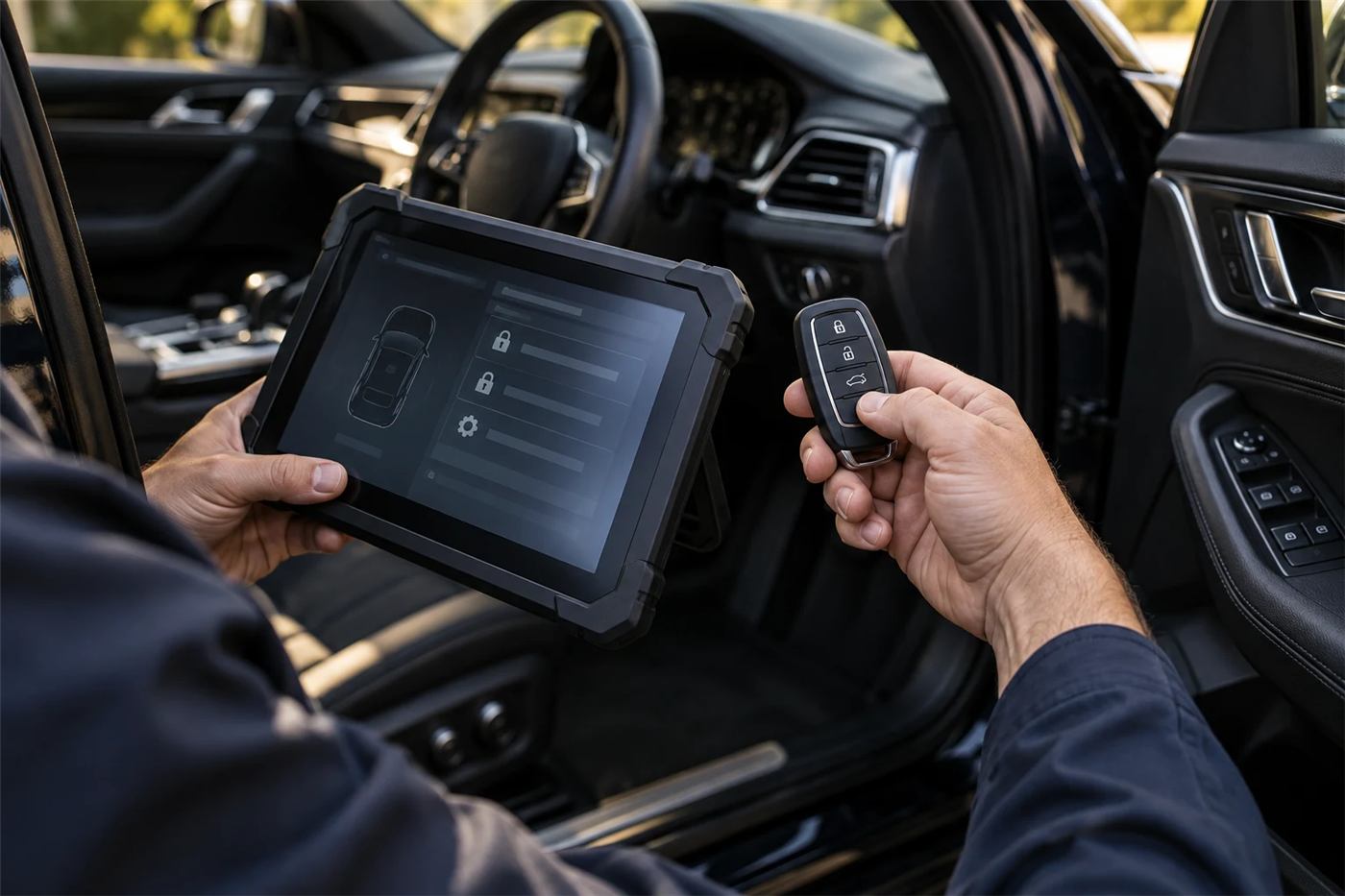
The best moment to make a spare is the moment you notice there is only one. A technician arriving at your home or workplace can cut a new key, program it to the car, and test it, all on site. The original stays in your hands and keeps working throughout. The whole job is generally a matter of working through steps in order, not a long repair.
Different key types lead to different jobs. A basic transponder key needs a cut blade and a programmed chip. A remote head key adds buttons for lock and unlock. A smart key or push-button fob needs a fob that the car's proximity system recognizes. Each of those is covered on its own page, including spare car key duplication and transponder key programming.
A word on what to avoid. A hardware store copy is a cut-only copy. It may open the door and turn in the ignition but it will not carry the chip the car needs, so the engine will not run. If you have already had that experience, our page on a copied key that opens the door but will not start the car explains why.
How the car keeps count of its keys
Most vehicles built in the last two decades store an internal list of the keys they accept. Each time a key is added, the list grows. Each time a key is removed from the list, that key stops working even if it was physically cut for the car. The list lives in the immobilizer or body control module, and the number of keys it can hold varies by make and model.
This matters for used car buyers. If the previous owner lost a key, the car may still recognize that lost key. Anyone who finds it and holds the matching blade could in principle use it. The cleaner fix is to have a technician add your new key and, where the car supports it, clear the older entries so that only keys in your possession are accepted. Some vehicles allow this in a straightforward way and some require specific equipment, and some do not allow it at all without dealer-level procedures.
A related point is that some cars limit the number of keys that can be programmed. If a car already has several keys registered, the technician may not be able to add another without removing one. Being told this by the technician is useful information about the car's history. It is also a reason to ask what the car knows before you decide how many keys to order.
What a technician checks on your visit
A good key appointment starts with identification, not with cutting. The technician will want to confirm who you are and that the car is yours. Expect them to look at the vehicle identification number, usually visible through the windshield or on the door jamb, and to compare it with the registration or title. This is normal and it protects owners. A locksmith who does not ask for any proof of ownership is a locksmith you may want to question.
Next the technician checks the existing key. They look at the blade for wear, the fob for battery weakness or cracks, and the way the key turns in the ignition or the door. They test each function. They also identify the key type, because two cars of the same make and year can use very different keys depending on trim level. Finally they connect the programming equipment to the car and read what it is willing to say about its key list.
Only after that do they cut, program and test. A reasonable visit ends with each key tested on the driver door, the trunk if applicable, the ignition, and the remote functions. You should see each test happen. If you want to understand what the job will involve before booking, our page on preparing for your key visit lists what to have ready.
How to prepare so the visit goes quickly
A little preparation saves real time. Gather the paperwork that shows the car is yours, such as the title or registration along with your photo identification. Make sure the name matches. If you just bought the car and the title transfer is still in progress, bring the bill of sale and any temporary paperwork you have. Technicians are generally able to proceed when the documents tell a consistent story.
Have the car where the technician can reach it. A driveway, a parking lot with room to open doors, or a covered garage all work. Programming usually requires the technician to sit in the driver seat for a time and to cycle the ignition, so the car should be unlocked or accessible and, ideally, not blocked in. If the existing key has a weak battery, mention it, since a failing battery can mimic a failing key.
Finally, decide in advance how many keys you want. Many owners choose two spares, one to keep at home and one to keep somewhere safe but separate. Others want a spare plus a plain valet-style option. Whatever you choose, ask about each part of the cost on the phone first. We give quotes by phone, and complicated jobs may need an on-site look. A service call charge is explained before anyone is dispatched. For a view of how that works, see how quotes work for key jobs.
- Find the title, registration or bill of sale.
- Have photo identification ready.
- Locate the vehicle identification number.
- Pick a spot where the technician can work comfortably.
- Hold on to the working key and keep it with you.
- Decide how many spares you want.
Dealership or mobile locksmith for the spare
Both are legitimate routes. A dealership can order keys by vehicle identification number and program them on its own equipment. The usual trade-offs are scheduling and transport. You generally have to bring the car to the dealer, and for some jobs the car must be left there. A mobile locksmith comes to the car, which matters if the car is hard to move or if you simply do not want to lose half a day.
Which option suits you depends on the vehicle. Some brands are well supported by independent equipment, and others have encrypted systems that favor the dealer. A mobile technician should tell you honestly when your car is one the dealer is better placed to handle. We would rather say so than start a job that cannot be completed. Our page on the differences between dealer and locksmith keys goes through the trade-offs in plain terms.
If you are weighing the two, ask each for what the visit includes, what happens if programming fails, and whether the key blade is cut on site. Those questions reveal more than a headline figure ever will.
Mistakes owners make with a single key
The first mistake is waiting. Owners often say they will handle it next month, and then the key fails in a parking lot. Keys do not announce when they are about to die. A cracked shell, a worn blade, a tired battery or a dropped fob can end a key's usefulness in a single moment.
The second mistake is making a copy from a poor original. A worn blade produces a worn copy. If your only key is already loose in the ignition or has been bent, tell the technician. They may cut the new key by the vehicle's key data instead of tracing the old blade, which gives a cleaner result.
The third mistake is keeping both keys on the same ring. A spare only protects you if it lives somewhere different from the original. Keeping both in the same bag or on the same hook means one loss takes both. The fourth is putting a spare in the car itself, such as in the glove box or under a seat. A thief who breaks in finds it and drives away. A spare belongs at home, with a trusted person, or in a secure place you control.
- Do not wait until the key is failing.
- Do not copy from a badly worn blade without telling the technician.
- Do not store both keys together.
- Do not hide a spare inside the vehicle.
- Do not assume a quick cut-only copy will start the engine.
Houston considerations for single-key owners
Houston is hard on keys. Summer heat bakes plastic shells and can make a battery in a fob fail sooner than expected. Humidity corrodes the contacts inside fobs and the wafers inside locks. Many drivers live with long commutes on the freeways, which means a car that will not start in the middle of the day has a real cost. Others park in garages or lots with lots of other people around, where a lost key can be picked up by anyone.
Storm season adds its own risk. A hurricane evacuation with one key is stressful, because a key left behind or lost in a flooded street takes the car with it. Our hurricane season key prep guide covers what to carry and what to leave. If you bought a used car that came from a flooded area, ask whether the key and the electronics were checked, since water damage can cause intermittent problems that look like key trouble.
The sensible Houston approach is to treat a spare as part of owning the car, not an optional extra. Whether you live in an apartment near the medical center, a house in the suburbs, or somewhere along the Gulf Freeway corridor, the logic is the same. One key is a single point of failure.
If the one key already failed
If you are reading this because your only key has stopped working, the situation is a bit different but not hopeless. First check the simple things. A weak fob battery can stop a remote from working while the physical blade still starts the car. A key that will not turn may be a sign of ignition wear, not the key itself. A dashboard security light that flashes is a clue that the chip is not being read.
If the key is lost or broken, do not keep trying it in the ignition, and do not force anything. Call us and describe what the car is doing. We can tell you whether the job is likely to be a simple replacement or an all keys lost situation, and whether the car can be handled on site. You can read more at our pages on car key replacement and what to do if you lose your only key.
Whatever the cause, bring the same documents and expect the same ownership checks. The sooner a replacement is organized, the sooner the car is usable again and the sooner you can have a proper spare. When you are ready, call and tell us the make, model and year, and what the key is doing.
Questions people ask
Is it worth making a spare if the car runs fine on one key?
Yes, because the one key is the only thing standing between you and a stranded car. A spare made from a working key is the simplest version of the job. Waiting until the key is lost or broken turns it into a longer visit that starts from nothing. Making the spare early is almost always the easier and calmer path.
Can a locksmith remove keys that the previous owner may still have?
On many vehicles the key list can be cleared and rebuilt so that only the keys you hold are accepted. Whether that is possible depends on the make, model and year. Some cars allow it with standard equipment, while others require dealer procedures. The technician can tell you what your car supports once they connect to it.
Will a hardware store copy start my used car?
Usually not. A cut-only copy can turn a lock but it lacks the transponder chip the car expects, so the engine will not run. It may be fine as a plain door-only key on some older vehicles, but for most cars from the last two decades a programmed key is required.
What proof do I need to get a key made?
Expect to show photo identification and something that ties you to the vehicle, such as the title, registration or a bill of sale. The technician will compare the vehicle identification number on the car with your paperwork. This protects you as an owner and is a sign of a responsible provider.
How many spare keys should I have made?
Many owners choose one or two spares. Keep one at home and the other somewhere separate and secure, such as with a trusted family member. Avoid keeping a spare inside the vehicle. Ask the technician whether your car limits the number of keys that can be programmed before you decide.
Do you give prices before coming out?
Quotes are given by phone only. Tell us the make, model, year and key type and we will explain what the job involves. Some complicated jobs need an on-site visit first. There is a service call charge, and it is explained on the phone before anyone is dispatched, so nothing about it is a surprise on arrival.
Describe the situation by phone and we will tell you what the job involves. Quotes are given by phone. Jobs that cannot be quoted without seeing them need a technician on site, and the service call charge is explained on the phone before anyone is dispatched.
(713) 574-7660Related pages
Written by Claude (AI) (AI) for Houston Car Key Locksmith.