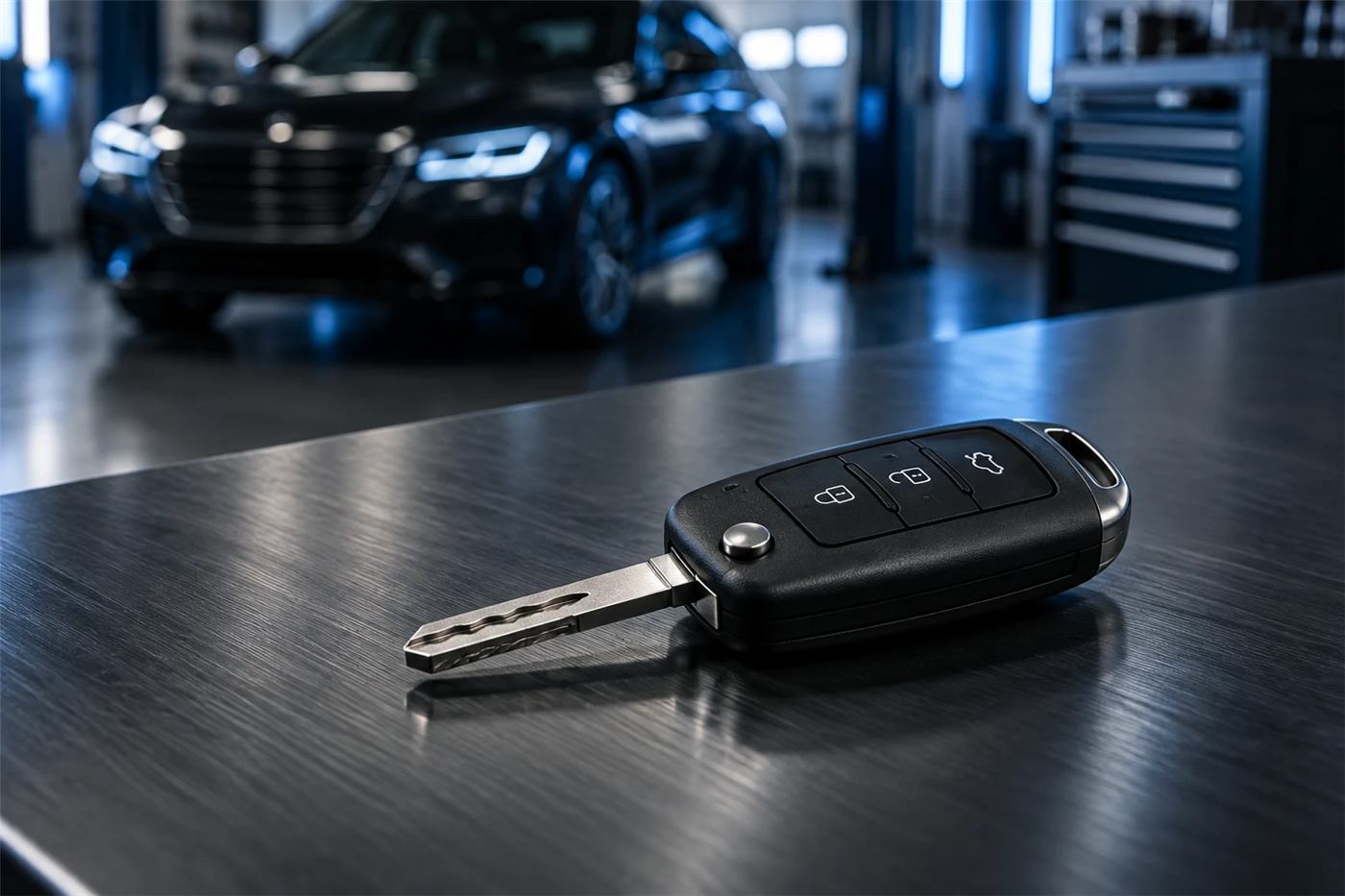
Why keys belong on your storm list
Most Houston households have a hurricane routine of some kind. Water, batteries, medications, documents, pet supplies, a full tank of fuel. Car keys usually ride along without anybody thinking about them, because they live in a pocket or a bowl by the door and they have always been there. The trouble is that a storm disrupts exactly the habits that keep keys where they belong. People pack in a hurry, shuffle bags between vehicles, hand a spare to a relative who is driving a second car, and leave a house in the dark with the power already out.
A modern key is also not just a piece of metal. Most vehicles built in the last two decades carry a transponder chip or a proximity fob that has to be recognized by the vehicle before the engine will run. That means a lost or water damaged key during an evacuation is not a simple duplicate job on a roadside, and it is not something that can be fixed at a gas station in a town you have never visited. Planning ahead turns a potential crisis into a non event.
This guide is written for Houston area drivers, from the Gulf Freeway corridor down to Galveston Bay, across Katy, Cypress, Kingwood and every neighborhood in between. It is general preparation advice. If a storm is bearing down on you and anyone is in danger, follow local emergency instructions and call 911 first. Keys can be dealt with after everyone is safe.
The evacuation key checklist
Start the checklist days before a storm is expected to arrive, while stores are open, roads are clear and you can still think calmly. The goal is simple: every vehicle you intend to move should have a working key you can find in the dark, and at least one backup should be somewhere different from the primary.
- Count every key and fob for every vehicle in the household, including the ones in drawers. Test each one by locking, unlocking and starting the vehicle, so you learn now rather than at a motel parking lot that a fob is weak.
- Replace weak fob batteries before the storm, not during it. A fob that works only when held against the dash is telling you it is close to failing.
- Decide who carries which key. If two cars leave together, each driver should hold the key for their own car and also carry a backup for the other, so a single dropped bag does not strand anyone.
- Put keys in a sealed waterproof pouch or small dry bag, and clip it inside a larger bag you will not leave in a vehicle trunk that may flood.
- Photograph the registration, insurance card and the vehicle identification number on the dash or door jamb, and store the pictures where you can reach them without a signal.
- Take a mechanical emergency blade out of any smart fob and check that it is present, so you know how to open a door if the fob battery dies on the road.
- Write the phone number of a mobile locksmith, your insurer and your roadside plan on paper, in case your phone battery is gone.
- Leave one spare key with a trusted person outside the storm zone if you can, so a replacement does not depend on getting back into your own home first.
Where to keep the spare, and where not to
A spare key is only useful if it survives whatever took the original. During hurricane season that means thinking about water, wind and distance. A spare stored inside the vehicle defeats the purpose in a flood, because the vehicle is the thing at risk. A spare hidden in a magnetic box under a bumper will be soaked, rusted or ripped off by moving water. A spare in a garage drawer on the ground floor of a flood prone property may be under several inches of water before anyone can get to it.
Better options keep the spare elevated and sealed. A waterproof container on an upper shelf, an interior closet on a higher floor, or a sealed bag in the bag you carry out with you all work. For households that evacuate by driving inland, carrying the spare on your person, separate from the primary key, is the simplest approach. If the primary key falls into a puddle, a storm drain or a flooded parking lot, the spare is still dry in a different pocket.
Smart fobs deserve extra care. These contain a circuit board, a small battery and sometimes a sealed antenna, and repeated soaking can corrode contacts and leave the fob working only some of the time. If you are relying on a fob for the evacuation drive, make sure the backup is either a second fob stored dry, or a physical key blade that does not depend on electronics for opening the door.
One more point for households with a spare that has never been tested. Do the test before the season starts. A spare that has never actually started the engine is a guess, and a guess is a poor thing to rely on when roads are crowded and you are far from home. If it does not work, it can usually be programmed or replaced, which is a far calmer appointment in August than during a storm warning.
Waterproof storage that actually works
Storage products vary widely in quality. A zipper sandwich bag will not hold up if it is dropped in standing water or squashed under other gear. A rigid small case with a gasket seal does better, and a roll top dry bag, the kind used by kayakers, is a sound low cost choice. Whatever you use, test it at home by closing it with a paper towel inside and leaving it in a sink of water for a few minutes. If the towel is dry, the seal is doing its job.
Label the container and make sure everyone in the household knows where it is. A key pouch tucked in an obscure pocket is no help if the person who packed it has gone ahead in another vehicle. Many families keep a small evacuation kit that stays packed through the season and holds copies of documents, cash, chargers, a basic first aid kit and the key pouch. Everyone knows the kit exists and who is carrying it.
Think about metal too. Keys sealed in damp air can still corrode, especially near the Gulf where salt in the air is part of daily life. Dropping in a small desiccant packet, the kind that comes in shoe boxes, helps keep moisture down. Do not use anything that leaves oils or residue on a fob, and do not store a fob with a magnet or a heavy ring of other keys that can scratch its case.
Finally, remember that the dry bag protects against water, not against forgetting. The most common key emergency in an evacuation is not a flooded fob, it is a key left on a kitchen counter in a house everyone has already locked and left. Put the key pouch on the evacuation checklist as a line item, and check it off the same way you check the medications.
Flood prone parking and where you leave the vehicle
If you are not taking a particular vehicle with you, where you leave it matters. Houston has a long history of street and parking flooding, and anyone who has lived here a few years knows which underpasses, low lots and street segments take water first. Moving a vehicle to higher ground, such as an upper level of a parking structure, is a common approach, though you should follow the rules of the property and any guidance from local officials.
Before leaving a vehicle behind, lock it and take every key with you. This sounds obvious, but in a rush it is easy to leave a spare in a console or a fob in a cup holder. A vehicle left with keys inside invites theft once a neighborhood has been evacuated, and a key left in a flooded vehicle will be damaged along with it. Check the glove box, the center console and the visor, because those are the places spares tend to hide.
Take photographs of the vehicle from all sides, including the odometer, before you leave it. If it is later damaged, those photos help with insurance documentation. Disconnecting a battery is something some owners do, but it is not necessary for everyone and can erase settings or complicate certain security systems, so ask your dealer or a qualified technician before making that a habit.
If a flood warning covers your area and the vehicle cannot be moved, do not try to drive through moving water to rescue it. A vehicle is replaceable, and so is a key. Your safety is not. Emergency services consistently ask people to avoid driving into flooded roads, and the advice applies to fetching a vehicle as much as to evacuating.
Key access after the storm
Once the weather has passed and you are cleared to return, the first thing many owners want is to get a vehicle running. Slow down for a moment. If a vehicle has taken on water, particularly above the door sills, do not attempt to start it. Water in the cabin can damage control modules, wiring and the electronics that talk to your key. Starting a wet system can turn a repairable problem into an expensive one. You can read more about this in our guide to flood damaged vehicles and their keys.
If the vehicle stayed dry but the power is out, a fob that normally works with a button press may not respond because of weak batteries, interference or a depleted vehicle battery. Use the physical emergency blade in the fob to open the driver door. If you are not sure where the blade is, our guide to the emergency key blade explains how most fobs release it. A dead vehicle battery can also stop a push button start from working, and in many cars there is a specific spot on the steering column or console where you hold the fob to start the engine anyway.
If a key has gone missing or been damaged during the storm, document what happened and keep any proof of ownership you have, such as the title, registration or insurance paperwork. A qualified technician will ask for proof that the vehicle is yours before making a key, and having these on hand makes the visit smoother. We explain that process in proof of ownership for keys.
After a major storm, demand for tow trucks, repair shops and dealers can be intense, and locksmith work competes with a long list of other recovery needs. A mobile visit at your location can save a vehicle from needing a tow, since the key work happens where the vehicle sits. Whether that is available on a given day depends on road conditions and demand, and nobody can honestly promise a time during a regional emergency.
What insurance and documents to keep handy
Key replacement after a storm sometimes overlaps with insurance. Whether a policy covers lost or damaged keys depends on the specific coverage and the reason for the loss, so there is no general answer. What is useful is having your policy information, the claim line number and the vehicle details available before a storm, rather than hunting for them afterward. Our overview of insurance and lost car keys explains the kinds of questions to ask your carrier without promising any particular result.
Keep copies of the title or registration, the insurance card and a photo ID in the same sealed bag as your keys. If the vehicle is financed, keep the lender contact number too. The vehicle identification number is worth writing down separately, since it appears on the dash, the door jamb, the registration and the insurance card, and it is what a technician uses to look up the right key information.
Digital copies are a good second layer, but do not rely on them alone. Phone batteries run down, and cell service often drops in the days after a storm. A paper copy in a waterproof pouch works regardless of signal. If you use a cloud folder, test that you can open it offline.
Different households, different risks
Not every household faces the same risks. A family with a teenage driver has an extra key to track and an extra person who may be driving separately. A couple who share one vehicle may have only one key between them. An older adult who is evacuating with help may be leaving a vehicle in a garage and handing the key to someone who will check on it. Each of these situations calls for a small adjustment to the plan.
For multi vehicle households, write a short list of which key belongs to which vehicle and who holds it, and keep it in the evacuation kit. After a stressful drive, it is easy to forget which pouch holds which fob. For families with a work truck or van that the business depends on, keep a second key stored away from the vehicle and from the main set, so a single event does not take everything.
For people who rent or lease a vehicle, check the rental or lease agreement. Some come with roadside plans that include lockout or key assistance, and some require you to contact the company before arranging a replacement. If you drive a rideshare or delivery vehicle, plan what happens to income if a key is lost, since time without the vehicle is the real cost.
Boat and trailer owners often have separate keys for towing equipment, hitches and storage units. Add those to the checklist so they are not left behind. A trailer you cannot unlock at an evacuation destination is another version of the same problem.
What a technician will check if you do have a key problem
If you return from an evacuation with a key that has stopped working, a technician will usually begin with the simplest causes. Is the fob battery weak or corroded? Is the key blade bent or worn? Does the vehicle battery have enough charge to power the immobilizer? These checks often explain what feels like a bigger fault. Humidity and heat can both aggravate small weaknesses, and our guide on humidity and key care describes the habits that help.
If those checks pass, the next step is determining whether the vehicle still recognizes the key. A technician uses diagnostic equipment connected through the vehicle diagnostic port to read what the immobilizer sees. If the system has lost its learned keys, it may need to be re taught. If the key itself has failed, a new one is cut or programmed, and the old one may be removed from memory if it is lost.
A technician also asks for proof of ownership and some form of ID, which protects you as much as anyone. If a company will program a key for any caller without checking, that is a warning sign. Our guide on choosing a mobile locksmith in Houston lists what to look for when you are verifying a provider.
Quotes for key work are given by phone after the details of the vehicle and situation are known. A service call charge applies for the visit, and it is explained on the phone before anyone is dispatched. Complicated jobs may need an on site look first. There is no way to responsibly give a number before knowing the make, model, year and what keys exist, and no honest provider will pretend otherwise.
A simple seasonal routine
Rather than scrambling when a storm appears on the forecast, build key checks into your regular preparation at the start of the season. Early in the summer, test every key and fob, swap batteries where needed, locate every spare and confirm that each one starts the engine. Order a replacement if one is missing. Buy and test a waterproof pouch. Add the key kit to your general evacuation supplies.
Mid season, when a system forms in the Gulf and the forecast begins to concern you, move the key pouch to the top of your list. Confirm that the people who will be driving know where the keys are. Fill the tank, take photographs of vehicles, and finalize where each vehicle will go. Decide ahead of time who has the authority to make decisions about a stranded vehicle if you are separated.
After the season, review what worked. Did the pouch hold up? Was a spare missing? Was a fob weak? Treat any failure as a reason to fix the underlying gap while things are calm. A spare key made in October, with nothing happening on the radar, costs far less stress than a replacement during an emergency, even though a quote always comes by phone for the specific job.
If you would like help testing your keys, adding a spare or checking that a fob is healthy before the season peaks, call and describe the vehicle. We can talk through what is involved and what to have ready, and you can decide whether a visit makes sense. If you are reading this in the middle of an emergency and anyone is at risk, call 911 first and come back to the keys afterward. When it is safe and you need a hand, call and we will talk it through.
Questions people ask
Should I leave a spare key inside my car during a hurricane?
No. A key stored in the vehicle is exposed to the same flooding and theft risk as the vehicle itself, and it hands anyone who gets inside a way to drive off. Keep spares in a sealed waterproof pouch on your person or in a higher, dry spot at home, and keep them separate from the primary key.
Can I start a vehicle that has been in flood water?
It is best not to. Water in the cabin can damage control modules, wiring and the electronics that recognize your key, and trying to start it can cause more harm. Have the vehicle inspected by a qualified shop first, and ask about the key and immobilizer system as part of that inspection.
What if my fob stops working during an evacuation?
Check the fob battery first, then use the physical emergency blade to open the door. Many cars have a spot on the steering column or console where you can hold the fob to start the engine even when the battery is weak. If none of that works, call a mobile locksmith and explain the vehicle and location.
Does insurance cover a key lost in a storm?
It depends on the policy and the cause of the loss, so there is no one answer. Comprehensive coverage sometimes applies, but terms vary. Ask your carrier directly, keep your policy number handy and document what happened with dates and photos. We cannot tell you what your policy covers.
How many spare keys should a household keep during storm season?
At least one tested spare for every vehicle, stored somewhere different from the primary key. Households that evacuate in more than one vehicle benefit from carrying a backup for each car. A spare that has never been tested is only a guess, so confirm that it starts the engine before the season begins.
Can a locksmith come to my vehicle after a storm?
Mobile service is possible when roads are passable and the vehicle can be reached, but demand and conditions after a regional emergency are unpredictable, so no honest provider can promise a time. Call, describe where the vehicle is and what happened, and the situation will be explained plainly before anything is scheduled.
Describe the situation by phone and we will tell you what the job involves. Quotes are given by phone. Jobs that cannot be quoted without seeing them need a technician on site, and the service call charge is explained on the phone before anyone is dispatched.
(713) 574-7660Related pages
Written by Claude (AI) (AI) for Houston Car Key Locksmith.