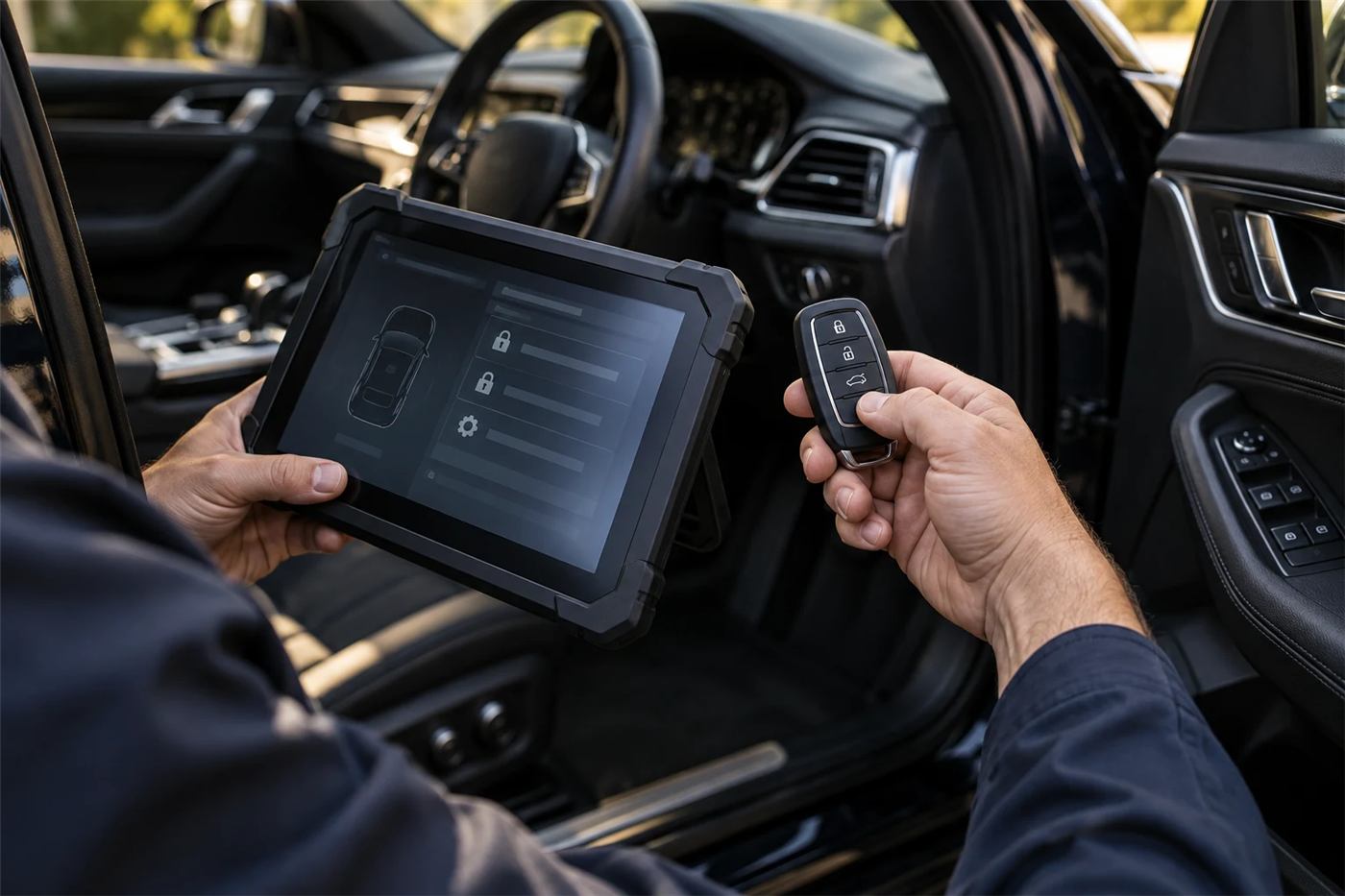
Two paths to the same result
Whichever route you choose, the end goal is identical: a key that opens the door, starts the engine, and is recognized by the vehicle's security system. The difference lies in how you get there, where the work takes place, how long you wait, and what you have to arrange along the way.
A dealership service department works from a fixed building with a parts counter, an appointment calendar, and factory diagnostic equipment for the brands it sells. A mobile locksmith works from a van, travels to your car, and carries cutting and programming equipment that covers many makes. Neither is automatically better. The right choice depends on the car, the key type, the situation you are in, and how much of your day you can give up.
This guide walks through the practical steps of each option so you can decide with clear eyes. It does not mention prices on purpose. Costs depend on the vehicle, the key type and the circumstances, and any trustworthy provider will explain theirs before work begins. On this site, quotes are given by phone only.
How the dealership process usually works
At a dealer, you normally start by calling the service department or the parts desk. They will ask for your vehicle identification number and some proof that you own the car. For many newer models they order the key blank or smart key from the manufacturer, which can mean waiting for a shipment. Once the part arrives, you schedule an appointment for cutting and programming.
If you still have a working key, the visit can be simple: you drive in, hand over the key and paperwork, and wait or leave the car. If you have lost every key, the situation is harder. The car cannot be driven to the dealership, so it has to be moved some other way. That is where towing enters the picture.
Dealers can be a very good choice when the car is under a manufacturer program, when a recall or software update is also needed, or when the vehicle is a model that only the factory tools can program. They also keep records tied to the brand, which some owners find reassuring.
- Call and give the VIN plus proof of ownership
- Wait for the key or fob to be ordered if it is not in stock
- Book a programming appointment during business hours
- Arrange transport for the car if no key works
- Pick up the vehicle and test every function
How a mobile locksmith visit works
With a mobile locksmith, the first step is also a phone call. You describe the car, the year, the make and model, and what has happened to the key. The call taker asks whether any key still works, whether the car has a push button start, and where the car is parked. From those facts you get a quote by phone, and a technician is dispatched to your location.
On arrival, the technician confirms who you are and that the vehicle is yours, checks the car, and then cuts and programs the new key on site. Everything happens beside the car, in a driveway, an apartment lot, a parking garage or a roadside shoulder where it is safe to work. When the work is done you test the key in the lock, the ignition and the remote buttons before the technician leaves.
The model suits people who cannot easily leave work, who have no way to move a car, or who are stranded away from home. Learn more about the service itself on the car key replacement page, or read how we compare to the factory route on dealership alternative key service.
Towing and transport: the hidden step
Towing is the factor most people forget until they are standing next to a locked, silent car. If every key is gone, the vehicle usually cannot be started, and many cars cannot be put into neutral without power. Moving it to a dealership then means a tow truck or flatbed, a driver who can reach you, and a drop-off arrangement at the service entrance.
That extra step costs time and adds another company to the chain. It also adds some risk: a car being loaded onto a flatbed in a crowded Houston parking lot is a car that can be scratched or bumped. Some drivers have roadside assistance through insurance or a membership that covers a tow, and that can make the dealer route much easier. Check your policy before you decide.
A mobile locksmith removes the tow from the plan in most cases because the work is done where the car sits. There are exceptions, which are covered later. If a vehicle is stuck in a place where a technician cannot safely work, such as a flooded lot or a tight underground level, moving it first may still be necessary.
Appointments, hours and waiting time
Dealership service departments run on posted hours, and keys can be a lower priority than warranty repair or routine maintenance. If a key must be ordered, the wait for the part comes before the wait for the appointment. Some owners find the process predictable and well organized. Others find it slow when they need a car that day.
A mobile locksmith works around your schedule more than a building does. Many people call from work, from a grocery store lot or from home in the evening. Because technicians travel, arrival time depends on traffic, distance and how many calls are already scheduled. No honest provider can promise an exact arrival window across a metro area as large as Houston, so beware of anyone who does. Ask the dispatcher for a realistic estimate when you call, and treat it as an estimate.
If you have a tight deadline, such as a flight, a job shift or a child to collect, tell the person on the phone at the start. It helps them judge what can realistically be done and in what order.
When the dealer is the better choice
It would be dishonest to say a locksmith is right for every vehicle. There are times when the dealership is the better answer, and a good locksmith will tell you so. Some very new models, or certain brands with tightly controlled security systems, require factory access or manufacturer credentials that independent shops cannot always reach.
Other cases that lean toward the dealer include a car still under a bumper to bumper plan that covers key replacement, a vehicle with other electronic faults that also need factory diagnosis, and a fleet or lease situation where the contract requires factory service. If your car is a very recent release, a quick call to ask whether independent programming is possible is a smart first move.
Be wary of any provider who claims they can do everything for every car. Straight answers sound like this: yes we can do that model, no we cannot, or we need to confirm the details first. A technician who says maybe and explains why is usually more trustworthy than one who says yes to everything.
- Very new model years with locked down security
- Cars covered by a plan that includes key replacement
- Vehicles that also need factory software updates
- Lease or fleet contracts that require dealer service
- Situations where your insurer names a preferred shop
When a mobile locksmith is the better choice
A mobile locksmith tends to win when the car is stuck where it is, when time matters, or when you have lost every key. Picture a commuter in a Woodlands parking garage at the end of a shift, a parent in a Katy school lot, or a student at a Montrose apartment complex whose only key fell down a drain. In each case the car cannot move, and a technician who comes to the vehicle solves the problem on the spot.
Locksmiths also tend to handle the common key types that most Houston drivers carry, such as transponder keys, remote head keys, flip keys and many smart keys. If you need a spare while your existing key still works, an appointment can often be set around your day. See all keys lost service and key fob programming for how those jobs run.
Another reason owners choose a locksmith is simplicity. One company, one phone call, one visit, and the key is cut and programmed together instead of in separate stages.
What both options will ask from you
Neither route works without proof that the car is yours. This is a safety measure, not an inconvenience, and it protects you. Expect to show a government photo ID and a document tying you to the vehicle, such as a registration, a title or a current insurance card. Read the guide on proof of ownership for keys to see what is accepted and why.
You will also be asked for the vehicle identification number, usually found on the lower corner of the windshield on the driver side, on the driver door jamb sticker, and on your registration. A clear photo of it saves time on the call. The VIN guide explains how the number is used to look up key data.
If a provider does not ask for any proof at all, that is a warning sign. A company willing to program a key for anyone who calls is a company that could help a thief. Good technicians ask questions precisely so they can help the right person.
Questions to put to each provider
Before you book with either choice, put the same short list of questions to both and compare the answers side by side. Ask what information they need to give a quote, whether the quote is for the whole job, what happens if the key they bring does not match your car, and what you must have ready when they arrive or when you drop the car off.
Ask about the service call charge and whether it is explained before anyone is sent. On this site that charge is covered on the phone before dispatch, and the full figure comes from the quote conversation, never from a web page. Ask also whether the new key will be tested in front of you, and whether the old lost key can be removed from the car's memory if that is possible for your model.
The guide on questions to ask before booking has a longer checklist, and how quotes work explains why the answers differ from one job to another.
Putting it together and making the call
If you still hold a working key, can spare time during weekday hours, and drive a brand that restricts independent access, the dealer may be the natural pick. If your car is stranded, every key is missing, or you simply cannot take a day away from work, a mobile locksmith is often the more practical road. Both are legitimate. What matters is that you choose with real information instead of urgency.
A useful trick is to make two calls before you commit. Describe your situation to the dealership parts desk, then describe it to a mobile locksmith. Compare how clearly each explains the steps, the documents they need and the unknowns. The provider who answers plainly, asks sensible questions and does not pressure you is the one to trust.
If you decide a mobile visit fits your situation, call and tell us the year, make and model, and what has happened to your key. We will explain the process, give you a quote by phone, and tell you honestly if your car is one that should go to the factory instead.
Questions people ask
Is a locksmith key as good as a dealer key?
For most common vehicles, a properly cut and programmed key from a qualified mobile locksmith performs the same as a dealer key. It opens the door, starts the car and talks to the immobilizer the same way. For a few very new or tightly restricted models the factory may be the only route, and a good technician will say so honestly before starting any work.
Will using a locksmith affect my vehicle warranty?
Adding a key generally does not change a warranty on its own, but terms differ between manufacturers and plans. If your car is under a plan that covers key replacement, call the plan administrator first to learn what they require. When in doubt, read your warranty booklet or ask the service department a direct question before you book.
Do I have to tow my car to a dealer if I lost all keys?
Usually yes, because the car cannot be started or easily moved without a key. Some owners have towing through insurance or a roadside plan. A mobile locksmith can often do the work where the car sits, which avoids the tow, though a vehicle in an unsafe or inaccessible spot may need to be moved first.
Why do you not list prices on the website?
Key work varies by vehicle, key type, whether any key still works, and where the car is located. A fair figure can only come after those facts are known. We give quotes by phone, explain the service call charge before anyone is dispatched, and arrange an on-site visit for anything more complicated.
What if my car is too new for a locksmith to program?
It happens with some recent releases. Call and describe the car. If independent programming is not possible for that model, we will tell you plainly and suggest the dealership instead. Giving you the correct answer is more useful than starting a job that cannot be completed on site.
What should I have ready before calling either option?
Have the year, make and model, the VIN, a photo ID, and a document that ties you to the car such as registration or title. Know the exact location of the vehicle and whether any key still works. With those facts you can get clear answers quickly from either a dealer or a mobile locksmith.
Describe the situation by phone and we will tell you what the job involves. Quotes are given by phone. Jobs that cannot be quoted without seeing them need a technician on site, and the service call charge is explained on the phone before anyone is dispatched.
(713) 574-7660Related pages
Written by Claude (AI) (AI) for Houston Car Key Locksmith.