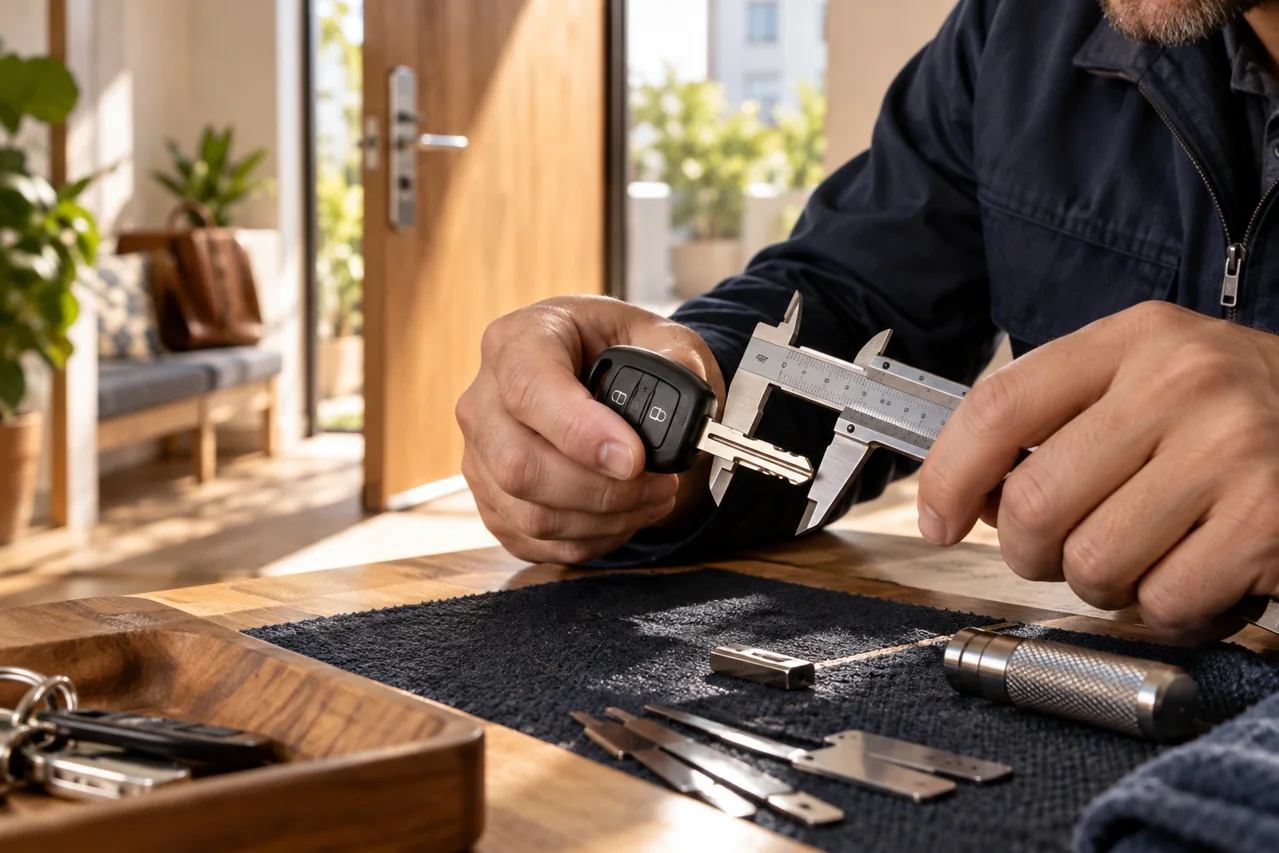
What a laser cut key looks like and why it exists
A traditional car key has a row of notches along one or both edges. The notches lift pins in the lock to the right height. A laser cut key, also sold under names such as sidewinder, internal cut, or high security key, works differently. Its pattern is a wavy track milled into the flat face of the blade, and the blade is usually thicker than an older key.
The reason for the design is security and durability. A track milled into the middle of the blade is harder to read by eye and harder to copy on a simple machine. Because the cuts are made in the face and the edges are smooth, the key also wears more slowly, and the lock inside is built to a tighter tolerance.
Despite the name, most laser cut keys are not cut by a laser. They are cut by a milling cutter on a machine built for the job. The name comes from the appearance of the cut, which looks as if it had been traced with a fine beam. Manufacturers across the industry use these keys, and they are common on vehicles from Asian, European, and American makers, usually on models from the early 2000s forward.
Why they need a different machine
The cutting machine at a hardware store handles edge-cut keys. It clamps the blade, traces the original with a guide, and cuts the copy on a wheel that moves along the edge. It cannot reach into the face of a laser cut key and follow a milled track.
A laser cut key requires a machine with a cutter, a clamp that holds the blade at the right angle, and a way to set the depth of every position along the track. Some machines read the original key and cut a copy. Others cut from a code, which is the only choice when every key is lost. The machine and its calibration matter, because a tiny error in depth can leave a key that goes in but does not turn.
A mobile locksmith who services these keys carries a portable machine suited for them. That is one reason laser cut work takes more time than a simple copy. The technician has to select the right blank, set the machine for that key's pattern, cut carefully, and test the result in the lock. A blank that is slightly wrong or a machine that is not properly set can ruin a blank and leave you with nothing to show for it.
Laser cut versus edge cut keys
The table below sets out the differences that matter to a car owner. It is general, and specific vehicles may vary.
| Feature | Edge cut key | Laser cut key |
|---|---|---|
| Where the cuts are | Notches along the edges | Wavy track milled in the face of the blade |
| Blade thickness | Thinner, flat | Thicker, often with a visible channel |
| Machine needed | Standard duplicator | Specialized milling machine |
| Time to cut | Short | Longer, with more setup and checking |
| Wear | Edges can round off with use | Slower wear because the face is protected |
| Typical programming | Chip may or may not be present | Chip is common, so programming usually follows |
Copying a laser cut key you still have
If you have one working laser cut key, a duplicate is the simplest and most sensible job. The machine can trace the original, or a technician can determine the pattern from it and cut a new blank. After cutting, the new key is tested in the door and the ignition and, if it has a chip, programmed to the vehicle.
A few cautions apply. A worn original can produce a worn copy. If the key you hand over has been used for years and its track is rounded, a copy cut from it may not turn as smoothly as a key made to the vehicle's factory pattern. In that case a technician may suggest cutting from the code or decoding the lock instead.
Another caution is the key's own condition. A key that is bent, cracked, or has a loose head is a poor model to copy. Bring it in the state it is in, and let the technician decide what to do. For more on copying and spares, our page on spare car key duplication goes through why a spare is worth making early.
When every key is lost
With no original, a laser cut key must be made from a code or from the lock. Our page on key cutting by code and VIN explains how that works. A technician with proper authorization may be able to obtain the cut pattern from the vehicle's VIN, then cut a key on a suitable machine.
If the code route is not available, the lock can be decoded, meaning the technician reads the lock and cuts a key to match. Decoding a laser cut lock is more demanding than decoding an edge-cut lock, and it depends on the lock being in decent condition. Some locks are simply not practical to decode on site, and a replacement cylinder may be the path.
Once a key is cut, it still needs programming if the vehicle has a transponder chip. That is done with diagnostic tools connected to the car. For the full process, see our page on all keys lost car key service. A technician will tell you at the start which steps your car needs.
Why the cutting often takes longer
Owners are sometimes surprised that a laser cut key takes more time than they expect. The reasons are practical. The machine has to be set up for the blank. The blank has to be matched to the key's keyway. The cutter has to follow a precise track, and the technician checks the depth of each position, not just the overall look.
After cutting, the key is tested in the door, the ignition, and sometimes the trunk or glove box, since some vehicles use the same key for each. A smooth turn in each is the target. A key that goes in but needs to be wiggled is rejected and recut.
This care is the difference between a key that works for years and a key that wears the lock. A poorly cut laser key can chew up a cylinder, and a damaged cylinder is a much bigger job than a key. Quotes reflect the work, but they are given by phone only, and we do not post figures on this site. The time involved is one reason a phone conversation about your specific vehicle comes first.
What goes wrong with a poorly cut laser key
Because the track in a laser cut key is shallow and precise, small errors have large effects. A cut that is a fraction too deep or too shallow in a single position means a pin or wafer in the lock does not align, and the key will not turn, or turns only with force.
The signs of a bad cut are familiar once you know them. The key goes in smoothly but sticks halfway through the turn. It works in the door but not the ignition, or the other way around. It works on a cool morning and binds when the lock heats up. A key that must be jiggled is a key that is slightly out of tolerance.
Forcing such a key does damage. Wafers in the lock can bend or break, and the key itself can twist or shear off inside. What began as a simple copy can end as a replacement cylinder and an extraction call. The sensible response to a stiff new key is to stop using it and have it checked or recut right away.
A technician who cuts keys professionally will test every cut in the vehicle's own locks before handing the key over, and will recut if anything feels off. If you are working with someone else and the key feels rough on its first use, say so before the visit ends, not after. A good technician would rather fix a cut on the spot than hear about it a week later.
Blanks, quality and why the source of the key matters
A key starts as a blank, a piece of metal with the right shape and keyway but no cuts. Blanks vary in quality. Some are made by the vehicle's own manufacturer, some by respected aftermarket makers, and some by low-volume sources whose metal and tolerances are poor. A soft blank can wear quickly, and a blank with a slightly different shape can bind in the keyway.
For laser cut keys the choice of blank matters even more, because the fit in the lock is tight. A technician selects a blank that matches the keyway of your vehicle, and checks it before cutting. If a blank looks wrong, it is set aside.
This is one reason buying a bare key online and asking someone to cut it can be a gamble. The blank may be the wrong profile, or too soft, or locked to a different chip system. If you have a key you bought yourself, tell the technician before the visit and send a photo so the fit can be judged. If the blank cannot be used, you will be told, and a suitable one will be found.
The right blank, cut on the right machine, and tested in the lock, is what a good laser cut key comes down to. The rest of the work follows from those three things.
Programming after cutting
Most laser cut keys carry a transponder chip, which means a cut blade alone will not start the car. After cutting, a technician connects a diagnostic tool to the vehicle's port and authorizes the new key. For some makes the car needs a security code obtained through a separate authorized channel before it will accept a new key.
The process is not the same on every vehicle. Some accept a new key after a short series of steps with the old key in place. Others require the tool to talk to the immobilizer module and register a key from scratch. Push button systems have their own approach. In every case the technician tests that the car starts, that the remote functions work, and that any existing keys still operate.
If your key is a fob with a hidden laser cut emergency blade, the cutting and programming are two separate jobs that may be done in sequence. Our pages on transponder key programming and smart key replacement describe those steps. When you call, ask which of them your vehicle needs.
Vehicles that commonly use laser cut keys
Many makes have adopted this style. You will find laser cut keys on a long list of Japanese, Korean, European, and American vehicles, and the date at which a particular model switched from edge cut to laser cut varies. Some models offer both across different years or trim levels, and some use a laser cut emergency blade hidden inside a smart key.
If you are not sure which type you have, look at the blade. A key with edge notches and a flat face is an edge cut key. A key with a wavy channel milled along the face, or a thick blade with a visible track, is laser cut. A key with a thin blade tucked into a fob may be either.
Our make pages carry notes on specific brands, including Honda, Toyota, and Hyundai, which all use laser cut keys on various models. If you give the year, make, and model on the phone, the technician can tell you what your key is likely to be.
Caring for a laser cut key
A few habits extend the life of one. Do not use the key as a tool: prying a package open, scraping paint, or turning a stiff lock with pliers can bend the blade or damage the track. A bent key is harder to read and wears the ignition faster.
Keep keys clean. Grit in a pocket or on a ring can work its way into the milled track and into the lock. A quick wipe now and then is enough. Avoid spraying heavy oil into locks, since oil attracts dirt, and use a dry graphite or lock-specific lubricant if a lock needs it.
Avoid heavy key rings. A weight of keys hanging from the ignition wears the cylinder and the key. If you carry many keys, take the car key off before you drive, or use a lighter ring. If the key has started to stick or turn hard, replace it before it breaks. Our page on broken key extraction explains what happens when a key snaps in a lock.
Calling about a laser cut key
Have the year, make, and model ready, and a photo of the key if you have one. Say whether you have a working key to copy or none at all, whether the key has a chip or a remote, and where the vehicle is parked. Have your ID and proof of ownership available, since the technician will check both.
Quotes are given only by phone. We do not publish prices on this site and do not give ranges without knowing the vehicle. If the job is complicated, an on-site visit may be needed first, and a service call charge applies, explained before anyone is dispatched. We do not promise arrival windows.
Service is mobile across the Houston area, so the machine comes to the car. Call, tell us what you have and what happened, and we will explain what the technician will do.
Questions people ask
How do I know if my car key is laser cut?
Look at the blade. A key with a wavy channel milled into its flat face, or a thick blade with a visible track down the middle, is laser cut. A key with notches along its edges is edge cut. A thin blade in a fob can be either type. A technician can confirm from the year, make, and model.
Can a hardware store copy a laser cut key?
Usually not well. These keys need a specialized machine that can follow the track in the face of the blade. A standard duplicator cuts edges only. A poorly cut copy can fit badly and wear the lock, so it is better to have the key cut on the right machine by someone who tests it.
Why does a laser cut key take longer to make?
The machine has to be set up for the blank, the cutter follows a precise track, and each depth is checked. The finished key is tested in the door and ignition. Skipping these steps risks a key that wears the lock. The time spent is what makes the key work smoothly.
Can you make one if I have lost all my keys?
Often yes. A key can be cut from a code looked up by VIN, or from the lock by decoding it. If the vehicle has a chip, programming follows. A technician will explain which steps apply to your car. Some locks are not practical to decode, and replacement may be needed.
Does a laser cut key always have a chip?
Not always, but it often does on vehicles from the early 2000s forward. If a chip is present, the key must be programmed to the car before the engine will start. The technician can tell you from the year, make, and model whether your vehicle needs it.
Can a worn laser cut key be copied?
It can, but a copy of a worn key may be worn too. If the track is rounded, a technician may suggest cutting from the code or decoding the lock for a cleaner result. Bring the key as it is and let the technician decide the best way to cut the new one.
Describe the situation by phone and we will tell you what the job involves. Quotes are given by phone. Jobs that cannot be quoted without seeing them need a technician on site, and the service call charge is explained on the phone before anyone is dispatched.
(713) 574-7660Related pages
Written by Claude (AI) (AI) for Houston Car Key Locksmith.