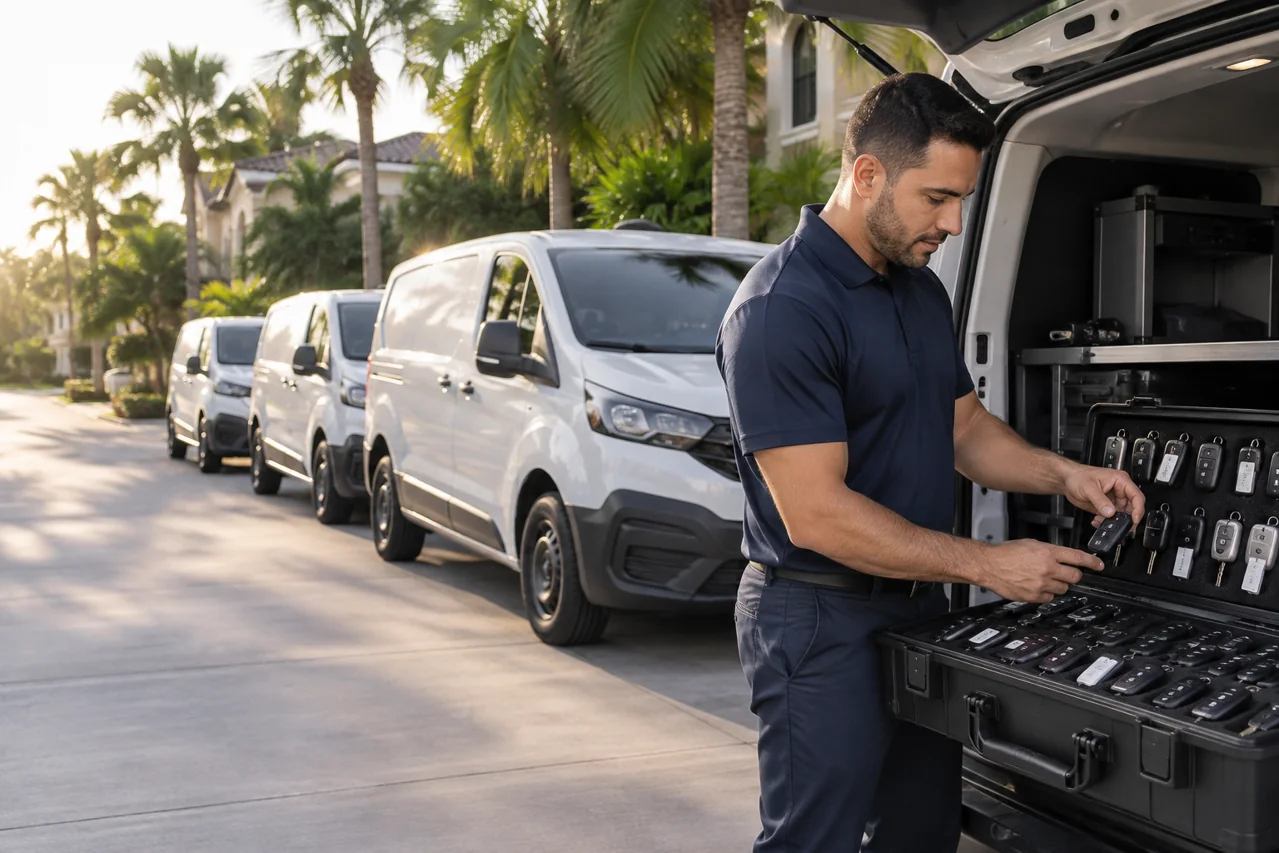
What is happening when a copy turns but the engine will not run
A modern car key has two jobs. The first is mechanical: the cut blade lifts the pins or wafers inside the lock and ignition so the cylinder can turn. The second is electronic: a small transponder chip inside the plastic head answers a signal from the car. If the car does not hear the right answer, the engine control computer will not allow fuel or spark, no matter how perfectly the blade turns.
A copy made at a hardware store or a kiosk is typically only the first job. The machine traces the blade and cuts a matching one. It does not produce a chip, and even if the head contains a blank chip, that chip has never been taught the car's identity. So the door opens, the ignition turns, the dashboard may light up, and then the car does nothing, or it cranks and stalls, or it starts for a second and cuts out.
This is not a sign that the blade is bad. In most cases the cut is fine. The missing piece is programming. That is a different process from cutting and it needs equipment that talks to the car. Our page on transponder key programming describes what that equipment does.
Signs that point to a missing or unprogrammed chip
There are several clues. The most telling is a security light on the dashboard. Many cars show a small icon of a key, a lock or a car with a padlock. When a recognized key is present the light flashes briefly and goes off. With an unrecognized key it may stay on, blink steadily, or blink quickly while you try to start the car. If your original key behaves differently from the copy, the light tells you the car is making that distinction.
A second clue is the sound. Some cars crank normally with a bad chip but never catch. Others do not crank at all. Some start for a moment and shut off, which is the car deciding that the key is not valid after the first check. A third clue is that the original key starts the car every time while the copy never does, even in the same ignition on the same day. That comparison strongly separates a key problem from a battery, starter or fuel problem.
Do not worry that you did something wrong by trying. Turning a cut-only key in the ignition does not harm the car. It simply cannot get past the security system.
- Dash security or key light stays on or flashes quickly with the copy.
- Original key starts the car, copy never does.
- Engine cranks and stops, or does not crank at all.
- Doors lock and unlock with the copy but nothing more happens.
- Push-button cars say key not detected or show a warning.
A simple, safe way to test the copy
You can learn a lot in a couple of minutes without any tools. Start by confirming the car itself is healthy. Use the original key and start the car. If it starts normally, the battery, starter and fuel system are doing their jobs. This step alone rules out most of the other explanations.
Next try the copy. Insert it fully, turn to the on position without cranking, and watch the dashboard. Note whether the security light behaves the way it does with the original. Then try to start the engine. If it fails every time while the original works every time, the copy is not recognized. Do not repeat the attempt many times in a row, since repeated attempts can drain the battery and some cars lock out the immobilizer for a short period after several failures.
Finally, check the physical fit. A copy that is stiff, needs jiggling or does not go all the way in may be a poor cut and not a chip issue. If it feels rough, stop. Forcing a poorly cut key can damage the ignition. You should not need to wiggle it, and our page on signs your ignition cylinder is wearing out explains how to tell a worn lock from a bad key.
Why some copies work and others do not
Not every vehicle needs a chip. Older cars from before the mid nineties often use a plain metal key, and a cut-only copy is perfectly fine for them. That history is why many people reasonably assume a copy will always work. Then they buy a newer car, copy the key the way they always have, and the result is confusing.
Even among newer vehicles there is variety. Some systems use a simple fixed number in the chip, and certain chips can be copied by a device that reads and writes them. Other systems use encrypted exchanges where the car sends a challenge and the key must answer correctly. Those cannot be duplicated by simply cloning the visible data. They need to be added to the car's key list through a programming procedure.
A copy might also work on one car and not another of the same model because of trim differences, a different immobilizer version, or a replaced computer. When a technician asks about the exact year, trim and engine, it is because the right chip depends on those details. A vehicle that appears the same from the outside can accept a different key family inside.
What the fix looks like
The fix is to program the transponder in the copy to the car, or to replace the copy with a key that has the correct chip and then program it. A mobile technician generally does this at your location. They identify the key type, confirm the chip fits the vehicle, cut or verify the blade, connect programming equipment to the car's diagnostic port, and add the key to the list. Then they start the car and test each function.
In some cases the head of the existing copy contains the right kind of chip, and programming is all that is needed. In other cases the head is a blank shell with no chip at all, and the technician will advise using a proper key. If the original key is available, the process is easier because the car can authorize the new key from the original. If it is not available, the job becomes an all keys lost style procedure, which takes more time.
Either way, you should not be asked to leave the car for days. Most programming is done on site. If your vehicle is among the minority where a dealer must be involved, a careful technician will say so before starting. Our overview of car key replacement covers the usual paths.
Cloning versus programming a copy
Some shops sell clones. A clone copies the chip data from the original key into a new chip so that the car sees the same identity twice. For certain vehicles that works. For others the car uses rolling or encrypted codes and a clone fails or works for a short time and then stops.
Programming, by contrast, adds a new unique key to the car's list. The car knows about it as a separate key. This is generally more stable and gives the car a way to tell keys apart, and it supports removing a lost key from the list later. Many technicians prefer programming where it is available. We explain the trade-off in detail on our page about cloned key fob problems and limits.
If a clone was what you were sold and the car will not start, the clone may simply be incompatible with the vehicle. That is not a disaster. It means the right next step is a programmed key rather than another clone attempt.
Do not try tricks that could cause trouble
When a car will not start, it is tempting to try things you saw online. Resist the urge. Do not tap the key against the ignition, spray lubricant into the cylinder, or hold the key at odd angles hoping the chip will be read. Lubricants can attract dirt and make a lock harder to turn. Forcing a key can bend it or damage the ignition tumblers.
Do not disconnect the battery in the hope of resetting the immobilizer. On some cars that causes other systems to need relearning, and it does not give a cut-only copy a chip. Do not try to program a key yourself with online procedures unless the vehicle manual explicitly describes an owner procedure for your model. Many such procedures require an existing working key and a specific sequence, and mistakes can lock out the system temporarily.
What you can safely do is gather information. Write down the make, model, year and trim. Note the dash lights. Photograph the key head and any marks on it. This helps the technician prepare the right parts before arriving.
What to tell us when you call
A short, clear description lets the technician judge the job before arriving. Tell us the make, model and year of the car. Say what kind of key you have: a plain metal key, a key with a plastic head, a key with buttons, or a push-button fob. Mention where the copy was made and what it was supposed to do. Explain what the car does when you try to start it, including the dash lights.
Say whether you still have the original key and whether it works. If the original is in hand, the job is typically more direct. If you are not sure the original is reliable, say that too. Also mention where the car is parked, since mobile work needs room to operate and, ideally, a safe place to sit in the driver seat for a while.
We give quotes by phone. Complicated jobs may need an on-site visit first, and there is a service call charge that is explained before dispatch. Our page on questions to ask before booking lists what to expect from any provider, including us.
- Give the make, model, year and trim.
- Describe the key type and what the copy looks like.
- Say whether the original still works.
- Describe the dash lights and any sounds.
- Tell us where the car is parked.
Avoiding the same problem next time
The easiest way to avoid a non-starting copy is to ask the right question before paying. When requesting a copy, ask whether it will be programmed and whether the engine start will be tested before you leave. A provider who is selling a cut-only key should say so plainly. A provider who also programs the chip should be able to explain how.
If you rely on one key, plan to add a proper spare rather than a quicker door-only copy. A door-only copy has limited use: it lets you open the car but not drive it. That can be useful in a narrow sense, such as a valet key that opens the door but cannot start the engine, but it is not a spare in the sense most owners mean. See our guide on why you need a spare key now for the reasoning.
Keep records. When a technician programs a key, note the date and how many keys the car now has. If you sell the car later, that information helps the next owner. And if the car goes to a dealership for other work, mention which keys you hold so nothing unexpected happens to the key list.
Houston details worth knowing
In a city this spread out, a car that will not start with a new key is more than a nuisance. A person might have made the copy near work, driven home, and discovered the problem in a driveway an hour away. A mobile technician can reach many parts of the metro area without towing. That matters if your car is parked in a garage at an apartment complex, on a residential street or at a workplace lot.
Heat and humidity also matter. Heat can soften low-grade key heads and humidity can corrode contacts, which sometimes leads to unreliable readings even with a good chip. If you have had a copy made and it works only sometimes, mention that. An intermittent problem might come from the key, from the ignition or from the car's reader coil, and the technician can test each.
When you are ready, call us with the details above. We will tell you what the job is likely to involve and whether your vehicle can be handled at your location.
Valet-style copies and cases where door-only is intentional
Not every cut-only key is a mistake. Some owners deliberately keep a door-only key. A simple metal key that opens the door and the trunk but cannot start the engine is a valet-style arrangement. It lets someone retrieve an item from the car without being able to drive it away. For a car that is parked with attendants or lent briefly, that is a reasonable safeguard.
The confusion arises when a door-only key is made by accident and mistaken for a full spare. The easy way to avoid that is to label it. If you intentionally keep a cut-only key, mark it with tape or a different ring so nobody grabs it when they need to drive. And do not rely on it as your emergency spare, because it cannot get you home.
If you are not sure what you have, a technician can tell in seconds. They can test whether the head carries a chip and whether the car recognizes it. For related information see our page on valet key problems, which covers what valet keys can and cannot do.
Questions people ask
Why does the copied key turn in the ignition but the engine will not start?
Because turning the key only needs the right blade cut, while starting the engine needs the car to recognize the transponder chip. A cut-only copy has the shape but not the electronic identity. The car's computer sees no valid chip and keeps the engine from running, even though everything feels normal mechanically.
Can the copy I already have be fixed, or do I need a new key?
It depends on what is inside the head. If it contains a compatible chip, programming may be all it needs. If it is a blank shell, a technician will recommend a proper key with the right chip and program that instead. Photos of the key and the car details help us judge this before the visit.
Will trying the copy again and again damage the car?
It will not damage the ignition if the key fits smoothly, but repeated attempts can drain the battery and some cars briefly lock out the immobilizer after several failures. Test it once or twice, compare with the original key, then stop. Forcing a stiff key is more likely to cause harm than anything else.
Does programming need the original key?
Having a working original makes the job simpler on most vehicles, because the car can authorize a new key from it. Without one, the process is an all keys lost procedure, which usually takes longer and requires more steps. We can still handle many vehicles that way, and the phone call will tell you what applies to yours.
Is a clone the same as a programmed key?
No. A clone copies the existing key's data into a new chip. A programmed key is added to the car as a separate, unique key. Clones work on some vehicles and fail on others. Programming is generally more dependable where available, and it allows individual keys to be removed later if one is lost.
Can you come to me, or do I have to tow the car?
In most cases a mobile technician can come to the car, so towing is not needed. We will ask a few questions on the phone to confirm that your vehicle can be handled on site. If a dealer-only procedure is involved, we will tell you before any work begins.
Describe the situation by phone and we will tell you what the job involves. Quotes are given by phone. Jobs that cannot be quoted without seeing them need a technician on site, and the service call charge is explained on the phone before anyone is dispatched.
(713) 574-7660Related pages
Written by Claude (AI) (AI) for Houston Car Key Locksmith.