The problem with a car that cannot move
Most people assume the dealership is the default answer for a new car key. It is a reasonable assumption. The brand name is on the building, the parts counter is in the back, and the service advisor has seen your model before. The trouble starts when the key you need to replace is the only way to start the vehicle. A car with no working key cannot be driven anywhere, so the first leg of a dealership trip is not a drive at all. It is a tow, usually arranged on a different phone call, with a different company, and often at a different time from the appointment you eventually make.
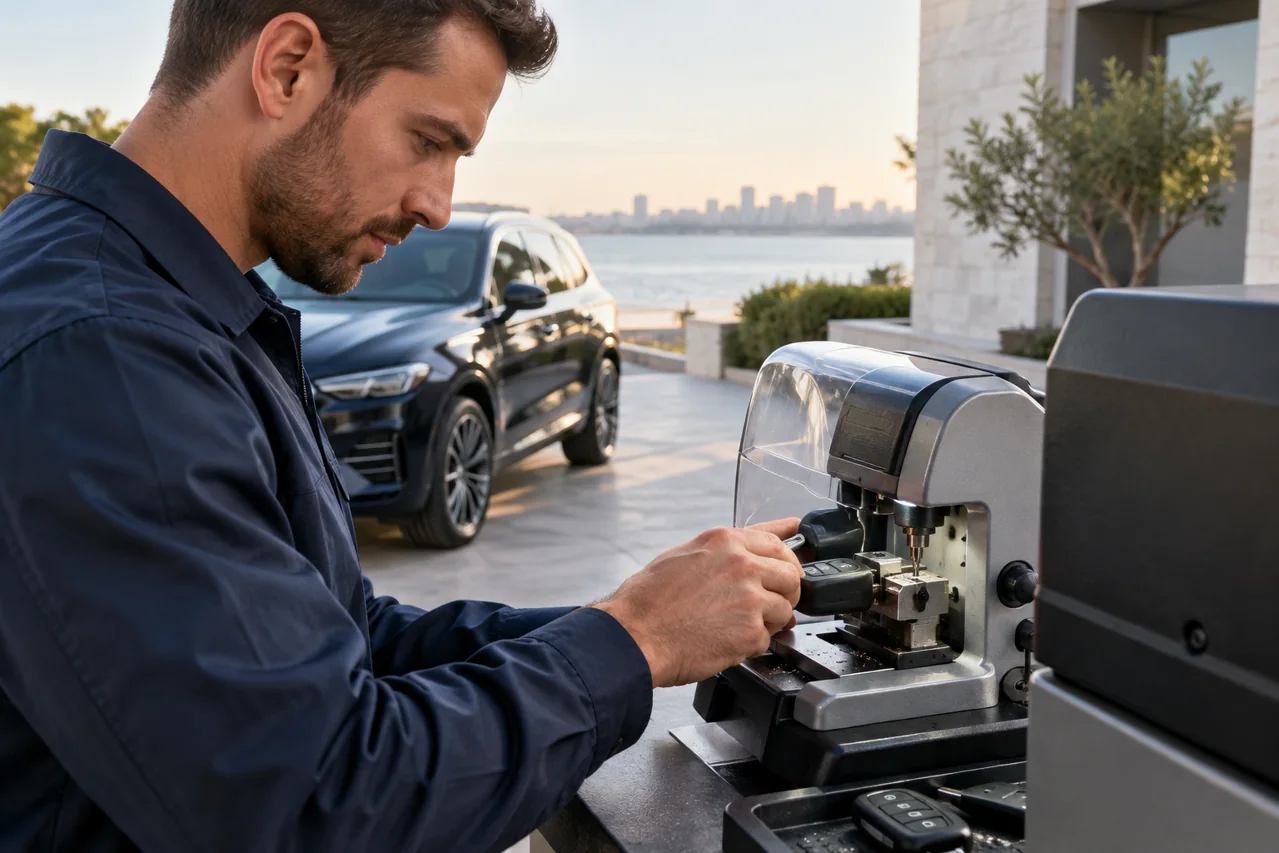
That is the heart of the comparison. A mobile visit brings the cutting machine, the programming equipment and the key blanks to where the vehicle is parked. A dealership route moves the vehicle to the equipment. Neither is wrong in every case, and a good locksmith will tell you honestly when your particular vehicle is better served by the dealer. This page walks through the real differences so you can decide with a clear head instead of guessing in a stressful moment.
Houston adds its own wrinkles. The metro area is large, dealership service departments are spread across many corridors, and traffic on the major freeways can turn a short distance on a map into a long afternoon. A lost key is rarely convenient, and the location of the vehicle matters as much as the make.
What a tow adds to the job
Towing is not just a cost line. It is a coordination task. Someone has to book the tow, confirm the vehicle can be loaded where it sits, meet the driver, and confirm the destination accepts vehicles without keys. A car parked in a tight garage level, a locked gated lot, or a driveway blocked by other vehicles can complicate loading. Some vehicles with electronic parking brakes or steering locks need extra handling because they cannot be rolled freely.
There is also the question of the vehicle sitting at a service department overnight. Dealerships schedule keys around their service lanes, and a vehicle that arrives without a key may wait for a technician who is available to program it. That can be quick on a quiet day or drawn out when the shop is busy. Ask the dealership directly how they handle a vehicle delivered on a flatbed with no key, and who calls you when the work is done.
A mobile visit removes the transport step. The technician comes to the parking space, the driveway, the office lot or the roadside where the vehicle already is. For an owner who also needs to get to work, pick up children or reach a hospital appointment, avoiding the second set of logistics is often the deciding factor.
- Tow booking, driver arrival and loading are a separate chain of calls.
- Some garages and gated lots limit where a flatbed can reach.
- Vehicles with electronic parking brakes may need careful handling.
- A vehicle left at the dealer may wait for an open programming bay.
Parts ordering and key blanks
Key replacement begins with the right hardware. The blank has to match the vehicle's blade profile or smart key frequency, and the electronic parts have to be compatible with the immobilizer in that exact model and year. Dealerships order original manufacturer parts, which sometimes means waiting for a shipment if the exact key is not stocked on the shelf. A dealership that sells many makes cannot keep every key for every trim level.
A mobile locksmith carries a broad stock of common blanks, shells and transponder chips, and can source others from suppliers who deal in aftermarket and original-equipment keys. For many mainstream vehicles the right key is already in the van. For rarer models, a technician can often tell you on the phone whether the part is likely to be on hand or whether it needs to be ordered, so you know before anyone drives anywhere.
It is worth asking either provider the same direct question: is the key for my vehicle in stock today, or does it need to be ordered, and if it is ordered, what happens next? A clear answer on parts is more useful than any promise about speed. If a part has to be ordered, a return visit is part of the plan, and a locksmith should say so up front.
When you call us, have the make, model, year and, if you can read it from the dash or door jamb, the VIN. Those details let a technician reason about which key type your vehicle uses before a quote is given.
Appointment logistics compared
Dealership service works on appointments because service bays and technicians are shared across many repair jobs. That is a sensible system for scheduled maintenance. It is less comfortable for an urgent key situation, because the key job has to be fitted around oil changes, recalls and warranty repairs that were booked earlier.
A mobile locksmith's day is organized around dispatch instead of service lanes. You describe the situation, the technician confirms what can be done at the vehicle, and the visit is arranged around where you are. Arrival times depend on the day, traffic and the technician's earlier jobs, so ask for the realistic arrival window when you book instead of expecting a fixed promise.
Neither model is faster in every case. A dealership with an open bay and the key on the shelf can be efficient once the vehicle is there. A mobile visit can be efficient when the vehicle is already in a convenient spot and the key is common. The honest approach is to compare the full chain for your situation: where the car is, how it would get to the dealer, when the dealer could start, and whether a technician can reach the vehicle where it sits.
| Question to ask | Mobile visit | Dealership route |
|---|---|---|
| Where does the work happen? | At the vehicle | At the service department |
| Is a tow needed? | Usually not | Often, if no key works |
| Who orders unusual parts? | Technician sources them | Parts counter orders them |
| How is timing set? | By dispatch and location | By the shop schedule |
| Can you stay with the vehicle? | Yes, in most cases | No, vehicle is left |
Vehicles that really do need the dealer
Honest advice has to include the cases where the dealership is the better road. Some vehicles use manufacturer systems that lock key programming behind the maker's own secure network. Certain late-model European and a few domestic models require a security authorization that only the manufacturer's dealer network can issue, tied to the VIN and sometimes to the owner's identity. When that is the case, no outside technician can legally or technically finish the job, and a responsible locksmith will tell you so on the first call instead of taking a service visit that cannot succeed.
Other vehicles need a part that only the manufacturer supplies, such as a proprietary smart key with a locked firmware version, or a replacement control module when the existing one has failed. If the underlying problem is a faulty immobilizer module or body computer, a new key will not fix it, and the repair belongs in a shop with the manufacturer's diagnostic tools.
Vehicles still under a manufacturer's coverage can also be a reason to go to the dealer. Check your paperwork for what the coverage includes. Some owners prefer to keep all work with the brand so that records stay in one place. That is a legitimate preference, and a locksmith has no reason to argue you out of it.
The practical step is to give the technician your make, model and year on the phone and ask directly whether the job is one a mobile technician can complete at your vehicle. If the answer is no, you have saved yourself a visit.
Vehicles where a mobile visit works well
A large share of vehicles on Houston roads use transponder keys, remote head keys and many smart key systems that mobile technicians program routinely. Popular pickup trucks, family sedans, compact SUVs and commuter cars from the main brands often fall into this group. When the vehicle sits in a driveway, an apartment lot or a workplace garage, the technician can cut a key from the vehicle's data, program it to the immobilizer, and test it in the ignition and the doors before leaving.
Mobile service is also well suited to situations where the key was lost somewhere the vehicle cannot easily be moved. A pickup parked at a job site, a car in a hospital garage, or a family vehicle in a church lot does not need a tow just so a key can be made. Bringing the work to the vehicle keeps it simple.
Everything in this section depends on the vehicle, the lock system and what the technician finds. That is why the first call matters. Describe the vehicle, say how many keys you still have, if any, and explain where it is parked. A technician will then tell you whether a mobile job is realistic, what an on-site visit would involve, and what the quote covers.
Where a job is complicated, such as a European smart key with an unusual security process, an on-site visit may be needed to assess it before a final quote is given. A service call charge applies for that assessment and is explained on the phone before dispatch.
How the quote works, and why it comes by phone
Quotes for key work depend on details that cannot be guessed from a web page: the vehicle, the key type, whether any working keys remain, and where the vehicle is. For that reason quotes are given by phone only. A technician asks a few questions, explains the work, and tells you what the job involves before anyone is sent.
A dealership will also quote by phone or at the service desk, and it is sensible to ask both for the same information so the comparison is fair. Ask what the quote includes: the key itself, cutting, programming, any diagnostic time, and any service call or tow arrangements. Ask whether anything could change the figure once the vehicle is examined, and what the process is if it does.
Be wary of any provider who gives a firm number without asking what vehicle you drive. Key work varies too much for that. Also be wary of a quote that cannot be explained line by line. A clear quote names what you are paying for.
Our process is simple. You call, describe the vehicle and the situation, and receive the quote on the phone. If the job is straightforward, a visit is arranged. If it is complicated, an on-site assessment is proposed, with the service call charge explained before dispatch so there are no surprises when the technician arrives.
Proof of ownership applies on both routes
Whichever route you choose, a reputable provider will ask you to show that the vehicle is yours before making a key. That protects owners from anyone trying to obtain a key to a car that is not theirs. Dealerships ask for registration and photo identification. A mobile locksmith should ask for the same things.
Have your photo identification and the vehicle's registration or title ready, and be ready to match the name and the vehicle. If the vehicle is leased or company owned, bring the lease paperwork or a letter from the company that authorizes the work. For a vehicle you recently bought, a bill of sale along with the title application may be needed until registration is issued.
If someone offers to make a key without asking for any proof at all, treat that as a warning sign. It does not make the process easier for you. It means the provider does not care who ends up with the key. Our guide on proof of ownership for car keys lists what to prepare so the visit goes smoothly.
Verifying credentials is also your right. Ask any locksmith for their business name, how they are permitted to operate, and check that the details match what appears on their paperwork. Do the same with any dealer department you use.
A way to decide in five minutes
If you are standing next to a vehicle with no key, a short checklist can settle the choice without a long search. Start with the vehicle itself: is it a mainstream model with a transponder or smart key, or is it a rare or very new model? Next, consider location: could a technician reach it where it sits, or is it in a place that cannot be accessed? Then consider timing: do you need the vehicle today, or is a scheduled dealer visit acceptable?
Call a mobile locksmith first with your answers. Because the phone call costs nothing but a few minutes, it tells you whether the vehicle is a good fit for a mobile visit and what the quote is. Then, if you wish, ask a dealership for its own figures and compare. You are not committing to anything by asking.
If the vehicle is one that requires manufacturer authorization, you will hear that quickly and can arrange a tow with the facts in hand. If it is not, you may avoid a tow altogether.
- Gather the make, model, year, VIN and your photo identification.
- Note exactly where the vehicle is parked and whether it can be reached.
- Count how many working keys remain, including spares at home.
- Call a mobile locksmith and ask whether your model is suited to an on-site job.
- Ask what the quote includes and what the service call charge covers.
- If the answer points to the dealer, arrange the tow with those details.
Related services and next steps
If your situation is a complete loss of keys, read our page on all keys lost car key replacement to see how a technician works from the vehicle's data when nothing opens the car. If you only need a copy, spare car key duplication explains why making a spare before the last key disappears is far simpler than starting from nothing. For the comparison written from a buyer's view, dealer versus locksmith keys covers the broader trade-offs.
A mobile visit is not for everyone and it is not for every vehicle, and we say so plainly. What it does offer is a way to avoid a tow and a shop appointment when your vehicle is suited to it. The only way to know is to describe your vehicle and your situation to a person who can answer.
When you are ready, call. Tell the technician the make, model, year, the location and how many keys you have. You will hear whether the job suits a mobile visit, what to expect on arrival, and what the quote covers, all before anyone is dispatched.
Questions people ask
Can a mobile locksmith make a key if I have no working key at all?
In many cases yes. When every key is gone, a technician can often cut a new key using the vehicle's information and program it to the immobilizer on site. Whether that is possible depends on the make, model, year and security system. Call, describe the vehicle, and the technician will tell you honestly whether the job suits a mobile visit or needs the manufacturer.
Will the dealership always be more reliable than a locksmith?
Not necessarily. Reliability depends on the technician, the equipment and the vehicle. A dealership has the manufacturer's tools and parts channel, which matters for certain models. A qualified mobile technician with current programming equipment can handle many mainstream vehicles well. Ask either provider the same questions about stock, process and what the quote covers before deciding.
Do I still need to prove the car is mine?
Yes, on any route. A responsible provider will ask for photo identification and registration or title that matches the vehicle before making a key. For leased or company vehicles, paperwork authorizing the work is usually needed as well. If a provider asks for nothing, treat that as a reason for caution.
What if my vehicle needs a part that has to be ordered?
Then the job usually becomes two steps, ordering the part and returning to fit and program it. A locksmith should tell you this on the phone, along with what happens next. A dealership may order the same part through its own channel. Ask either provider whether the key is in stock before you commit.
Why can you not give a price on a web page?
Key work varies by vehicle, key type, how many keys remain and where the car is parked. Quotes are given by phone after a technician hears the details. For complicated jobs an on-site visit may be needed first, and there is a service call charge that is explained on the phone before dispatch.
Is it safe to leave my vehicle at a dealership without a key?
Dealers handle keyless vehicles often, but it is reasonable to ask how they secure the vehicle, who will call you and how long it may wait for an available technician. If staying with the vehicle matters to you, a mobile visit keeps the work at your location where you can watch it.
Describe the situation by phone and we will tell you what the job involves. Quotes are given by phone. Jobs that cannot be quoted without seeing them need a technician on site, and the service call charge is explained on the phone before anyone is dispatched.
(713) 574-7660Related pages
Written by Claude (AI) (AI) for Houston Car Key Locksmith.