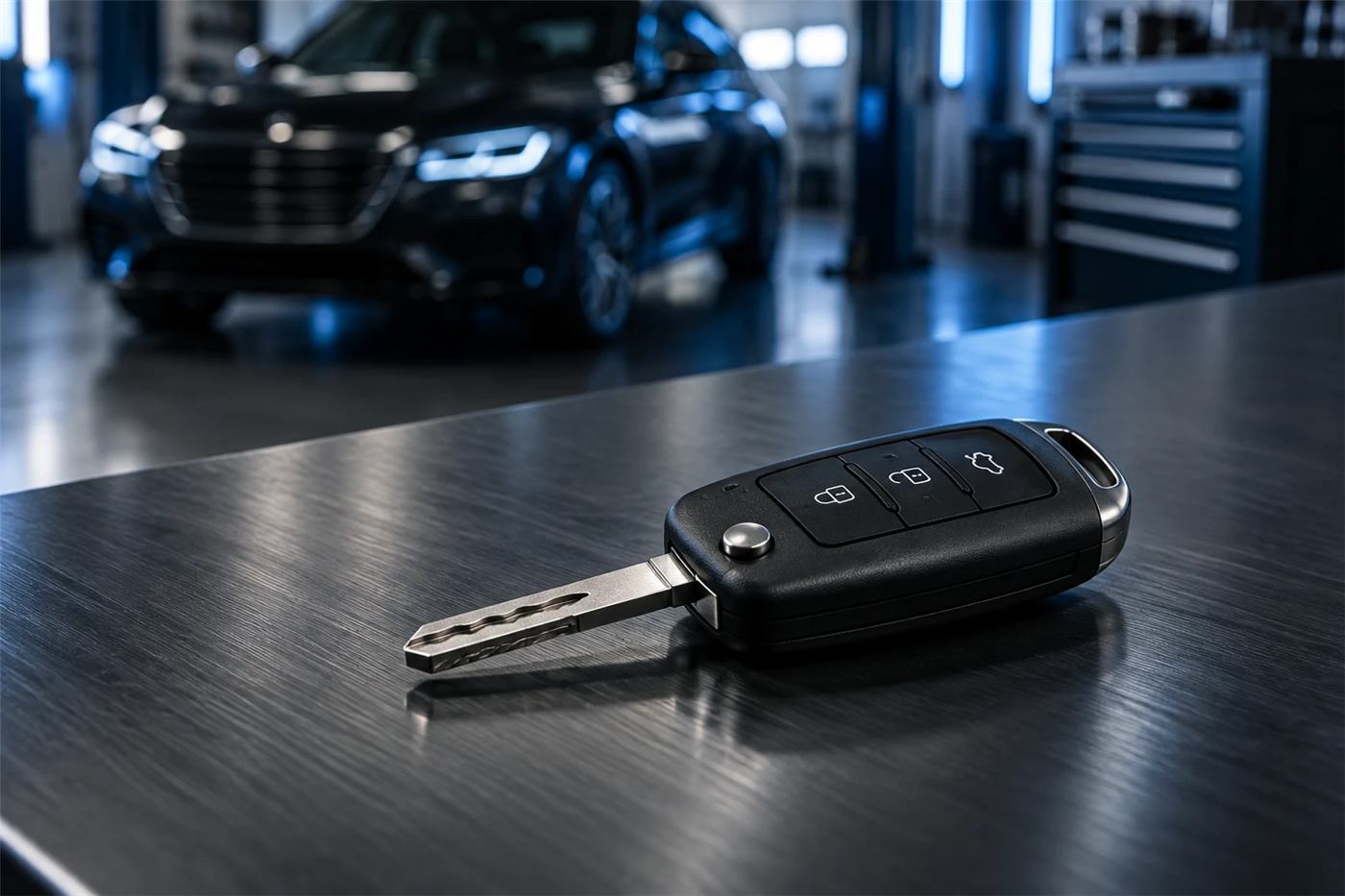
The short answer: how to tell in ten seconds
The quickest test is to look at how you start the car. If you put a key into a slot beside the steering column and turn it, you have a transponder key, sometimes with a remote built into the head. If you press a button on the dash while the key stays in your pocket or bag, you have a smart key, also called an intelligent key, a proximity key or a keyless fob.
A second clue is the key itself. A transponder key almost always has a visible metal blade that does the turning. A smart key usually has no visible blade, though many hide a small emergency blade inside the case, released by a latch or a button. A third clue is how the doors unlock: if you can open a door just by touching the handle with the fob in your pocket, you have a smart key.
A few cars sit between the two. Some vehicles have a key slot that accepts a fob or card and a start button beside it. Others have a push button and also require you to place the fob in a specific spot when the battery is weak. If you are unsure which group you belong to, describe what you do when you start the car, and that description is usually enough.
What a transponder key is
A transponder key is a mechanical key with an electronic identity. It has a cut blade that turns the ignition, and inside the head sits a small chip that answers a signal from the ignition. The vehicle computer checks the answer and, if it is accepted, lets the engine run. Many transponder keys also carry a remote for the door locks, either built into the head or on a separate fob.
These keys are common on vehicles from a wide span of years, from the point when chip security became standard until push button start became common. They come in several chip types, and the vehicle accepts only the type it was built to recognize. That is why two keys that look identical can behave differently: one has the right chip and one does not.
Because there is a blade, wear on the blade and on the ignition cylinder is part of the story. A transponder key that has been used daily for years may stick, and the cylinder may need attention. Our page on transponder key programming explains the replacement process in more detail.
What a smart key is
A smart key is a fob that communicates with the car by short-range radio. Antennas in the doors, the trunk and the cabin send out a signal, and the fob answers with a coded message. When the car decides that the fob is nearby and genuine, it allows the doors to unlock and the engine to start. You never insert anything.
The fob contains a battery, a transmitter, a receiver and an identification chip. Because it is doing more work, it uses more power than a simple remote, and its battery matters more. When the battery weakens, you may see a dash message, notice reduced range or find that the car starts only when the fob is held against the start button or placed in a marked spot.
Smart keys are common on newer vehicles of many makes, and they are standard on a large share of newer trucks and SUVs around Houston. Our pages on smart key replacement and push button start keys cover the details.
Side by side: the main differences
The table shows the pattern, but the details depend on the make and model. Some cars blur the lines, and the best way to be sure is to describe your car to a technician.
| Feature | Transponder key | Smart key |
|---|---|---|
| How you start the car | Insert the blade and turn | Press a start button with the fob inside |
| Visible blade | Yes, always | Usually hidden as an emergency blade |
| Door unlocking | Press a button or use the blade | Touch the handle or press a button |
| Battery matters for starting | Rarely | Yes, a weak battery can cause warnings |
| Common failure points | Worn blade, worn ignition, chip | Battery, water damage, circuit board |
| Replacement steps | Cut a blade, program the chip, pair the remote | Program the fob to the vehicle, check the emergency blade |
| Relay theft risk | Low | Higher, since the fob signal can be extended |
What each type means when you lose a key
With a transponder key, the physical blade can be cut from a code or from an existing key, and the chip has to be programmed. If you still have one working key, adding another is usually simpler than starting from nothing. If every key is gone, the technician can cut a blade from the lock or the vehicle information and program the chip, which takes more steps but is a routine job for a mobile professional.
With a smart key, the new fob has to be programmed to the vehicle through the diagnostic port. If you have one working fob, the process may be simpler. If you have none, the car needs to be told to accept a new set, and some vehicles have extra security steps. In either case, missing keys can often be erased from the car memory so they no longer start it.
In both situations, the technician will verify that you own the vehicle before doing the work. Bring photo identification and registration or title. Our page on proof of ownership for keys explains why.
Failure signs you can recognize
Each type has its own early warning signs. A transponder key that is wearing out may feel gritty in the ignition, need wiggling to turn, or leave marks on the blade. The remote part may need a harder press. A key that is starting to fail may start the car on one try and not the next.
A smart key that is struggling may need to be closer to the car, may cause a delay when you touch the handle, or may trigger a dash message about the key battery. You may find that it works in the morning and fails in the afternoon after being left in the heat. Intermittent behavior is the most common early sign of a failing fob.
In both cases, do not wait for complete failure. Replacing a battery, repairing a shell or adding a spare is simpler and calmer than an emergency. If your key has started to act oddly, treat that as a reminder to arrange a spare while the original still works.
- Transponder key: gritty feel, wiggling needed, intermittent starting.
- Smart key: reduced range, delays, dash messages about the key battery.
- Either type: cracks in the case, loose parts, water exposure.
- Any key used as the only key: reason enough to add a spare.
Security considerations for each type
Transponder keys are relatively resistant to casual theft. Without the right chip and the right programming, a copy will not start the car. Thieves who target these vehicles need more advanced tools or physical access to the key. The main risk is losing the key itself or leaving it where it can be taken.
Smart keys offer convenience and carry a different risk. Their radio signal can, in some situations, be captured and extended by a device so that the car believes the fob is nearby. This is known as a relay attack. Simple steps such as storing the fob in a signal-blocking pouch at home or keeping it away from the front door help. Our guides on relay attack protection and the Faraday pouch go into more detail.
In both cases, the best protection is awareness. Know where your keys are, do not leave them in the car, and have a plan for what to do if one goes missing. A technician can erase a lost key from many vehicles, which closes the door on its use.
Houston conditions that affect each type
Heat affects both types, but smart keys, with their batteries and receivers, are more sensitive. A fob left on a dashboard in summer can reach temperatures that shorten battery life. Humidity and sudden rain affect both, since corrosion attacks contacts and circuit boards. Flooding can ruin either type if the key is submerged.
Transponder keys may have a longer life in some circumstances, because they are simpler, but the ignition cylinder and the blade wear with use. Houston drivers who spend long hours in traffic and make many short trips put a lot of cycles on the ignition. Keep the ring light and keep the key clean.
If you drive near the coast, salt air adds to corrosion. If you work outdoors, dust, mud and sweat get into everything. A small pouch or a dedicated pocket for the key helps both types last longer.
Mixed households and older cars with newer keys
Many Houston households own more than one type of key without realizing it. A family might drive a newer SUV with a smart key and keep an older sedan with a transponder key for a teenager. Each car needs its own approach, and mixing them up leads to confusion: a spare fob from one vehicle will never work in the other, and a battery type that suits one fob may not suit the next.
It helps to label spare keys, using a small tag that names the vehicle rather than a plate number or address. That way, if a key is found by a stranger, it does not point to where the car lives. Keep spares for each vehicle in a safe place at home, and keep a short list of what each key is and who carries it.
Older cars sometimes surprise owners. A car built just before chip keys became standard may have a plain metal key, while a nearly identical car built a little later has a chip. A used car may even have a key that was replaced with a different type by a previous owner. If you bought a car second-hand and are unsure what its key is, describe it when you call, and the technician can help you work out what the car expects and whether the key you have is the right one.
Choosing the next step
Once you know which type you have, the next step is clear. For a transponder key, the questions are whether the blade and ignition are worn, whether the remote works and how many keys remain. For a smart key, the questions are whether the battery is weak, whether the case is damaged and how many fobs remain.
Either way, the phone call is simple. Tell us the make, model and approximate age of the vehicle, whether it has a start button or a keyhole, and what happened to the key. Quotes are given only by phone, and a service call charge is explained before a technician is dispatched. Complicated jobs may need an on-site visit first.
When you are ready, call the number on this page. We will help you work out what you have and what the replacement involves.
Questions people ask
My car has a start button. Does that mean it has a smart key?
Almost always, yes. A start button usually goes with a smart key that stays in your pocket. A few vehicles have a start button plus a slot that accepts a fob or card, so describe what you do when you start the car. A technician can usually tell from that description and the vehicle make and model.
Can I use a transponder key blank from a different car?
Usually not. The vehicle accepts only a specific chip type, and the blade has to match the lock. A blank that fits one car may carry the wrong chip for another. Programming also ties each key to the specific vehicle. A technician selects the correct blank for your make, model and age.
Is a smart key harder to replace than a transponder key?
Not necessarily harder, but different. A smart key replacement needs a new fob programmed through the diagnostic port, plus an emergency blade if applicable. A transponder key replacement needs a cut blade, a programmed chip and a paired remote. Both are routine for a mobile technician with the right equipment.
Why does my smart key sometimes fail to unlock the door?
The most common cause is a weak fob battery. Interference from phones, metal objects or nearby electronics can also block the signal. Try moving the fob away from other devices and, if the problem persists, have the battery checked. If a new battery does not help, the fob itself may need attention.
Do smart keys have a physical key inside?
Most do. A small emergency blade is hidden in the fob and released by a latch or button. It opens the driver door if the fob battery is dead. It usually does not start the car, although many vehicles have a backup spot where holding the fob lets the car read it anyway.
Which type is safer from theft?
Each has strengths. Transponder keys resist casual theft because a copy without the right chip will not start the car. Smart keys are convenient but can be exposed to relay attacks. Storing a smart key in a signal-blocking pouch and never leaving any key in the car are sensible steps for both.
Describe the situation by phone and we will tell you what the job involves. Quotes are given by phone. Jobs that cannot be quoted without seeing them need a technician on site, and the service call charge is explained on the phone before anyone is dispatched.
(713) 574-7660Related pages
Written by Claude (AI) (AI) for Houston Car Key Locksmith.