What happens when you press the start button
Pressing the start button feels like the beginning of the process, but the car has already been working for a moment. When your foot touches the brake, or when you open the door, the car sends out a short request through antennas placed around the cabin. The key answers with an encrypted reply. If the reply matches a key stored in the car's memory, the start button is allowed to do its job, the steering lock releases and the engine begins to turn.
If the reply does not arrive, or does not match, the car refuses. The dash may show a message, the button may flash, or the engine may crank and then stop. The car does not distinguish between a dead battery in the key, a key from a different car, a damaged antenna or a missing key. All it knows is that the handshake failed. That is why a smart key problem can feel confusing, since several different faults look the same from the driver's seat.
Understanding this exchange helps you describe the problem. If the car starts only when the key is held against the button, the handshake works at very close range but not at normal distance, which often points to a weak battery in the key. If the car refuses every key, including ones that worked yesterday, the fault may be in the car. Our page on smart key replacement covers the key itself in more detail.
The dash prompts and what they usually mean
Push-to-start cars use the instrument cluster to talk to the driver. A prompt such as press brake and push start tells you the car is waiting for the right conditions. A prompt about the key not being detected tells you the handshake failed. A prompt about a low key battery tells you the radio in the key is weak. A prompt that mentions the security system suggests the immobilizer is not accepting the key.
Some prompts depend on the make. One manufacturer may show a small key symbol with a line through it, while another shows a written message. A flashing light shaped like a car with a key inside is a common symbol for the immobilizer. If that light flashes quickly when you try to start the car, the car does not recognize the key, and no amount of pressing the button will help. Our problem page about the flashing immobilizer light describes what that light usually means.
Photograph the message before you call. A technician can often narrow the cause with a clear description of the dash. Mention what you were doing when the message appeared, for example after a battery change, a jump start or a long period parked. Context saves time and can steer the conversation toward the right tool.
Learning modes on common systems
Some push-start cars allow an owner to add a key through a built-in learning procedure, usually a sequence of door openings, brake presses and button presses that the car recognizes as a request to learn. These procedures are documented in the owner's manual for the vehicles that support them. They typically require that at least one working key is already known to the car, and they usually allow only a limited number of keys.
Learning modes exist for convenience, but they are not available on every model. Many newer systems require a diagnostic tool and a security authorization for any new key, and they do not offer a manual procedure at all. Even where a manual procedure exists, the new key must be a compatible type, with the right frequency and the right chip. A blank from the wrong family will not be accepted no matter how carefully the steps are followed.
If your manual describes a procedure and you have a compatible key, you can try it. If it fails after a careful attempt, stop and call a technician rather than repeating it many times, since some cars lock the learning mode after repeated failures. A car that has locked the learning mode may need a diagnostic tool to reset it, which adds work that would not have been needed.
What is left to a technician
A technician is needed whenever the car has no working key, whenever the car requires a diagnostic tool for key learning, whenever the new key is not a type the owner can pair by hand and whenever the immobilizer list needs to be erased. These cases cover most of the push-start cars on the road, which is why mobile locksmiths spend so much of their time on them.
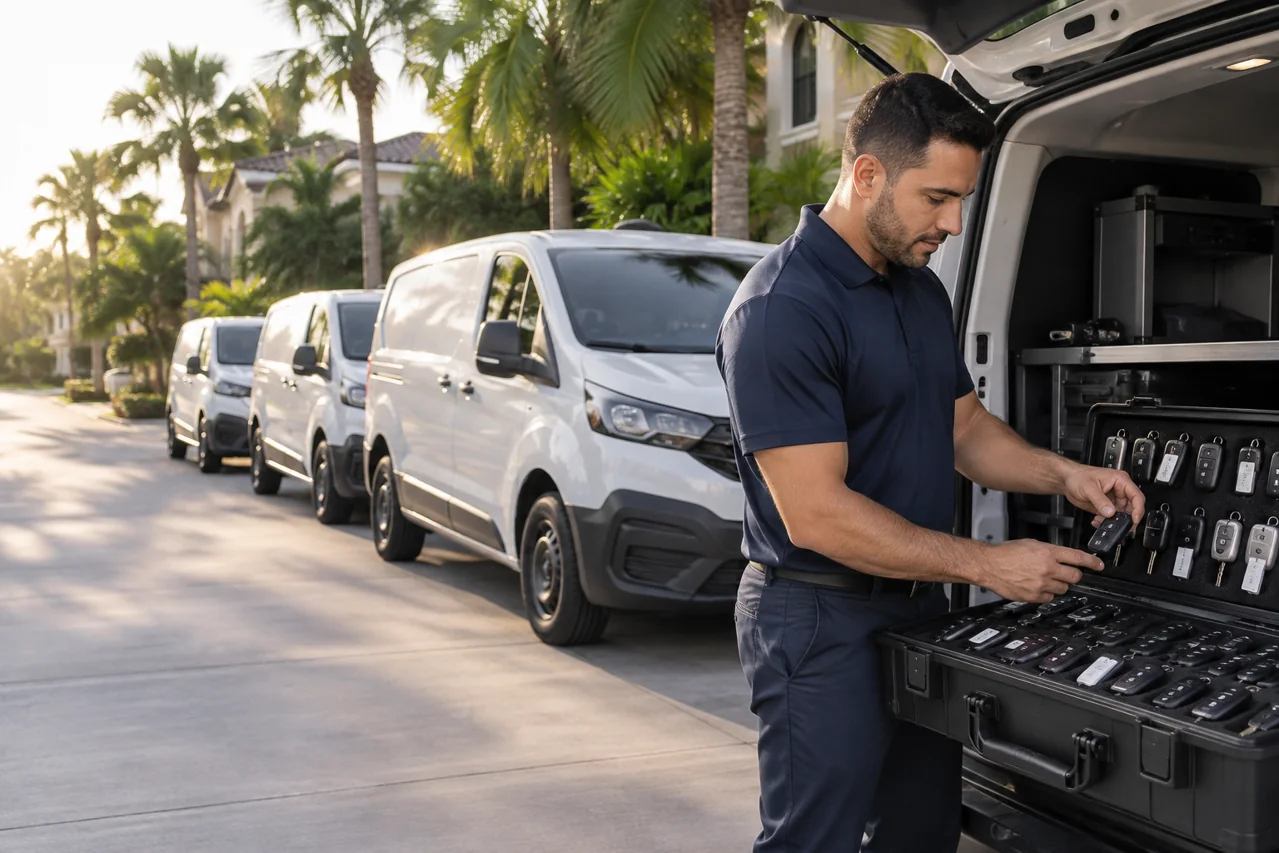
The tools matter. A technician carries a tablet that reaches the car through the diagnostic port, a set of programmers for many makes and a supply of key blanks. They also carry the knowledge of which cars need which steps, which cars impose waiting periods and which cars are known for trouble. That knowledge turns a long guess into a short procedure.
A technician can also separate key problems from car problems. If the car has a bad antenna, a weak battery or a faulty body control module, a new key will not fix it, and a good technician will say so before cutting anything. Our page on all keys lost service shows how the process changes when no key is left to start from.
Steps in a typical push-start key visit
The visit begins with a phone call in which you describe the car, the key you have and what the dash says. The technician explains what is possible and what to have ready, and gives the quote by phone. If the car is unusual, an on-site visit may come first, and the service call charge is explained before anyone is dispatched.
On arrival, the technician checks your identification and your proof of ownership. The car's identification number is read, the right key blank is chosen and the blade, if any, is cut. The diagnostic tool is connected, and the pairing routine is started. During pairing the car may beep, flash lights or show messages, and the technician may ask you to press the start button or open a door at certain moments.
At the end the technician tests the new key. You will watch the car start, stop and start again, and the remote functions are tried in turn. If the car supports it, the technician may also check that the proximity unlock works at each handle.
- Call, describe the car and the dash message, and receive the quote by phone.
- Show identification and proof of ownership when the technician arrives.
- The technician reads the vehicle number and prepares the key.
- The diagnostic tool pairs the key with the car's immobilizer.
- You test starting, stopping and every remote function before the technician leaves.
When the problem is the car and not the key
Sometimes the key is fine and the car is the problem. A weak or recently replaced car battery can cause strange behavior, because the antennas and computers depend on stable voltage. A car that dies and restarts, or flashes warnings, may be telling you that the battery is the cause. Replace or test the battery first before blaming the key.
Interference can also confuse the handshake. A phone, a wireless charger or another key on the same ring can sometimes disturb the signal. If the car starts when you remove the key from a crowded ring or from a pocket with other electronics, you have found the cause. Keeping the key in a separate pocket is a simple fix.
If these simple steps do not help, the antenna, the receiver or the control module may be at fault. A technician with a diagnostic tool can read stored fault messages from the car and tell you where the signal is getting lost. That repair may be outside the world of keys, and an honest technician will tell you when a mechanic or a dealer is the better next step.
Questions drivers ask after a key is added
Once the new key is working, a few practical questions tend to come up. The first is whether the old keys still work. In most cases they do, unless the technician erased the key list on purpose. Test each key before the technician leaves, so you know exactly which keys the car accepts and can raise any surprise while help is still on site.
The second question is how to keep the new key healthy. Smart keys use a small battery, usually a coin cell, which weakens gradually. A key that has become slow to unlock the doors, or that needs to be held near the start button, is asking for a new battery. Replacing it promptly avoids a stranded morning. Our page on key fob battery replacement explains how to do it without losing the pairing.
The third question is what to do with the extra key. Treat it as insurance. Store it away from the car and away from the main key, and check it every few months by using it for a day, so that you learn early if its battery has weakened. A spare that has never been tested is a spare you cannot trust.
The last question is about the dash. After pairing, the instrument cluster may show a message once or twice about a key being learned or a key count changing. That is normal. If a security light stays on, or if a message about service persists after a few drives, tell the technician, who can recheck the pairing and the car's memory.
Keys that look alike but are not interchangeable
Two push-start keys for different cars can look nearly identical. The shape of the case, the logo and the button layout may match, yet the radio frequency, the chip and the internal software can differ. A key that is correct for one model year may be wrong for the next, even from the same manufacturer, because the security system was revised.
This is why a phone call that includes the exact year, trim and sometimes the vehicle number is more useful than a description such as a Toyota with a start button. The technician can match the key family to the car before arriving, which avoids a wasted trip and a wrong blank. If you have a key in hand, read any numbers on the back or inside the battery compartment and mention them.
It is also why keys bought without advice can disappoint. A key purchased online may pair with one car and refuse another, and a used key may already be locked to a different vehicle. Letting the technician supply the blank avoids that risk and puts the responsibility for compatibility on the person doing the work.
Houston conditions that affect push-start keys
Houston's heat and humidity are hard on small electronics. A key left on a dashboard in summer can reach temperatures that harm the battery and the circuit board, and a key carried in a pocket through a long humid day can pick up moisture. Keys that have been wet often fail slowly, with intermittent faults before final failure. Our guide on summer heat and car keys offers simple habits that reduce the risk.
Flooding is another local risk. A car that sat in standing water may have damaged antennas, modules and keys, and starting it can make the damage worse. If your car or key has been in floodwater, do not keep trying to start it, and mention the exposure when you call. Our guide to flood damaged vehicle keys explains what to expect.
Parking structures in Downtown, the Medical Center and the Galleria can create signal problems of their own, because dense steel and electronics can disturb the handshake. If your car behaves differently in a garage than at home, mention it. It is a clue about interference rather than a failing key.
Protecting a push-start car from theft
Push-start cars are a favorite target for relay theft, in which a device amplifies the key's signal from inside the house to the car outside. Thieves can open and start the car without touching the key. The risk is highest when the key is left near the front door, and when the car is parked close to the house.
Reduce the risk by storing keys away from exterior walls, in a metal tin or a signal blocking pouch. Some keys have a sleep mode that you can activate with a button sequence, which the owner's manual describes. Our guides on relay attack protection and Faraday pouches give practical steps.
A steering wheel lock and a visible deterrent also help, since thieves prefer an easy target. None of these measures is perfect, but together they make your car a harder choice than the one next to it.
Planning ahead and calling a technician
The best time to add a push-start key is while you still have a working one, because the process is simpler and the cost of a mistake is lower. A spare stored away from the car, and from the main key, is a real safeguard. Our page on spare car key duplication describes the process for cars that still have a working key.
If you already have no working key, call and describe the situation. Give the make, model and year, say what the dash shows and say where the car is parked. The technician can explain the steps and what documents to have ready.
A calm call, a clear description and a few documents are all you need to start. Call now, and a technician will talk you through the next step for your car.
Questions people ask
Why will my push-start car not accept a new key?
A new key must be paired with the car's immobilizer before it works. A blank key, even one that looks right, has no identity the car recognizes until a technician or a manual procedure adds it. The wrong chip or frequency can also prevent pairing, which is why the make, model and year matter on the call.
Can I add a key using the owner's manual?
Some cars allow it if you already have a working key and a compatible new key. Many do not. If the manual describes a procedure, follow it once carefully. If it fails, stop and call a technician, because repeated failed attempts can lock the learning mode on some vehicles.
What does the flashing key light mean?
A flashing key or lock symbol on the dash commonly means the immobilizer is active and has not recognized the key. It can be caused by a key that is not paired, a damaged chip or a weak key battery. Photograph the light and describe when it flashes when you call.
Does the technician need to see my car title?
The technician needs proof that you may have a key made for the car. A government photo identification plus a registration, title or insurance card that shows the vehicle number is the usual combination. Ask on the phone if your situation is unusual, such as a company vehicle or a recent purchase.
Can the job be done at my home or office?
In most cases, yes. A mobile technician brings the tools to the car. The car needs to be reachable and parked in a safe spot with room to work. A few vehicles may need an inspection first, and the technician will tell you on the phone whether that applies to yours.
How are quotes given?
Quotes are given only by phone, after the technician hears the make, model, year and the key situation. Complicated jobs may need an on-site visit first. There is a service call charge, and it is explained on the phone before anyone is dispatched.
Describe the situation by phone and we will tell you what the job involves. Quotes are given by phone. Jobs that cannot be quoted without seeing them need a technician on site, and the service call charge is explained on the phone before anyone is dispatched.
(713) 574-7660Related pages
Written by Claude (AI) (AI) for Houston Car Key Locksmith.