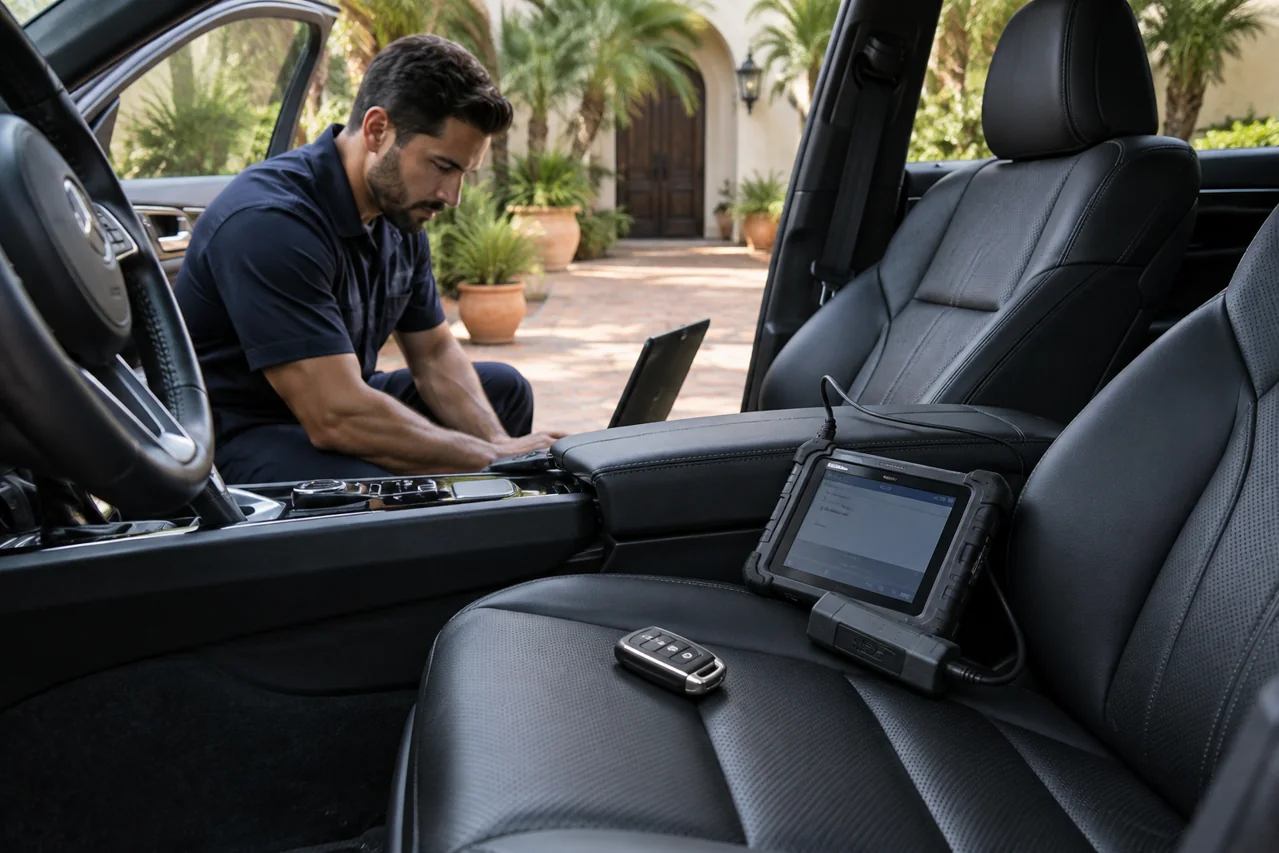
Three systems in one plastic body
A remote head key looks like a single object, but inside it three systems work side by side. The blade is a mechanical part, cut to turn the door locks, the trunk lock and the ignition. The transponder chip is a passive electronic part that identifies the key to the car's immobilizer when the key sits in the ignition. The remote circuit is a small battery-powered radio that sends lock, unlock, trunk and panic signals when you press a button.
These parts are independent. The chip does not care whether the remote works, and the remote does not care whether the chip is recognized. A key can start the car but not lock it, or lock it from across the parking lot but refuse to start the engine. That independence is useful once you understand it, because it tells you which part to blame when something stops working.
Because the parts are separate, replacing a remote head key means three tasks: cutting the blade, pairing the chip and pairing the remote. A technician can do all three in one visit, but each step has its own requirements and its own chance of trouble. Our page on transponder key cutting and programming covers the chip side in more detail.
How the remote is paired separately from the chip
The chip is introduced to the immobilizer, which sits close to the engine controls. The remote is introduced to a different receiver, often in the body control module, which handles the doors, the lights and the alarm. Each module keeps its own list of known keys. Adding a key to one list does not add it to the other.
Some cars let the owner pair a new remote with a sequence of steps, such as turning the key to the on position several times, pressing a button and listening for the locks to cycle. These procedures are listed in the owner's manual for the cars that support them. They commonly need a working key already in hand, and they allow only a certain number of remotes.
Other cars require a diagnostic tool for remote pairing, as they do for chip pairing. A technician will connect the tool, select the body module and introduce the new remote. Afterward every button is tested at a few distances. A remote that works only when held against the car has a weak battery, a poor pairing or a problem with the receiver.
What the battery does and does not do
The battery in a remote head key powers only the remote part. A dead battery will silence the buttons but will not stop the engine from starting, because the transponder chip needs no battery. This is one of the most useful facts about the key. If the buttons stop working but the car still starts, you almost certainly need a new battery, not a new key.
Batteries in these keys are usually small coin cells, and they typically fade slowly. Signs include a shorter range, the need to press buttons more than once and a delay before the locks respond. If you notice these signs, replace the battery before it dies completely. Our page on key fob battery replacement explains how to do it without losing the pairing.
Do not assume that a dead remote means the key is dead. Many drivers pay for a replacement key when a battery would have solved the problem. If you are not sure, the technician can test the key in a few minutes, which is a much smaller job than making a new one.
Common faults and what they usually mean
The most common fault is worn buttons. The rubber pad or the contact beneath it may wear through, especially on a key that is used many times a day. Symptoms include a button that needs a hard press, a button that works only at certain angles or a button that has stopped working while the others are fine. A new shell or a new pad may solve it. Our page on key fob shell repair describes that option.
Another fault is a cracked case. The plastic head holds the parts together, and when it splits the board and the chip can shift or fall out. A split case should not be ignored, because a dislodged chip can be lost. If the case is cracked but the parts are inside, a replacement shell can often save the key.
A third fault is water damage. A key that has gone through the wash or fallen into a puddle may work for a day and then fail as corrosion spreads. Rinsing and drying may help if done at once, but a key that has failed after a soak is usually near the end of its life. Replace it promptly, because corrosion can also reach the chip.
- Buttons that need several presses usually point to a weak battery.
- A key that starts the car but cannot lock it has a remote problem.
- A key that locks the car but will not start it has a chip problem.
- A split case can let the chip fall out, so repair it early.
- A key that failed after water exposure should be replaced, not nursed.
Choosing a replacement key
A replacement remote head key has to match the car in several ways. The blade profile must fit the locks, the chip must belong to the right family, the remote frequency and button layout must match the car's receiver and the case should resemble the original. Getting any of these wrong leads to a key that does not work or that works only in part.
The safest approach is to let the technician choose the key based on your make, model, year and the key you hold. If you want to supply your own, call first and describe it, including any numbers on the case or inside the battery compartment. A used key from another car, or a key that looks right but has a different frequency, is likely to fail.
Button layout is a minor point that people sometimes overlook. A key with an extra panic button or a missing trunk button can confuse the car or leave a function unavailable. If you use remote start, remote windows or a power liftgate button, mention it so the technician can choose a key that carries those buttons.
What happens during a replacement visit
You start with a phone call, where you describe the car and the key situation. The technician explains what is possible, what to have ready and the quote. If an on-site inspection is needed first, a service call charge applies and is explained before dispatch. Quotes are given only by phone.
At the car, the technician checks identification and proof of ownership, reads the vehicle number and prepares the blade. The new key's chip is paired with the immobilizer, and the remote is paired with the body module. Throughout, you may be asked to press a button, open a door or watch a dash message.
The visit ends with a full test. The technician will have you lock and unlock the car from several distances, open the trunk, sound the panic button briefly and start the engine more than once. Report anything unusual then. Our guide on preparing for your key visit lists what to have ready.
- Call and describe the car and the key you have.
- Receive the quote by phone and learn about any service call charge.
- Show identification and proof of ownership at the car.
- The technician cuts the blade and pairs the chip and the remote.
- Test every button and start the engine several times before the visit ends.
When the remote works but the car will not start
A remote that locks and unlocks the car proves only that the remote circuit and its battery are alive. It says nothing about the chip. If the engine will not start, look for a flashing key or lock symbol on the dash, which usually points to the immobilizer. Try the spare key, if you have one. If the spare starts the car, the original chip is probably damaged.
A cracked key head can hide a loose chip, so look closely at the case. If it rattles, the chip may have moved. Do not keep turning the key and cranking the engine. Give the key a rest and call. Our page on a car that will not start when the key turns outlines other causes, including the battery and the starter.
A technician can test the chip and the remote separately. That test tells you whether the key needs a new chip, a new remote or a full replacement, and it prevents paying for parts that were never the problem.
Remote functions beyond lock and unlock
Many remote head keys do more than lock and unlock. Some open the trunk, some roll windows up or down when you hold a button, some start the engine from a distance and some raise a power liftgate. Each extra function depends on a feature in the car, and each is stored in the key's programming. A replacement that lacks a button, or that has the button but is not set up for the function, leaves you with a key that seems incomplete.
Remote start deserves its own mention. Some cars have a factory remote start that depends on the key's remote. Others have an aftermarket remote start, installed by a shop, that works with its own separate remote. These two systems may interfere with each other, and the key's behavior can change after an installation. If your car has an aftermarket system, tell the technician so that the key and the remote start can be checked together. Our problem page on remote start conflicts describes what can go wrong.
Panic and alarm functions also vary. In some cars the panic button can be disabled in settings, and in others a long press does something different from a short press. Learn how your buttons behave before and after a replacement, so you can tell the difference between a new key that works and one that works differently.
If you rely on a particular function, such as a power liftgate that opens from the key, test it during the visit. A technician can often adjust the pairing or check the car's settings if a function does not respond. Finding out while the technician is on site is far easier than discovering it a week later.
Questions worth asking before you book
A few questions help you compare providers and avoid surprises. Ask whether the technician can both cut the blade and pair the chip and the remote in one visit. Ask whether the key supplied will be a quality part matched to your car, and what happens if it does not pair. Ask what documents are needed, and whether there is a service call charge, which should be explained on the phone before anyone is dispatched.
Ask about erasing old keys if one was lost or stolen. A technician can often remove a missing key from the car's memory during the same visit, and this protects you from anyone who finds it. Ask about the number of keys the car can store, since some cars have a low limit and a new key may require removing an old one.
Finally, ask what the technician will test before leaving. A good answer includes every button, several starts of the engine and a check that older keys still work. Our guide on questions to ask before booking lists more that apply to any key job.
A short, clear call is the best way to compare options. Providers who answer these questions plainly, give the quote by phone and explain the process are usually the ones who will do the job carefully.
Using remote head keys in Houston conditions
Remote head keys live a hard life in this city. Summer heat can bake a key left on a dashboard. Humidity can seep into a worn case and corrode contacts. Rain, pool water and beach trips add moisture and salt. A key carried in a pocket through a long, sweaty day can fail sooner than one kept in a bag. Our guides on summer heat and car keys and humidity and key care offer practical habits.
Small habits help. Keep the key in a cool place, avoid hanging heavy items from the ring and replace the battery before it dies. Wipe the key with a dry cloth after exposure to moisture. If the key gets soaked, power it down by removing the battery if you can and let it dry fully before use.
If a key has been through floodwater, do not trust it. Salt and silt can corrode the board and the chip. Replace it and carry a spare so that a failing key does not strand you.
Making the next replacement easier
The easiest replacement is the one done while you still hold a working key. If your remote head key is aging, add a spare now. Our page on spare car key duplication explains the process. Store the spare away from the main key and away from the car.
Photograph both sides of the key and the vehicle number, and keep the images in a safe place. If a key is ever lost, those photos help identify the type quickly. Test the spare once in a while so a weak battery does not surprise you.
When you are ready to replace a remote head key, call and describe the make, model, year and what the key does and does not do. The technician will walk you through the steps, the documents and the next move.
Questions people ask
Do I need to program both the chip and the remote?
Yes, in most cases. The chip lets the engine start, and the remote controls the locks. They are paired separately, in different parts of the car. A new key that has only one of the two will either start the car without remote functions or operate the remote without starting the engine.
My remote stopped working but the car starts. Is the key bad?
Probably not. A dead or weak battery in the remote is the most likely cause, and the chip does not use that battery. Replace the battery first. If the buttons still fail, the remote may need re-pairing or the circuit board may be damaged, which a technician can test.
Can the old remote be moved into a new key?
Sometimes. If the circuit board is healthy and only the case is broken, a new shell can hold the old parts. If the board is damaged, a whole new key is needed. A technician can check the board and tell you which option makes sense.
Is a remote head key the same as a smart key?
No. A remote head key has a metal blade that you insert in the ignition, and the remote is used with button presses. A smart key works by proximity and starts the car with a button. They use different electronics and are paired differently.
How many remotes can my car learn?
It depends on the make and model. Some cars accept only a few, and adding another may require removing one. The technician can tell you the limit for your vehicle on the phone and plan the visit around it.
How are quotes given?
Quotes are given only by phone, after the technician hears the make, model, year and key type. Complicated jobs may need an on-site visit first. There is a service call charge, and it is explained on the phone before anyone is dispatched.
Describe the situation by phone and we will tell you what the job involves. Quotes are given by phone. Jobs that cannot be quoted without seeing them need a technician on site, and the service call charge is explained on the phone before anyone is dispatched.
(713) 574-7660Related pages
Written by Claude (AI) (AI) for Houston Car Key Locksmith.