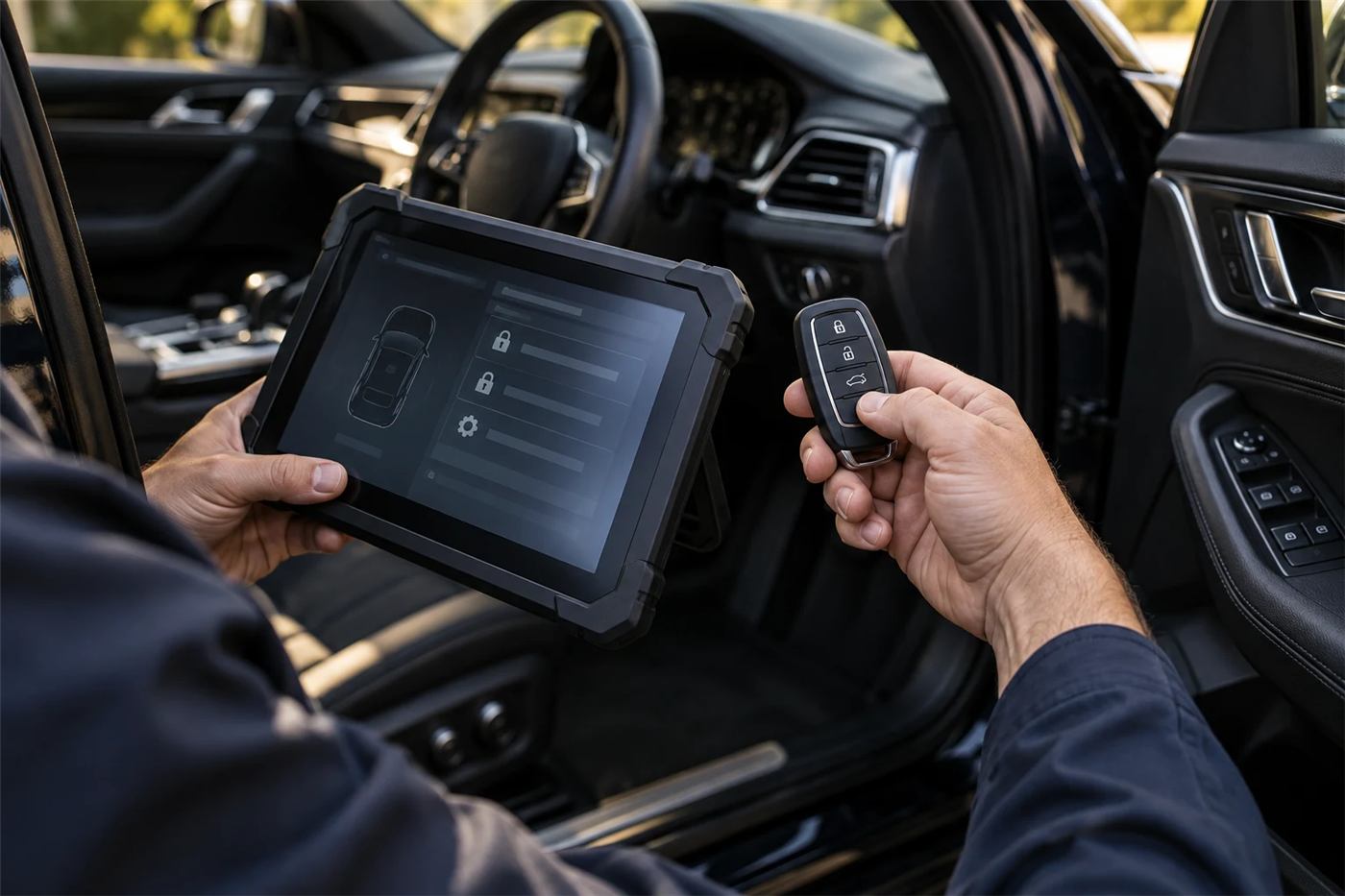
How an aftermarket remote starter works with the car
A factory key proves to the car that a legitimate driver is present. The transponder chip answers the car's request and the engine is allowed to run. A remote starter has a problem to solve: when you press a button from across the parking lot, there is no key in the ignition. So how does the car decide to run?
Most aftermarket systems answer with a bypass module. This small box is wired into the car and holds either a copy of the key's identity or a way to imitate it. When the remote starter fires, the bypass module presents that identity to the car, and the car behaves as though the real key were present. When you then get in and insert the real key, the bypass steps aside.
That arrangement works well when everything is set up correctly. But it means a second device is taking part in the car's security conversation. Any problem with that device, its wiring, its stored data or its settings can show up as a key problem. For background on how the security conversation works, our guide on the immobilizer explained is a useful companion.
Common symptoms of a conflict
The symptoms can look like several different faults. The car may start from the remote but not with the key. It may start with the key but the remote starter does nothing. The dash security light may flash or stay lit. The engine may start and run for a second and then stop. The factory remote buttons may work intermittently or not at all.
Another symptom is the car stalling soon after a remote start when you open the door and insert the key. This can happen when the handover between bypass module and real key does not complete. A different symptom appears after a battery disconnect or a repair: the car works with a key but the remote starter now refuses to run until reconfigured.
Timing is a clue. If the trouble began soon after a remote starter was installed, or soon after a key was added or replaced, a conflict is likely. If the car has been fine for years and the trouble is new with no recent changes, other causes become more likely, such as a worn key or a weak battery.
- Remote start works but the key will not start the car.
- Key works but remote start no longer runs.
- Security light stays on or flashes oddly.
- Engine starts then stalls when the key is inserted.
- Factory fob buttons became unreliable after installation.
Why adding or replacing a key can upset the system
When a technician programs a new key, the car's key list changes. On some vehicles, adding a key resets or rewrites information that the bypass module relied on. The module may have learned the car's key identity at installation. If the identity it stored no longer matches what the car now expects, the module fails to answer and the car refuses the remote start.
A second issue is the key count. Some cars accept only a certain number of keys. A bypass module may occupy one of those slots because it was registered as a key during installation. If you already hold the maximum number of keys, adding another may require removing one, and the entry that goes might be the one the module depends on.
These problems are not signs of a defective key. They are interactions between systems that were not designed together. Before programming any key to a car with a remote starter, tell the technician about the remote starter. That detail changes how the job is planned. If you are replacing a lost key, our page on car key replacement explains the general process.
What a technician looks at first
The first task is to establish what is installed. A technician will ask who installed the remote starter and when, and what brand of bypass module is used. Under the dash there may be a small box with wires, often tucked near the steering column. Its brand and model matter, because different modules have different reset and relearn procedures.
Next comes testing the factory side. The technician checks whether a known good original key starts the car with the aftermarket module disconnected or in a bypass state. If the car starts fine, the factory security system is healthy and the module is where to look. If it does not, the problem lies in the key list or the car's own components.
Only after that does programming begin. A reasonable plan might involve putting the module in a safe state, programming the key, testing it, and then reconnecting and relearning the module. We do not promise that every vehicle can be handled this way on site. Where the remote starter installer must reconfigure the module, a good technician will say so honestly and explain what to ask the installer to do.
Who should fix what
The responsibilities divide naturally. A locksmith handles the keys and the car's key list. A remote start installer handles the starter system and its bypass module. A conflict sits in the overlap, so you may need both. A technician from either side can often handle more than the minimum, but each tends to know their own equipment best.
If the remote starter was installed recently, return to the installer first for anything involving its settings. The installer may have a configuration they can reapply. If the problem began after key work, the locksmith can help restore the key side and tell the installer exactly what changed.
It is useful to carry documentation. If the installer gave you a receipt with the model of the bypass module, keep it. That one line saves time. A page on questions to ask before booking lists what to mention when you call, including accessories that change how a car behaves.
What not to attempt yourself
Remote starters connect to the ignition, the starter and sometimes the fuel and security circuits. Working on them without the right knowledge can cause electrical damage or leave a car in an unsafe state. Do not cut or splice wires under the dash to bypass a module. Do not unplug the module repeatedly in the hope that it will reset.
Avoid removing the module entirely as a diagnostic step unless the installer says it is safe. On some installations the module is spliced into the immobilizer circuit, and removing it without restoring the original wiring leaves the car unable to start. Do not hold the key against the module or try to teach it a key by trial and error following an online video.
A safe, useful action is to note what you have. Take a photo of any visible device under the dash, write down the brand if it is visible, and note the symptoms and when they started. That information is valuable to any technician and costs nothing to gather.
A worked example in plain terms
Imagine a family pickup with a remote starter installed some time ago. The driver loses the only key and orders a replacement. A technician programs a new key to the truck. The truck starts with the new key. Then the owner notices the remote starter no longer works. The bypass module had learned the old key's identity. When the key list was rebuilt, the old identity was removed, and the module's stored identity no longer matches any key the truck accepts.
The fix is to relearn the module to the truck. That requires the module's own procedure, which may involve a particular sequence of key turns and button presses, or a connection to the module with the installer's software. The locksmith cannot always do that part, but can tell the installer exactly what happened, which makes the repair quicker.
The lesson is not to avoid remote starters. It is to tell every technician about them up front. Doing so lets the technician plan the order of work and, where needed, coordinate with the installer. A related situation is covered at key not detected message on a push start car, where accessories and interference can also play a part.
Push-button cars and remote start
Cars with push-button start have their own remote start arrangements. Some come with factory remote start built into the fob. Others get an aftermarket system with a bypass module that imitates a fob inside the cabin. These systems rely on the car detecting a fob nearby, so interference and placement matter.
A common complaint is that the car says key not detected after a remote start, or that the engine shuts down once the driver steps in. This can happen when the module's imitation fob and the real fob confuse the car's antennas, or when the module's settings no longer match a replaced fob. In these cases the fix is generally in the module's configuration plus careful key programming.
A factory remote start is usually simpler. If your fob has a remote start button and the feature stopped working after fob replacement, the replacement may lack that function or may not have been programmed for it. Our page on push-button start keys explains what these fobs include.
Planning key work when you have a remote starter
If you already know you need a key and you have a remote starter, a bit of planning avoids repeat visits. Tell us on the phone that the car has an aftermarket starter. Share the brand if you know it. Mention whether the remote starter currently works and whether it was installed by a shop you can contact.
Ask the installer, in advance if possible, whether the module will need to be relearned after a key is programmed and what they need from you. Some installers can talk a technician through the steps. Others prefer to do the relearn themselves. Either way, the sequence of work is easier when everyone knows what to expect.
Be realistic about the visit. A job on a car with a remote starter may take longer than a plain key job, and there may be cases where the locksmith programs the key and the installer completes the system. That is not a failure. It is a division of work that matches how the car was modified.
- Tell the locksmith about the remote starter when booking.
- Provide the module brand and installer if known.
- Ask the installer what relearning will be needed.
- Have the locksmith complete the key work first.
- Have the installer relearn or reconfigure the module.
When the fix is only a new key
Not every remote start problem is a conflict. Sometimes the cause is a failing key. A worn chip, a weak battery or a cracked fob can mimic a conflict. A quick way to separate the two is to try the key with the remote starter's bypass behavior in mind: does the key start the car reliably when the remote starter has not been used that day?
If the key fails regardless, replace or repair it. Our page on a key fob that has stopped working covers the usual causes. If the key works normally and only the combination with the remote starter misbehaves, the module is the likely suspect.
Whatever the cause, it is worth sorting out. A car that sometimes refuses to start is stressful to rely on. Call with the make, model, year, the symptoms and the remote starter details. We will explain what the job is likely to involve and what to ask the installer.
Choosing an installer with keys in mind
If you have not yet added a remote starter and are thinking about it, a few questions at the installer's counter prevent later trouble. Ask what kind of bypass module the vehicle needs and whether it stores a copy of a key or imitates one. Ask what happens to the remote starter if you later add or replace a key. Ask whether the installer records the settings so they can reapply them. Ask whether the system uses one of the car's key slots.
Ask also about your own habits. If you tend to carry the fob in a bag with other electronics, or if you have several drivers with different keys, tell the installer. A good installer designs around how the car is actually used. A factory remote start, where the car maker offers one for your model, avoids many of these issues because it was designed with the key system in mind, though it is not available on every vehicle.
Finally, keep the paperwork. A receipt naming the module and the installer turns a mystery into a short phone call years later. When you eventually need a spare key or a replacement, that paperwork is as useful to the locksmith as the key itself. Our page on why you need a spare key now explains why planning ahead pays off.
Questions people ask
Can a remote starter stop my car key from working?
It can interfere. The bypass module takes part in the car's security exchange, and if its settings, wiring or stored data clash with the key list, the car may refuse the key or stall after starting. The key itself is often fine. The conflict is between two systems that were not designed together.
Why did my remote start stop working after I got a new key?
The bypass module may have learned the old key's identity. When the key list was rebuilt, that identity may have been removed, so the module no longer matches. The module usually needs to be relearned to the car, either by its own procedure or by the original installer.
Should I tell the locksmith about my remote starter?
Yes, always. It changes how the job is planned and may change the order of work. If you know the brand of the bypass module and who installed it, mention that too. That detail helps the technician avoid problems and tell you what the installer may need to do afterwards.
Is it safe to unplug the module to test the key?
Not unless the installer says so. On many installations the module is spliced into the ignition or immobilizer wiring, and removing it can leave the car unable to start. Leave any under-dash device alone and let a qualified technician decide how to test around it.
Can you reprogram the bypass module?
That depends on the module and the vehicle. Our focus is the key side. We can program keys and tell you exactly what changed so the installer can relearn the module. If a module's relearn is simple and our technician has the means, they may help, but we will say so before starting.
How are quotes handled?
Quotes are given by phone only. Complicated jobs, which can include cars with aftermarket starters, may need an on-site visit first. There is a service call charge, and it is explained on the phone before dispatch. Call with the vehicle details and a description of the symptoms and we will talk it through.
Describe the situation by phone and we will tell you what the job involves. Quotes are given by phone. Jobs that cannot be quoted without seeing them need a technician on site, and the service call charge is explained on the phone before anyone is dispatched.
(713) 574-7660Related pages
Written by Claude (AI) (AI) for Houston Car Key Locksmith.