What makes Midtown different for car keys
Midtown is dense. Residential towers share blocks with restaurants, bars, small businesses and parking structures, and many people live here without a driveway of their own. Vehicles sit in resident garages, in paid lots, on side streets and in shared parking behind buildings. The setting affects every part of a key job: where the technician can park, how close the vehicle is to a safe working position, and how long the visit can take before someone needs the space.
The same density creates a particular kind of key problem. In a neighborhood where many people walk, take rideshares and move between several venues in an evening, keys go missing in transit. A key left on a bar counter, dropped in a rideshare, or slipped out of a jacket pocket while dancing is as common here as a misplaced key at a suburban supermarket.
None of that stops a mobile visit from working. It does mean the first call should give plenty of detail about where the vehicle is, how to reach it, and what the surroundings look like. A technician who knows there is a gated garage, a narrow ramp or a loading zone can plan before arriving, and the visit goes better for everyone.
Apartment tower garages and gate access
Many Midtown residents park in a garage attached to their building, with gates, fobs and sometimes attendants. Those systems are designed to keep non-residents out, and that includes a locksmith who is not on a visitor list. If you need a technician to reach a vehicle inside such a garage, arrange access before the visit.
Contact building management or the front desk, tell them a locksmith is coming to work on your vehicle, and ask how a visitor can enter. Some buildings issue a temporary pass. Others need you to meet the technician at the gate and let them in. Have the name of the garage level and your space number ready, and remember that clearance heights may affect where the technician can park.
If your garage access card is on the same key ring as the lost car key, the problem has two parts. The building can usually issue a replacement card on proof of residence. That is separate from the car key, but solving it first can make everything else easier. Our page on lockout in a parking garage covers the access side of garage trouble.
Some buildings limit work that makes noise or uses equipment in common areas. A key job is quiet, but check your building's rules and tell the office what you are planning, so that nobody is surprised.
- Tell building management a locksmith is coming and ask how visitors enter.
- Have your level, space number and gate details ready for the call.
- Check whether your garage card or fob was on the lost key ring.
- Mention any height limit at the garage entrance.
- Keep photo identification and vehicle registration with you.
Tight garage clearances and working space
Some garages in dense areas have narrow bays, low ceilings and ramps with sharp turns. A technician needs enough room to open the driver door fully, sit in the seat or work from beside it, and set down equipment. In very tight spaces, working space can be the limiting factor.
A vehicle parked tightly between pillars or other cars may need to be moved by a short distance before work begins. If the key is lost, moving the vehicle is awkward, because you cannot start it. For a vehicle that rolls freely in neutral, a short push by a few people may be possible. Be careful, and never push a vehicle if there is any chance of a collision or injury. Many modern vehicles have electronic parking brakes or steering locks that stop them from moving without the key.
If a vehicle cannot be reached from the driver side, a technician may be able to work from the passenger side, since the diagnostic port is usually under the dash and accessible from either door. Tell the technician what is on either side of the vehicle when you call.
This is one of the places where detail on the phone saves a wasted visit. A technician who knows that the driver side is against a concrete wall can bring equipment suited to working from the other side or from the back seat.
Nights out: bars, restaurants and the lost key at closing
Midtown is known for its evening activity. Restaurants, bars and clubs bring people in late, and a key can be lost in the noise of a night. The typical pattern is simple. Someone arrives by car, parks, goes inside, and leaves hours later to find the key missing from a pocket or purse.
There are good steps to take before calling a locksmith. Retrace your steps. Check with the venue's staff, the table you used, the restroom, the coat check and any rideshare you took. Ask security whether anything was handed in. A key that turns up within a few hours saves the whole process.
If the key does not turn up and you have been drinking, do not attempt to drive. Arrange a safe ride home, and deal with the key in the morning. A locksmith can often make a replacement the next day, and the vehicle is safer where it is. Our page on lost car keys at night covers the choices for after-dark situations.
If a friend or family member holds your spare key, now is the moment to ask for help. If the spare is far away, a technician may still be the quicker route, depending on distance and how the night is going.
Street parking and curbside work
Midtown's side streets provide parking for residents and visitors, and many vehicles sit at the curb overnight. Curbside work is routine for a mobile locksmith, but it needs care. Traffic passes close by, pedestrians walk along the sidewalk, and the diagnostic port is inside the vehicle where the technician must sit or kneel.
A technician will often work from the curb side door where possible, and may ask you to keep other people clear of the work area. If traffic is heavy, the technician may suggest a different position for the vehicle if it can move, or a different time of day. Safety takes priority over speed.
Check local parking signs. Some Midtown streets have time limits, permit zones or restrictions at certain hours, and we cannot confirm the rules for your particular block. Look for posted signs and plan accordingly, and tell the technician if a deadline applies so that the visit can be arranged to fit.
If your vehicle is blocking a driveway or lane, say so on the phone. A technician can advise whether the work can be done where the vehicle stands or whether a short move is wise. A blocked driveway is a reason to be quick and practical about the plan.
Smart keys, push-button starts and Midtown commuters
Many Midtown residents drive newer vehicles with smart keys and push-button starts, which are convenient for short, frequent trips. A smart key lives in a pocket, and the vehicle opens and starts when it detects the key nearby. That convenience hides a weakness: a smart key can fail silently. A weak battery, a damaged circuit or a lost pairing leaves the owner with a vehicle that does not respond.
If a smart key stops working, try the backup method first. Most smart keys include a hidden emergency blade to open the driver door, and a spot on the dash or in the cabin where the fob can be held to start the engine when the battery is flat. Your owner's manual shows where. If the backup works, the fob battery is the likely cause. If it does not, the fob may need re-pairing or replacing.
When a smart key must be replaced, the job involves cutting the emergency blade if there is one and programming the electronic part to the vehicle. Our page on smart key replacement explains what is involved, and the page on key not detected message covers the common warning.
Quotes for smart key work are given only by phone, after the technician hears the make, model and year. Some models need more than others, and an on-site visit may be needed for the complicated ones.
Rideshare, walking and why keys disappear here
Midtown residents often leave the car parked and take a rideshare or walk. That is smart for a busy night, but it means keys travel in different places than usual. A key left on a rideshare seat is gone as soon as the driver moves on. A key in a back pocket can slip out as someone climbs in.
If you think you left it in a rideshare, contact the service through its app. Most have a way to message the driver about a lost item. Do it as soon as you can, since drivers move on quickly. If you left it at a venue, call during opening hours and ask for a manager.
A key lost on foot is harder to trace. If it fell on a sidewalk, it may be picked up by a passer-by who does not know whose it is. If your key has a tag with an address or a phone number on it, remove it now. A tag naming your address and an unclaimed key together invite trouble.
A key that has not been found after a reasonable search should be treated as lost. If there is any reason to think it was taken, see our page on car key reprogramming after theft or loss, which explains how a missing key is erased from the vehicle's memory.
What the visit involves, and what to have ready
Call and describe the vehicle, the key situation and the location. A technician will ask for the make, model and year, how many keys you hold, and where the vehicle is parked. Quotes are given only by phone. If the job is simple, a visit is arranged. If it is complicated, an on-site visit may be needed to assess it before a final quote, with a service call charge explained on the phone before dispatch.
On arrival, the technician will ask for photo identification and registration or title that match the vehicle. This is a firm requirement across the industry and protects owners. If your paperwork is in the vehicle, bring it out before the visit, since a locked vehicle may mean it cannot be reached.
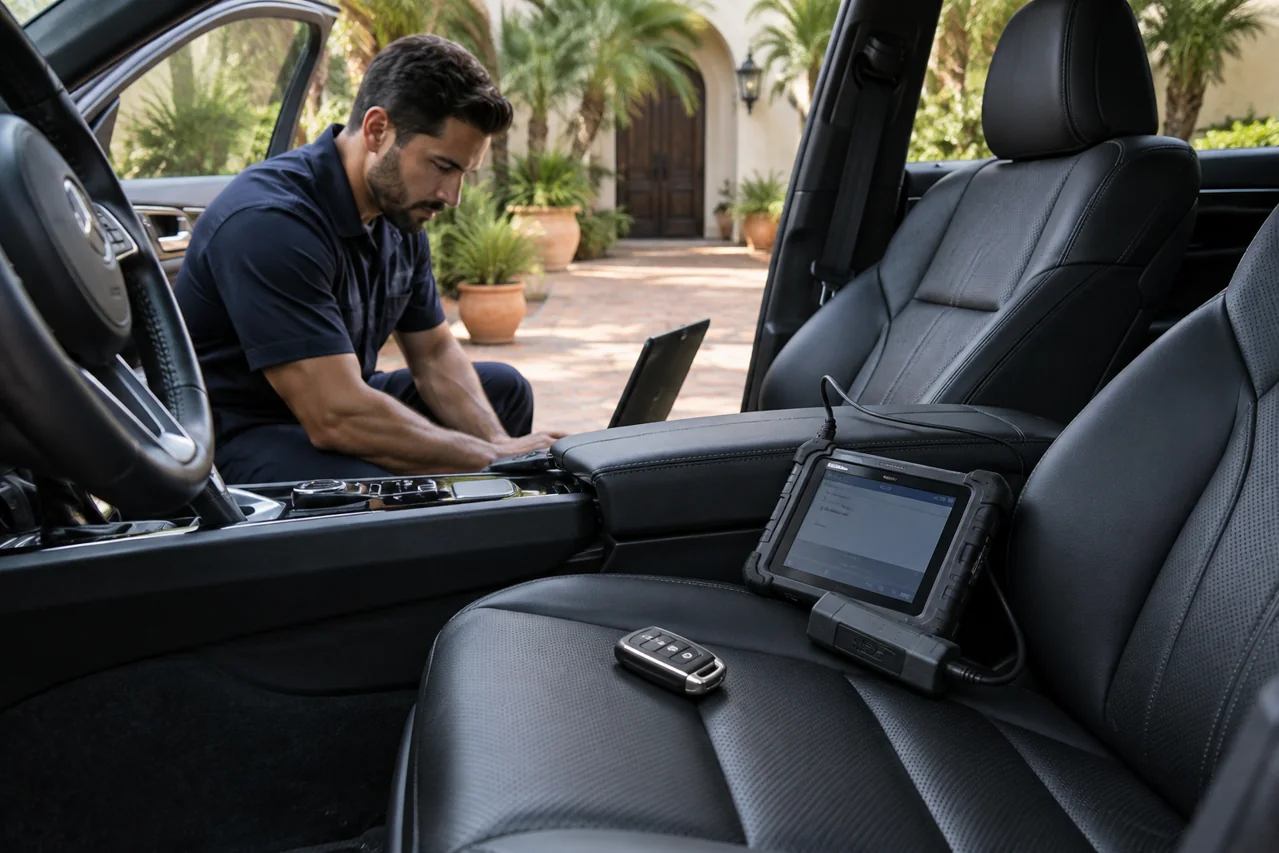
The technician then works at the vehicle, connecting to the diagnostic port, reading the immobilizer, cutting a blade if needed and programming the key. The key is tested before the visit ends. Ask the technician to show you each function working.
If you live in a building with rules about visitors, arrange access ahead of the visit. If you are meeting the technician at a gate or desk, say so on the phone so that the right person is waiting.
Habits that make Midtown life easier
A few simple habits reduce the chance of a stressful night. Keep a spare key in a safe place that you can reach, such as with a trusted friend, in a secure drawer at home, or at your workplace. Having a spare turns a lost key from a crisis into a minor errand. Our page on where to keep a spare key covers sensible places and risky ones.
Use the same pocket every time. Zip or button the pocket if you can. Attach a tracking tag to the key ring if you wish, understanding that it helps only when the key is within range of your phone or a network of other devices. Read our key tracking tags guide for what to expect.
Keep your garage access card, building fob and car key on separate rings where practical, so a single loss does not lock you out of everything. Keep a photograph of your registration and vehicle details on your phone, since you will need them when you call.
If a key problem is in front of you now, call. Say where the vehicle is, what is wrong, and what you hold. You will hear a clear answer about the next step.
Questions people ask
Can a technician reach my vehicle inside a residential tower garage?
Usually, if access is arranged. Tell building management a locksmith is coming and ask how visitors are admitted. Some buildings issue a pass, others need you to meet the technician at the gate. Give the technician the level, space number and any height limit when you call so that the visit can be planned.
What if my vehicle is parked too tightly for work?
Tell the technician what is on each side of the vehicle. The diagnostic port is usually reachable from either front door, so working from the passenger side may be possible. If the vehicle needs to move, never push it where there is a collision risk, and remember that many modern vehicles will not roll without the key.
I lost my key at a bar. Should I drive home with a spare?
Only if you are completely sober. If you have been drinking, arrange a safe ride and deal with the key the next day. A locksmith can usually help once the situation is calmer, and the vehicle is safer parked. Check with the venue about lost items before you give up on the key.
Can the visit happen at the curb on a busy street?
Often, yes. Curbside work is common, but the technician puts safety first and may work from the curb side or ask for a better position if possible. Check local parking signs for time limits, and tell the technician if a deadline applies so the visit can be arranged to fit.
My smart key stopped working. Do I need a new one?
Not always. Try the backup start method in your owner's manual, and consider the battery first. If the backup works but normal use does not, a battery is likely. If it does not work, the fob may need re-pairing or replacing, and a technician can test it and tell you which.
Why are quotes only given by phone?
Because key work depends on the vehicle, the key type, how many keys remain and where the car is. A technician needs those details to quote accurately. For complicated jobs an on-site visit may be needed first, and a service call charge applies, explained on the phone before dispatch.
Describe the situation by phone and we will tell you what the job involves. Quotes are given by phone. Jobs that cannot be quoted without seeing them need a technician on site, and the service call charge is explained on the phone before anyone is dispatched.
(713) 574-7660Related pages
Written by Claude (AI) (AI) for Houston Car Key Locksmith.