Why a Porsche key calls for extra care
Porsche vehicles carry sophisticated anti-theft electronics, and the key is a central part of that protection. The key holds a coded transponder, a radio for the buttons and, on many models, a keyless entry function. The car stores information about each key it knows, and it will not start for one it has not accepted. That design protects owners well, and it also means that replacing a key is a more demanding job than it would be on a basic economy car.
Because of the value of the vehicle, owners are right to be cautious about who touches the security system. A mistake can leave a control module locked or a car unable to start, and some of those problems are expensive to undo. A good technician is open about what they can do and what they cannot, and will tell you plainly if your car is one that belongs at a dealer.
Around Houston, Porsche owners tend to fall into a few groups: families with a Cayenne or Macan for daily use, enthusiasts with sports cars that come out on weekends, and drivers who bought a used Porsche and are now sorting out missing keys. Each group has different needs, and the phone call is where those get sorted out.
Cayenne and Macan: the everyday Porsches
The Cayenne and the Macan are the Porsche models most often seen on Houston streets, from school drop-offs in West University to office lots in the Energy Corridor. Both are SUVs, and both use keys that fit the modern pattern: a fob that unlocks the doors by radio, a chip that identifies the key to the car, and a keyless function that lets the car start with the fob inside.
Keys for these models have changed across generations. Earlier versions used fobs with a visible shape and a physical blade for emergency use. Later versions use a more streamlined fob with a hidden blade. The buttons and the interface also differ, and a fob that fits one generation may not be compatible with another, even if the outside looks similar. The vehicle identification number is the best way to settle which fob is correct.
These vehicles also tend to have several keys in circulation, because families share them. When one is lost, the instinct is to replace only that one. It is worth asking whether the remaining keys are in good condition and whether adding a spare would be sensible, since the equipment is already connected during a visit.
Sports cars and the ignition location
Porsche is famous for placing the ignition to the left of the steering wheel on many classic and modern sports cars. The tradition dates back to racing starts, where a driver could turn the key with the left hand while engaging the gear with the right. On many models today, the ignition is a switch or a start knob in that position, with the key either inserted or kept nearby.
That placement is a charming detail until something goes wrong. A key that will not turn, a knob that does not respond, or a start that fails despite a good key can have several causes: a key problem, an ignition switch problem, a steering lock issue or a battery problem. The first step is sorting out which one.
For owners of older sports cars, there may be traditional mechanical keys in the mix. These are different from the modern fobs, and the work may involve cutting a blade and programming a chip, or dealing with an older immobilizer. A technician who handles European sports cars will ask which model and age of vehicle you have before saying more.
Authorization systems and what they mean for you
Porsche uses layered authorization. In simple terms, a new key has to be introduced to the car using equipment that the car accepts, and the process may involve data that is tied to the specific vehicle. Some models allow keys to be added through the diagnostic port with the correct tools. Others need more steps, such as reading and preparing a module, and in some cases the work requires manufacturer authorization that only a dealer can provide.
This is where honesty matters. Some Porsche models can be handled by a qualified mobile technician with the right tools. Others cannot be completed at the roadside and are best handled at a dealer or a independent shop. A technician who says yes to every Porsche on the phone without asking about the model and age is not being careful.
If your vehicle needs dealer authorization, a technician can still help in other ways: a ride to the right place is not part of the service, but advice about what to bring, what to ask and how to protect your car on the way there is. Ask what documentation the dealer will need, including proof of ownership and identification.
When a Porsche dealer is the right call
A dealer is the right call in several situations. If your car is under a manufacturer warranty or an extended plan that covers key replacement, the dealer route may be the way to use that coverage. If your model needs authorization data that only the factory system can supply, the dealer is the only route. If the car has an unusual or electronic problem that goes beyond the key, the dealer has diagnostic tools and parts access.
If all keys are lost on a vehicle that cannot be started, the car has to be transported, and a tow to a dealer or an expert is a normal step. Use a flatbed rather than a hook-and-chain tow for a Porsche, since low front ends and all-wheel-drive systems do not suit rough handling. Tell the tow operator the model and ask them to confirm the equipment before they arrive.
A mobile technician fits in the middle. For many Cayenne and Macan situations, the work can be completed on site, saving the tow and the delay. Our guide on dealer versus locksmith keys sets out the comparison, and you can also read about the dealership alternative key service for the general approach.
What to do if you lose a Porsche key
If you have lost a key, begin by retracing your steps. Check the usual places: pockets, bags, car seats, cup holders. Check any app or tag you may have attached. If the key was lost in a public place, consider whether it could have been taken, and if so, consider reporting it. Our guide on a police report for stolen keys explains when that is worthwhile.
If you still have another key, keep it safe and do not use it in a way that risks loss. If the missing key could be used by someone else, it is sensible to have it erased from the car memory during replacement, which a technician can do on many models. If you have no keys at all, do not try to force the car. Forcing the doors, ignition or steering lock on a Porsche can cause costly damage.
Gather the paperwork that proves ownership: registration, title and photo identification. If the car is financed or leased, have the contact details for the lender or leasing company in case they need to be involved. If you bought the car used, look for any paperwork from the previous owner that mentions keys.
Protecting a Porsche key from loss and theft
Porsche vehicles are targets for thieves, and keyless fobs are a known weak point. A relay attack uses a device to extend the fob signal so that a car can be opened and started without the owner knowing. A signal-blocking pouch kept in a bag or at the door of the house limits the risk. Our guides on relay attack protection and the Faraday pouch explain the idea in plain English.
Keep keys away from the front door and from windows where signal can reach a thief outside. Do not leave a fob in the car, even for a moment in a parking lot. Consider where you place the key at home: a drawer in a back room is safer than a bowl by the front door.
Houston adds its own considerations. Heat can cook a fob left on a dash, humidity can corrode contacts, and flooding can ruin electronics in a parked car. If you live in a flood-prone area, keep a spare key in a safe, dry place in the house rather than in the vehicle.
Buying a used Porsche: key questions to ask
Used Porsches change hands often, and keys are one of the details that can go wrong in a sale. Before you buy, ask how many keys exist, and ask to see all of them. A car sold with a single key is a warning sign worth taking seriously, because a replacement after purchase is far more involved than adding a spare to a car that still has a working key. Ask whether the keys have ever been replaced and by whom, since a replacement key programmed by an unknown party may have been added without any records.
Look at the physical condition of each key. Cracked cases, worn buttons and loose blades suggest heavy use. Test every key: unlock the doors, open the tailgate, start the car and shut it off. A key that works only intermittently during a test drive will be more frustrating once the car is yours.
If you are buying from a private seller, ask for the title and check that the vehicle identification number on the paperwork matches the number on the dash. Our used car buyer key checklist goes through these questions in order. After purchase, consider having a spare programmed while you still have working keys, and consider having any unknown key erased from the memory if there is any doubt about where it came from.
What a mobile visit looks like when it is possible
When your Porsche is a model that a mobile technician can handle, the process looks like this. You call and describe the car, its age and your situation. The person on the phone asks about the vehicle identification number, the key style and how many keys remain. If the job is suitable, you are given a quote by phone. If the job is complicated, an on-site visit may be needed first, and any service call charge is explained before dispatch.
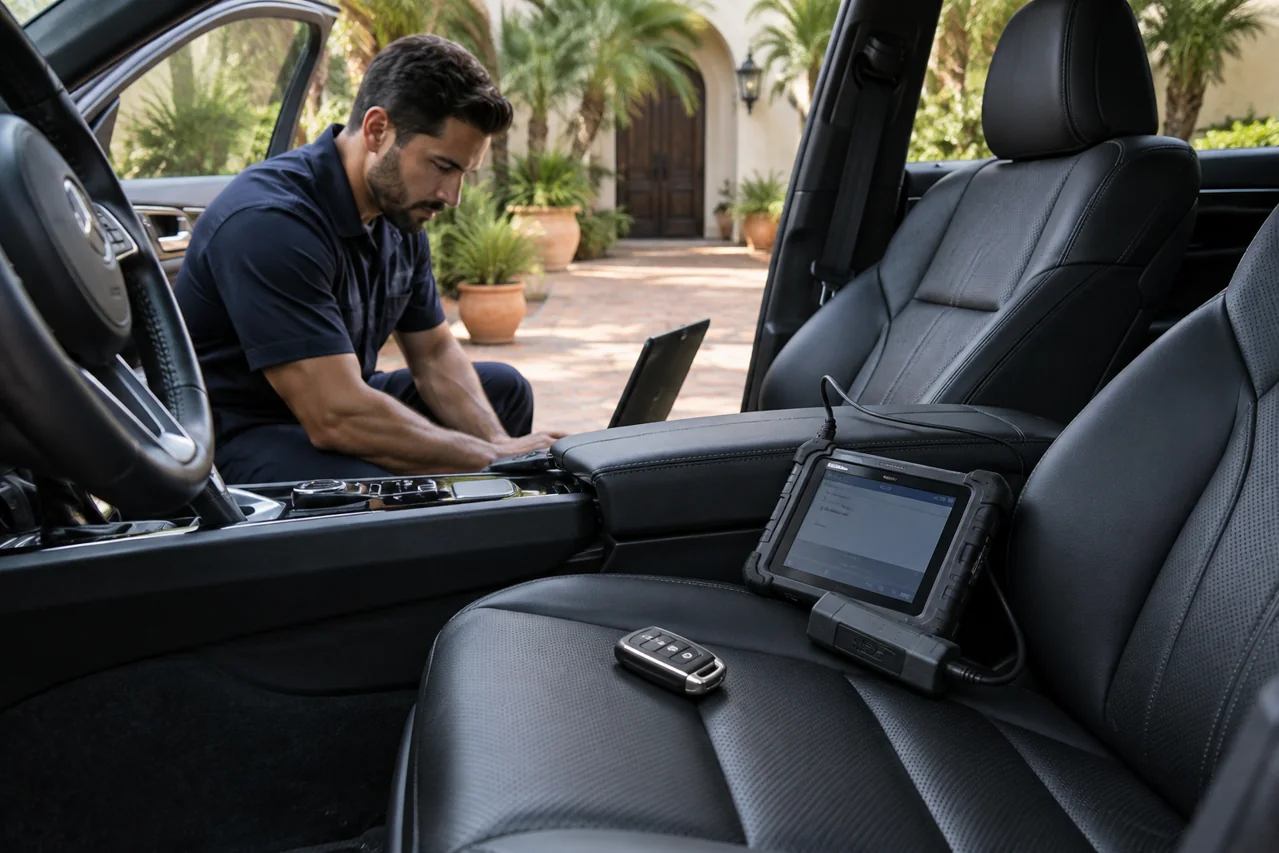
On site, the technician confirms identity and ownership, then connects equipment to the car and carries out the programming. Every function of the new key is tested: doors, tailgate, start and stop, and the keyless features if the car has them. You should receive a clear explanation of what was done and how many keys the car now recognizes.
If the job turns out not to be possible on site, you should be told so honestly and given guidance on next steps. That is better than an attempt that risks the car. When you are ready, call the number on this page, describe the model and situation and ask whether your Porsche is a good fit for a mobile visit.
Questions people ask
Can a mobile locksmith program a Porsche key?
On some models, yes. Cayenne and Macan fobs can often be handled on site with the right equipment, while certain models and situations need dealer authorization. The honest answer depends on the model, age and condition of your car, which is why the phone call includes questions about the vehicle identification number and the key style.
Why is the Porsche ignition on the left side?
It is a long-standing design choice from racing, where drivers could start the engine with the left hand while the right hand was ready to select a gear. On many models today it is a switch or start knob in that position. If yours will not respond to the key, mention the exact behavior on the phone.
What if I have lost every key to my Porsche?
Do not force the doors or the ignition. Gather proof of ownership and call. Some models can be handled on site after verification and an on-site look, while others need dealer authorization and a flatbed tow. Whichever route fits, quotes are given by phone and the service call charge is explained before anyone is dispatched.
Should I worry about someone using my lost key?
It is a fair concern. On many models a technician can erase a missing key from the vehicle memory during programming so it no longer starts the car. That does not necessarily stop it from unlocking a door on every model, so ask what applies to yours, and consider a police report if theft is possible.
How can I protect my keyless Porsche fob?
Store the fob in a signal-blocking pouch when at home, keep it away from doors and windows, and never leave it in the car. These steps limit relay attacks, where a thief extends the fob signal. They are inexpensive in effort and meaningful in protection, and they work alongside any security features the car already has.
What paperwork do I need for a replacement key?
Bring photo identification and proof of ownership such as registration or title. If the car is financed or leased, have the lender or leasing contact available. If the car is owned by a business, bring documents showing your authority to act. These checks protect owners and are standard for any make of vehicle.
Describe the situation by phone and we will tell you what the job involves. Quotes are given by phone. Jobs that cannot be quoted without seeing them need a technician on site, and the service call charge is explained on the phone before anyone is dispatched.
(713) 574-7660Related pages
Written by Claude (AI) (AI) for Houston Car Key Locksmith.