Three settings in one area
The area around Rice Village is really three places at once. There is the retail and dining district, with small blocks, parking lots and structures where visitors come and go. There is the residential neighborhood of West University Place, with established homes, driveways and garages. And there is the university community, with students, staff and visitors who live and park in a very different pattern.
Each of them produces its own kind of key problem. Shoppers lose keys in bags full of purchases and in fitting rooms. Residents struggle with aging keys, single spares and garage doors. Students lose keys in dorms and shared housing, and often hold a vehicle whose key history is murky.
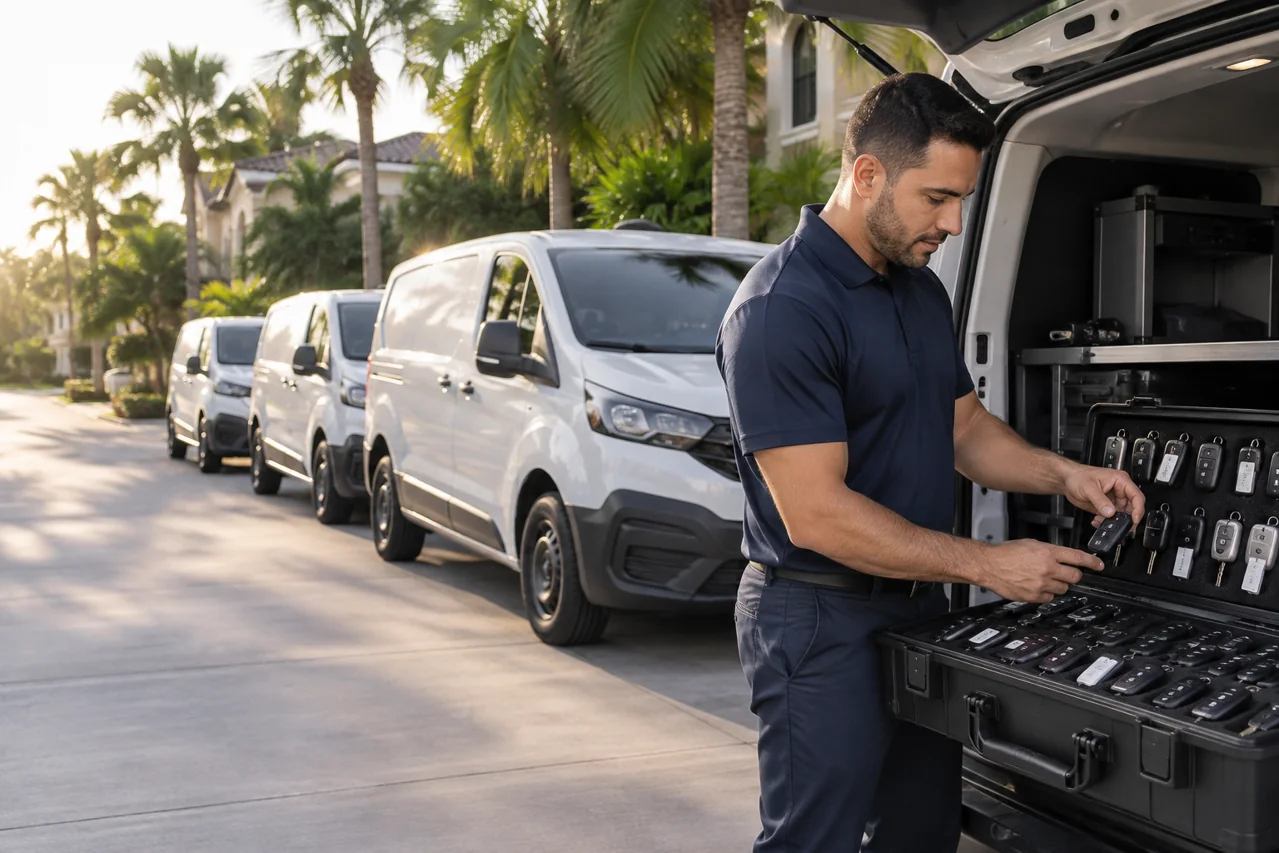
A mobile locksmith needs to be comfortable with all three. The technician must reach a vehicle in a lot, a driveway or a campus parking area, and work with an owner who may be a long-time homeowner or a student who is borrowing the family vehicle. The first phone call sets up what is needed, and good detail about the setting helps.
Retail blocks and Village parking
The shopping blocks have a mix of lots, structures and on-street spaces. Shoppers often park, walk through several stores, stop for a meal and return to find a problem. Common ones are a key dropped in a store, left on a table at a cafe, or lost from a bag with purchases.
The first step is to ask where you have been. Call the shops and restaurants you visited, and ask whether anything has been turned in. Staff are used to this. A key handed in at one store may not be passed on to another, so check each place you visited.
If the key is not found, the vehicle's location matters. In a structure, tell the technician the level and a marker. In a lot, give the address and the part of the lot. If the lot belongs to a business, tell the manager that a locksmith will work on the vehicle, which avoids a misunderstanding.
If the fob is the problem, not the key, such as when the buttons stop responding in a crowded place, remember that radio interference can reduce a fob's range in busy areas. Walk closer to the vehicle and try again, or use the emergency blade. Our page on key fob stopped working lists the common causes.
- Call every shop and restaurant you visited and ask about found items.
- Give the lot address or the structure level and a nearby marker.
- Tell a business manager that a locksmith will work on the vehicle.
- Try the emergency blade if the fob will not unlock the door.
- Keep photo identification and registration with you.
West University Place driveways and garages
The residential streets have established homes, many with driveways and attached or detached garages. Parking is mostly off-street, which makes mobile work comfortable. A technician can park near the vehicle, work in the driveway and carry equipment from a short distance.
Garages create their own questions. If the vehicle is inside and the garage door opener was on the lost key ring, you may still have a keypad or a house entry from inside. If the door is stuck shut, a separate service may be needed to open it. Tell the technician at the start whether the vehicle is accessible.
Households here often have several vehicles and drivers, with keys passing between family members. A key that goes missing may simply have been moved by someone else. Ask everyone before assuming it is lost. A teenager who borrowed the car, a relative who dropped it in a bag or a house guest may know exactly where it is.
If the vehicle's key history is uncertain, particularly after a purchase from a private seller, consider asking a technician to check how many keys the vehicle recognizes. Our guide on used car buyer key checklist explains what to look for.
Student vehicles and shared housing
Students bring a different pattern. Many hold a vehicle that was passed down by family, bought used from a stranger or shared with siblings. The vehicle's keys may be few, old and unreliable. Student life also involves frequent moves, shared rooms, borrowed bags and busy days, all of which raise the chance of a lost key.
A common situation is a student with a single key, and a spare that lives at home in another city. When the key is lost, the spare is a day's travel away. A technician can make a replacement at the vehicle with proof of ownership, which is often quicker than arranging for the spare to be sent.
Proof of ownership can be a challenge for students. A vehicle may be registered to a parent, and the student may hold only a copy of the registration or a note. A technician needs photo identification and paperwork that connects the person and the vehicle. If the owner is a parent, ask them to be available by phone or to send a document, and tell the technician when you call so that the visit is planned properly.
Our page on teen driver spare key guide offers advice for families, and applies to young adults at university as well.
The only key problem, and the spare you do not have
In all three settings, one problem recurs: only one key exists. A single key is a single point of failure. It can be lost, stolen, broken, soaked or worn out, and when it fails you are left with nothing.
Starting from nothing is a bigger job than copying a key that works. A technician must cut a key from the vehicle's information and program it to the immobilizer, which takes more time and equipment than adding a spare. Quotes are given only by phone, and the technician will explain what the job involves for your vehicle.
If you hold one working key, the single best thing you can do is make a spare now, while it is a calm errand. Our page on spare car key duplication explains how a copy is made and why it is simpler. Keep the spare somewhere safe and separate from the main key.
If you are in the position of having no key at all, see all keys lost car key service. The process is manageable. It just needs the right information at the start.
Smart keys, transponders and plain keys
Vehicles in the area span the whole range. A student's older sedan may use a transponder key with a plain head. A family's newer SUV may use a smart key. A grandparent's older car may use a plain metal key without any chip. Each has a different process.
A plain metal key can be cut at the vehicle on a portable machine. A transponder key needs cutting plus programming of the chip. A smart key needs programming of an electronic fob, and may need a blade cut for emergencies.
Tell the technician what you have. If you are not sure, describe it. Does the key have a thick plastic head? Does it have buttons? Does the vehicle start with a button or a key? A technician can usually work out the type from your answers and from the make, model and year.
Our page on transponder vs smart key explains the difference in plain terms, and will help you describe your key accurately.
Locked out in a lot or on a driveway
A lockout means the key is inside the vehicle and the doors are locked. It is different from a lost key, and the response is different. For a lockout, the aim is to open the vehicle without damage and without needing a new key.
We do not publish steps for opening locks, since a wrong attempt can damage the door seals, wiring and airbag components. If you are locked out, call for help. Tell the technician if the key is visible, if the engine is running, or if a child or pet is inside. A person or animal in a hot vehicle is an emergency, and 911 comes first.
If you are locked out and the vehicle is running, the situation is time sensitive and exposed. Say so right away, and keep a safe distance from traffic. A technician can advise on the best approach for your vehicle.
After a lockout, consider whether a spare key left in a safe place would have prevented it. A spare kept at home, with a trusted person, is a practical fix.
Proof of ownership and who can authorize
A technician will ask for photo identification and registration or title matching the vehicle before making a key. This is a firm rule across the industry. It protects owners from someone trying to obtain a key to a vehicle that is not theirs.
If the vehicle is registered to someone else, such as a parent or a employer, the person who holds the paperwork may need to authorize the work. A phone call or a document sent to the technician may help, though the technician decides what is acceptable. Plan for this before the visit.
Have the vehicle identification number ready. It is visible at the base of the windshield on the driver side and on the door jamb. A technician may use it to confirm the key type. Our guide on proof of ownership for car keys explains what usually works.
Be careful about anyone who offers to make a key without asking for ownership proof. A reputable provider checks. You can also ask for the provider's business name and how they are permitted to operate, and compare it with their paperwork.
What the visit looks like, and how to call
Call and describe the situation. Give the make, model and year, the location, the number of keys you hold and what happened. Quotes are given only by phone. If the job is simple, a visit is arranged. If it is complicated, an on-site visit may be needed to assess it before a final quote, with a service call charge explained on the phone before dispatch.
On arrival, the technician confirms ownership, connects to the diagnostic port, reads the security information, cuts a blade if one is needed and programs the key. Each function is tested before the visit ends. If a repair is needed, such as an ignition cylinder, the technician explains it first.
Arrival depends on the day, the traffic and earlier jobs. Ask for the technician's own estimate and keep your phone on. Be present at the vehicle, and tell the technician about any access issue, such as a gate or a lot with restrictions.
If you are in trouble now, call. A clear description of the vehicle, the place and the keys you hold gets you the fastest useful answer.
Habits for shoppers, homeowners and students
Shoppers can keep the key in one dedicated pocket and check it before leaving each stop. A bright key ring or a tracking tag makes it easier to spot in a crowded bag. Our key tracking tags guide explains what tags can and cannot do.
Homeowners can check the condition of each key, replace worn ones before they fail and store a spare in a secure place. Check that every household driver knows where the spare is, and that it is not in the vehicle.
Students can ask a parent to hold a spare and to keep a copy of the registration where it can be sent. They can also keep a photograph of the registration and vehicle number on a phone. Those two steps shorten any future call.
Everyone can make a note of how many keys exist for each vehicle. If the number is not known, a technician can check. A short phone call now saves a longer one later.
Questions people ask
Can you come to a shopping lot in Rice Village?
Usually yes. A mobile technician works at the vehicle. Give the lot address or the structure level and a nearby marker, and tell the business manager that a locksmith will be working on the vehicle. Ask for the technician's own arrival estimate, since it depends on traffic and earlier jobs.
My student car is registered to a parent. Can I still get a key made?
Often yes, with the right paperwork. The technician needs photo identification and registration or title that connects the vehicle to someone who can authorize the work. The parent may need to be reachable by phone or send a document. Tell the technician when you call so the visit is planned properly.
I only have one key. Should I make a spare now?
Yes. A copy made while a working key exists is simpler than a replacement made from nothing. Keep the spare somewhere safe and separate from the main key, and not inside the vehicle. A technician can explain the process for your vehicle by phone.
Is a lockout the same as a lost key?
No. A lockout means the key is inside and the doors are locked. A lost key means the key is gone. The responses differ. Describe your situation accurately when you call. If a child or pet is inside, call 911 first. We do not give instructions for opening locks yourself.
How do I describe my key if I do not know what type it is?
Describe the head, whether it has buttons, and how the vehicle starts. Give the make, model and year. A technician can usually work out the key type from that. Our guide on transponder versus smart keys can also help you tell which one you have.
Why are quotes not listed on the site?
Key work depends on the vehicle, the key type, how many keys remain and where the car is. Quotes are given only by phone. Complicated jobs may need an on-site visit first, with a service call charge that is explained on the phone before dispatch.
Describe the situation by phone and we will tell you what the job involves. Quotes are given by phone. Jobs that cannot be quoted without seeing them need a technician on site, and the service call charge is explained on the phone before anyone is dispatched.
(713) 574-7660Related pages
Written by Claude (AI) (AI) for Houston Car Key Locksmith.